The American Discipleship Question
White Paper | A Research Synthesis and a Proposed Model for Disciple-Making Published by Ordinary Movement · First Edition, Revised June 2026 ordinarymovement.com
How to Cite This Paper
Ordinary Movement, The American Discipleship Question: A Research Synthesis and a Proposed Model, First Edition, rev. June 2026 (Ordinary Movement, 2026).
Acknowledgments
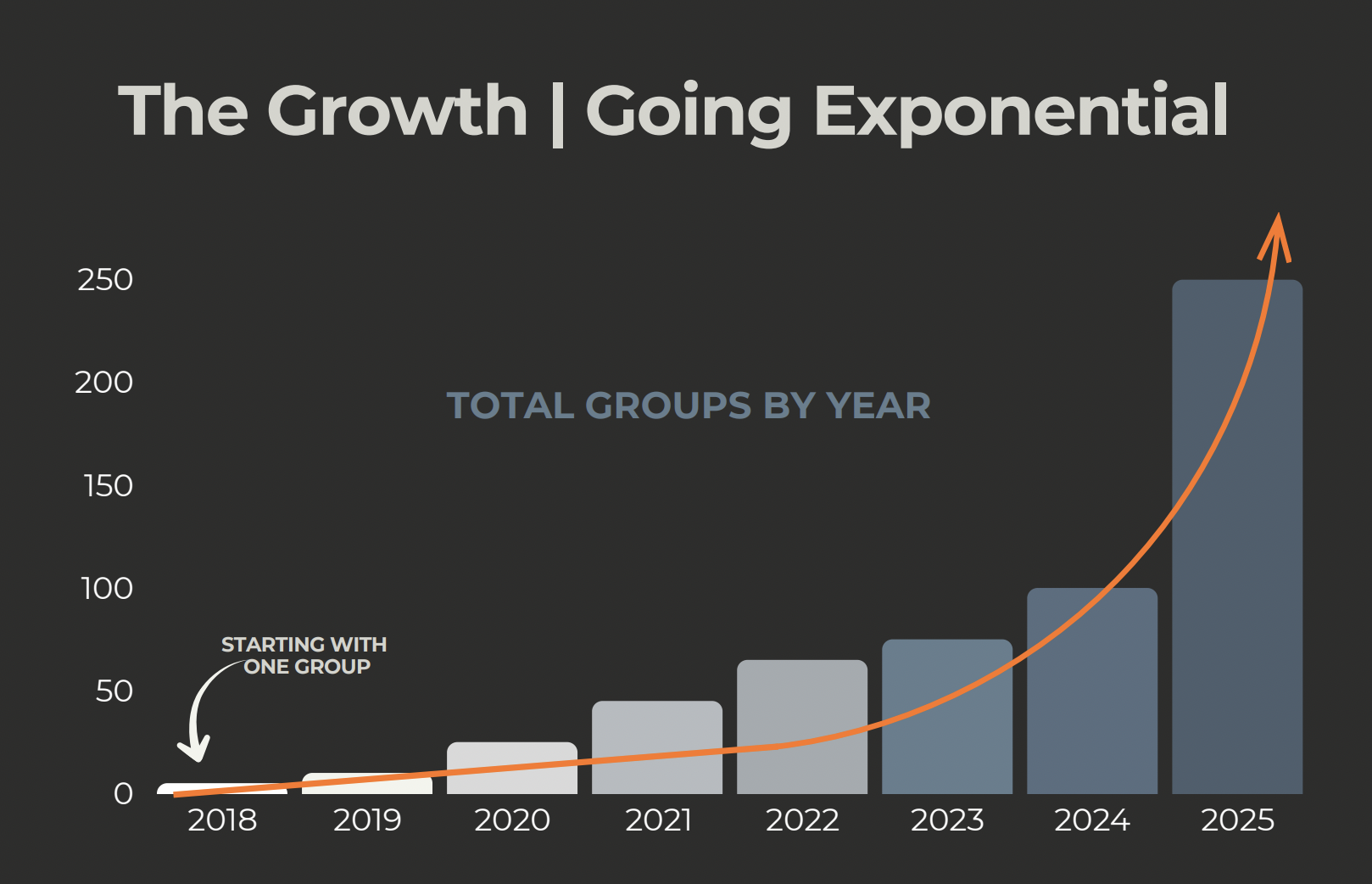
This paper is the product of work that started in 2018 with one small group of ordinary men in a living room. Eight years later, the network has grown to more than 288 documented groups across 36-plus states, with second, third, and fourth-generation chains visible in the data. None of it would be possible without the leaders and participants who took the risk to try something they were told they were not qualified to do. The research synthesis draws on the work of multiple institutional research bodies: Grey Matter Research and Consulting (for the 2020 National Study on Disciple Making in USA Churches), the Barna Group, Lifeway Research, the Pinetops Foundation, the Cultural Research Center at Arizona Christian University, the 24:14 Coalition, and the Lausanne Movement. The contemporary literature on disciple-making, surveyed in Part Seven, represents decades of practitioner and academic work that has made this paper possible. This is the First Edition. The data we track updates monthly. The American disciple-making field is moving. Subsequent editions will reflect new data, refined analysis, and reader feedback. We welcome correction, engagement, and pushback from researchers, practitioners, pastors, donors, and readers of every kind.
A Note on Financial Posture Ordinary Movement is a 501(c)(3) non-profit funded by individual donors. The platform, app, leader training, coaching, and ongoing resources are free to leaders and participants. Participants pay only for their workbook materials. The network operates with a single full-time paid position, the chief operating officer, supported by several part-time contractors. The founder works full-time but draws no salary, funding his own role so that donor contributions go directly to the mission, and the women’s-track director serves as a volunteer. Any compensation the organization does pay is set by the board of directors at non-profit norms and is not contingent on the multiplication metrics this paper documents. The decision to keep resources free and to operate without a founding church or denominational platform is a strategic commitment to platform independence and to keeping the work accessible to ordinary believers. Detailed financials are available on request.
TL;DR
American disciple-making faces structural challenges that the field has documented but not yet solved. The 2020 Grey Matter Research national study, conducted for Discipleship.org and Exponential, surveyed 1,000 Protestant pastors and found zero U.S. churches that statistically verified at Level 5 multiplication. Fewer than 5 percent qualified at Level 4. The study’s own conclusion: “We did not find clear examples of disciple-making movements (DMM) in the US.” Globally, approximately 1,965 mature disciple-making movements are documented. Roughly ninety percent operate among current or former unreached people groups. The conditions that produce movement elsewhere (persecution, oral culture, collective social structures, intense prayer cultures) do not exist in American soil. The biblical standard for disciple-making is four generations, drawn directly from 2 Timothy 2:2 where Paul names Paul, Timothy, reliable people, and others in a single sentence. This paper’s proposal is a middle path. Attractional church growth reaches people but does not reliably multiply disciple-makers. Pure decentralized disciple-making movements multiply but ask the American church for a degree of decentralization and surrendered control it has not been willing to adopt. The way forward is neither pole. It is a hybrid that carries the principles of disciple-making movements into the structure American Christianity already has, the local church, and lets movement grow outward from there. As that movement grows, its own fruit presses the originating church toward the sustaining structures it will need. This research report examines, across eleven parts, the theological foundations of disciple-making, three centuries of American disciple-making history, the global movement landscape, the contemporary literature, and one network’s multi-generational data tested against the field-recognized four-generation standard. The unit of analysis the network tracks (chains across a distributed network) differs from the unit Grey Matter applied (single churches), and the paper does not claim verified American disciple-making movement at the scale Grey Matter’s church-level standard would recognize. Ordinary Movement began with a single group in 2018 and was formally founded in 2019 to equip ordinary believers, men and women who often feel disqualified, undereducated, or unprofessional for ministry, to become disciples who make disciples. The deeper aim is a cultural shift in the American church, from consuming church to following Jesus and helping others do the same. Published by Ordinary Movement, May 2026.
Abstract
In 2020, Discipleship.org and Exponential commissioned Grey Matter Research and Consulting to conduct the most rigorous national study on disciple-making ever attempted in the United States. The study surveyed one thousand Protestant senior and lead pastors, stratified by denomination, region, and church size. It assessed each church against a five-level framework, from Level 1 (subtracting from disciple-making) to Level 5 (multiplying disciple-makers across four generations).1 The study’s title was High Aspirations Amidst Disappointing Results. The findings explain why. Fewer than five percent of U.S. churches qualified as Level 4. Zero churches were statistically verified at Level 5. Eighty percent of churches scored negatively. The research team’s own published conclusion: “We did not find clear examples of disciple-making movements (DMM) in the US.”2 Earlier Barna research conducted for the Navigators in 2015 had already documented the gap that the 2020 study confirmed at structural scale: eighty-seven percent of church leaders said discipleship was a top-three priority, but only twenty-seven percent reported having a clearly articulated plan or approach to it.3 This is the void. This paper sits inside that void. It builds, in eleven parts, the theological and empirical case for a different approach to American disciple-making. It begins with the biblical foundations of what a disciple is and what disciple-making requires. It traces the history of American disciple-making across three centuries. It documents the current state of the American church through primary-source research. It examines the global picture, where approximately 1,965 mature disciple-making movements operate, with roughly ninety percent of them located among current or former unreached people groups. It engages the contemporary literature seriously, treating peer practitioners as friends. It examines the ninety-three-year arc of the Navigators, the most experienced American disciple-making organization in existence, which now publishes “this isn’t a program” as the headline language of its flagship offering. It proposes a structured twenty-seven-session formation process built for ordinary believers, designed to run alongside existing churches, measured against the same four-generation standard the field’s own research uses to define disciple-making movement. It then presents the documented fruit of one network operating under that model since 2018, and engages openly with the counterarguments any serious disciple-making proposal must face. The proposal this paper advances can be stated simply. American discipleship is caught between two models that each fail it. The attractional growth model reaches people at scale but does not reliably multiply disciple-makers. The decentralized disciple-making movement model multiplies disciple-makers but asks the American church for a degree of decentralization and surrendered control it has not been willing to adopt. The way through is neither pole. It is a hybrid that carries the principles of disciple-making movements into the structure American Christianity actually has, the local church, and lets movement grow outward from there. The model documented in this paper is one working attempt at that hybrid, and the deeper wager is that the future of American disciple-making belongs to models that live in the middle. The claim is narrow. The network’s tracker documents what it documents, and the limits of that documentation are stated openly in Part Nine and Appendix D. The next decade will determine whether the model holds at scale. The work itself is straightforward: equip ordinary believers who often feel disqualified to become disciples who make disciples. The cultural shift behind that work is the actual goal, from consuming church to following Jesus and helping others do the same.
Table of Contents
Part One: Theological and Biblical Foundations of Disciple-Making
1.1 What Is a Disciple? The Biblical Definition
1.2 The Great Commission Mandate (Matthew 28:18–20)
1.3 The Pauline Pattern (2 Timothy 2:2)
1.4 The Apostolic Pattern (Acts 2:42–47, Acts 4:13)
1.5 Discipleship in the Early Church
1.6 The Reformation Recovery and Its Limits
1.7 The Holy Spirit and the Disciple-Making Work
1.8 Grace as the Operating Atmosphere
1.9 Why Discipleship Is the Church’s Core Mission
Part Two: A Brief History of American Disciple-Making
2.1 The Awakenings as Discipleship Phenomena (1730s to 1840s)
2.2 The Sunday School Era (1820s to 1970s)
2.3 The Postwar Parachurch Boom (1940s to 1970s)
2.4 The Jesus Movement and the Rise of Calvary Chapel (1960s to 1980s)
2.5 The Seeker-Sensitive Era (1970s to 1990s)
2.6 The Cell and House Church Movements (1990s to 2000s)
2.7 The Contemporary Disciple-Making Renewal (2000s to Present)
2.8 Where We Are Now
Part Three: The State of American Discipleship
3.1 What the National Study Actually Found
3.2 The Halo Effect: Why Pastors Cannot See the Problem
3.3 The Sermon Paradox
3.4 The Discipleship Deficit at the Lay Level
3.5 The Worldview Crisis
3.6 The Church Closure Layer
3.7 The Pastor Health Crisis
3.8 The Hidden Cost of the Addition Model
3.9 The Pinetops Forecast
3.10 What the Church Measures, and What It Could Measure Instead
3.11 The Pattern: Attend, Consume, Repeat
Part Four: Global Disciple-Making Movements, What Has Been Verified
4.1 The Global Scale
4.1a A Note on the Reliability of Movement Data
4.2 The Iranian Case
4.3 The Bhojpuri Case
4.4 The Chinese House Church Movement
4.5 African Disciple-Making Movements
4.6 The Global Disciple-Making Movement Operating Stack
4.7 Can This Pattern Run in American Soil?
Part Five: Why Multi-Generational Discipleship Resists American Soil
5.1 The Willing Leader Pool Is Small
5.2 Cultural Resistance to Multiplication
5.2a The Household Structure Gap
5.2b The Erosion of Family Cohesion
5.2c The Church Has Mirrored the Fragmentation
5.3 Comfort and Consumer Christianity
5.4 Sermon-Centric Formation Is the Default Pattern
5.5 The Prayer and Fasting Intensity Gap
5.6 Busyness, Real and Imagined
5.7 Time Horizon Compression
5.8 The Leader-to-Mentor Role Shift
5.9 Founder-Succession Timeline Asymmetry
5.10 The Moralistic Therapeutic Deism Problem
5.11 The Asymmetry Between Conditions
5.12 The Methodist Counterargument
5.13 The Funding Question
5.14 A Reconsidered Funding Model
Part Six: The Navigator Arc, A Ninety-Three-Year Preview
6.1 Founding and Early Identity (1933 to 1970s)
6.2 The Curriculum Era (1970s to Present)
6.3 The Church-Focused Curriculum Era (1975 to Present)
6.4 The Strategic Planning Pivot (2000s)
6.5 The Culture Transformation Pivot (2018 to Present)
6.6 The Research They Commissioned on Themselves
6.7 The Strategic Arc, Summarized
6.8 What the Arc Tells the Field
Part Seven: A Literature Review of Contemporary Disciple-Making Voices
7.1 Robert Coleman: The Pattern Recovery
7.2 Bill Hull: The Pastoral Vocation Reframe
7.3 Greg Ogden: Triads and Transferable Material
7.4 Dallas Willard: The Theological Reframe
7.5 Mike Breen and 3DM: Building a Discipling Culture
7.6 Jim Putman: Relational Discipleship
7.7 David Watson and the DMM Stream: The Global Bridge
7.8 Francis Chan: The Megachurch Refusal
7.9 Robby Gallaty: D-Groups at Scale
7.10 Doug Burrier: Sustainable Discipleship
7.11 Discipleship.org and Renew.org: The Field Infrastructure
7.11a The Contemporary Micro-Church and Movement Networks
7.12 What the Voices Agree On
7.13 What Remains Contested
Part Eight: The Ordinary Movement Discipleship Model
8.1 Ordinary Discipleship: Mission and Identity
8.2 The Three Core Values
8.3 The 27-Session Discipleship Process
8.4 The Complete Lifecycle
8.5 OC Groups: The Structural Answer to Split Resistance
8.6 Multiplication in Motion
8.7 The Mentorship Model
8.8 The Capacity Shift
8.9 Three Methodological Distinctives
8.10 Two Structural Distinctives for American Church Discipleship
8.11 The Maturation Arc: How Movement Matures Its Host
8.12 One Lane in a Church’s Discipleship Ecosystem
Part Nine: What the Discipleship Data Shows
9.1 The Definition That Sets the Bar
9.2 The Measurement Hierarchy
9.3 Why Four Generations Is the Disciple-Making Standard
9.4 What the Multiplication Data Documents
9.5 Generational Chain Counts
9.6 Conversion Rates Between Generational Gates
9.7 Participant-Level Multiplication
9.8 Transformation Survey Data
9.9 The Measurement Stack, Top to Bottom
9.10 Fruit Outside the Trackable Pipeline
9.11 Independent Verification of the Discipleship Data: The Path Forward
Part Ten: Counterarguments and Limitations
10.1 The Disciple-Making Movement Ecclesiology Critique
10.2 The Sacramental Question
10.3 Discipleship Curriculum or Disciple-Making Movement?
10.4 The Therapeutic Moralistic Deism Problem
10.5 The Survivorship Bias Question
10.6 The Single-Network Limitation
10.7 What This Paper Does Not Prove
10.8 The Founder-Dependency Question
Part Eleven: What the Next Decade Will Tell Us
11.1 The Three Indicators That Would Show the Model Is Not Scaling
11.2 The Honest Posture: Learner, Not Leader
11.3 What the Work Is Actually For
11.4 An Invitation
Appendices
Appendix A: Frequently Asked Questions
Appendix B: Glossary
Appendix C: Bibliography
Appendix D: Methodology Notes
Part One: Theological and Biblical Foundations of Disciple-Making
Any honest research on disciple-making has to begin with what disciple-making actually is. Methodology disconnected from theology produces technique. Technique without theology produces the very pattern the Grey Matter study documented: high aspirations amidst disappointing results.4 This part establishes the biblical and theological foundation that the rest of the paper rests on.
1.1 What Is a Disciple? The Biblical Definition
The Greek word mathētēs, translated “disciple” in English, occurs 269 times in the New Testament.5 It carries three load-bearing senses across that usage. First, a disciple is a learner: someone who attaches themselves to a teacher to receive instruction. Second, a disciple is a follower: someone who imitates the teacher’s life, not merely memorizes the teacher’s content. Third, a disciple is one who is sent: in the case of Jesus’ disciples specifically, the formation has a destination beyond the disciple’s own growth. Jesus’ own definition, given in John 8:31–32, is the most direct: “If you abide in my word, you are truly my disciples, and you will know the truth, and the truth will set you free.”6 Three elements anchor the definition. Abiding (continuing, remaining) in Jesus’ word. Knowing the truth. Being set free. Discipleship is not assent to a body of doctrine. It is sustained relational continuity with the person of Jesus, mediated by his word, producing measurable change. Luke 9:23 sharpens the cost: “If anyone would come after me, let him deny himself and take up his cross daily and follow me.” Discipleship costs the disciple’s autonomy. The disciple no longer determines the shape of their own life. They take up something heavy, daily, and walk a road someone else is already on. Three observations follow from these texts. First, discipleship is relational, not curricular. A person can complete every workbook published on the Christian formation market and not be a disciple. A person who has read no book at all but who is daily abiding in Jesus’ word, denying themselves, and following him is a disciple by the New Testament’s own definition. The contemporary tendency to equate discipleship with content delivery is foreign to the biblical concept. Second, discipleship is teleological. It has a destination. Jesus does not call disciples for their own sake. He calls them to send them. Mark 3:14 names both halves of the call explicitly: “And he appointed twelve (whom he also named apostles) so that they might be with him and he might send them out to preach.” With him and sent out. The order is fixed. Being with him precedes being sent. But being sent is not optional. Third, discipleship produces disciples. This is the Pauline argument we will examine in section 1.3, but it appears in seed form across the Synoptic Gospels. Jesus does not merely teach his disciples. He teaches them how to teach. Matthew 10 sends the Twelve out on a training mission in Jesus’ own lifetime. Luke 10 sends the Seventy-Two. The pattern is iterative from the beginning.
1.2 The Great Commission Mandate (Matthew 28:18–20)
The structuring text for Christian disciple-making is Matthew 28:18–20. It is worth quoting in full because nearly every theological argument in this paper traces back to it: “All authority in heaven and on earth has been given to me. Go therefore and make disciples of all nations, baptizing them in the name of the Father and of the Son and of the Holy Spirit, teaching them to observe all that I have commanded you. And behold, I am with you always, to the end of the age.” The grammatical structure of the commission has been the subject of substantial discussion. The main verb is mathēteusate, “make disciples.” This is the imperative around which the entire sentence is built. The three participles that surround it (poreuthentes, “going”; baptizontes, “baptizing”; didaskontes, “teaching”) modify and qualify the central command.7 D. A. Carson notes that the participle poreuthentes carries an attendant-circumstance force in this construction, meaning the going is assumed rather than optional.8 The disciples are going to be going. The question Jesus answers is what they should do while they go. The commission gives four content elements: First, make disciples. The primary verb. Not “make converts.” Not “make attenders.” Not “make believers.” Make disciples. The New Testament’s own definition of disciple, examined above, applies. Second, of all nations. The scope is universal. The Greek panta ta ethnē refers to people groups, not political nation-states.9 The commission has no geographical boundary. Third, baptizing them in the name of the Father and of the Son and of the Holy Spirit. The Trinitarian formula assumes Trinitarian theology. Disciple-making is not generic religious formation. It is formation into a specific identity rooted in a specific God who has revealed himself in three persons. The baptismal context also locates disciple-making inside the visible local church. Baptism is a church ordinance. The commission does not envision disciple-making that bypasses the local church. It envisions disciple-making that produces it. Fourth, teaching them to observe all that I have commanded you. Two words deserve weight. Teaching is didaskontes, the same root from which we get “didactic.” But it is paired with terein (“observe” or “keep”), which means more than intellectual assent. The Greek implies practiced obedience, sustained behavior, lived response. Teaching that does not produce obedience has not yet completed itself. The promise at the end, “I am with you always, to the end of the age,” is structurally important. The Great Commission is not given as a burden. It is given with the assurance of Jesus’ ongoing presence. This is not a contract with a delivery deadline. It is an invitation into Jesus’ own ongoing work, sustained by the Holy Spirit who indwells every believer. John Stott summarized the implications of Matthew 28 in language that is hard to improve on: “We have no liberty to stop short of the Lord’s own purpose: not ‘to bring people to a decision’ but ‘to make disciples’; not just to evangelize but to teach obedience.”10 The American discipleship gap, which we will document at length in Part Three, is most fundamentally the gap between the evangelistic activity the church has prioritized and the disciple-making the commission actually demands.
1.3 The Pauline Pattern (2 Timothy 2:2)
If Matthew 28 is the structuring mandate, 2 Timothy 2:2 is the operating instruction. Paul writes to Timothy from prison, possibly in his last letter, and gives the multiplication pattern in a single sentence: “And the things you have heard me say in the presence of many witnesses entrust to reliable people who will also be qualified to teach others.”11 Four generations appear in one sentence. Paul. Timothy. Reliable people. Others. This is the textual foundation for the four-generation standard the global disciple-making movement field uses to define movement. It is not a methodology invention. It is exegesis. A movement that consistently reaches the fourth generation is producing what Paul described. A movement that stalls at the first or second generation is not. The Greek verb parathou (“entrust”) is worth pausing on. It is a banking term, used elsewhere in 2 Timothy 1:12 and 1:14 for the gospel deposit itself.12 Paul is not asking Timothy to share information. He is asking Timothy to transfer something valuable into the care of trustworthy custodians, who will in turn transfer it to the next custodians. The metaphor implies that the gospel is not a stock of knowledge but a living trust that must be passed forward without being lost. The phrase “reliable people who will also be qualified to teach others” carries two qualifications. Pistois anthrōpois (reliable people, faithful people) names character. Hikanoi esontai kai heterous didaxai (will be qualified to teach others) names capability. Paul names both because both are required. A person of character who cannot teach will not multiply. A person who can teach but lacks character will multiply something other than the gospel. The four-generation standard is therefore not a methodology preference. It is the bar that 2 Timothy 2:2 sets and the bar that the field-level research adopts. Any disciple-making strategy that does not produce fourth-generation fruit has not yet completed what Paul described as Timothy’s task.
1.4 The Apostolic Pattern (Acts 2:42–47, Acts 4:13)
Two passages from the early chapters of Acts establish the operational pattern that emerged when the Holy Spirit launched the church on Pentecost. The first describes what the early disciples did together. The second describes who they were. Acts 2:42–47 establishes the four practices of the earliest disciple-making community: “And they devoted themselves to the apostles’ teaching and the fellowship, to the breaking of bread and the prayers.” These four practices, didachē (teaching), koinōnia (fellowship), klasis tou artou (breaking of bread), and proseuchai (prayers), are not optional add-ons to discipleship. They are its operating substrate.13 Disciple-making that lacks any of these four is doing something other than what the first disciples did. The passage closes with a striking sentence: “And the Lord added to their number day by day those who were being saved.” Two words matter. Added, not subtracted. Day by day, not in occasional revivals. The early church grew through sustained ordinary discipleship that produced sustained ordinary fruit. This is the textual ground for the conviction that consistent disciple-making produces consistent church growth without requiring a separate evangelism program. Acts 4:13 establishes the identity of those doing this work: “Now when they saw the boldness of Peter and John, and perceived that they were uneducated, common men, they were astonished. And they recognized that they had been with Jesus.” Three words deserve weight. Agrammatoi, translated “uneducated,” literally means “unlettered,” without formal training in the rabbinic schools.14 Idiōtai, translated “common men,” is the word from which English “idiot” derives, but in its New Testament context it means simply “ordinary” or “without official position.”15 These are not pejoratives in Luke’s writing. They are descriptions of fact. Peter and John lacked the credentials the religious establishment recognized. But the third descriptor changes everything: syn tō Iēsou ēsan, “they had been with Jesus.” The Sanhedrin recognized that what Peter and John lacked in credentials, they possessed in spiritual formation. The presence of Jesus in their lives had produced something the religious establishment could not produce in itself. This is the textual foundation for the conviction that ordinary believers, formed by sustained relationship with Jesus, are sufficient for disciple-making. The work is not reserved for the seminary-trained. It is the standing assignment of every follower of Jesus who has spent time with him.
1.5 Discipleship in the Early Church
The patristic literature documents how the earliest post-apostolic church carried forward the Matthew 28 mandate. Two texts deserve attention because they shape what disciple-making looked like in the second through fifth centuries. The Didachē (also called The Teaching of the Twelve Apostles) is the earliest surviving extra-biblical church manual, dated by most scholars to the late first or early second century.16 Its first six chapters describe “The Two Ways,” a structured catechetical curriculum that new converts were expected to learn before baptism. The structure is significant. New disciples were not converted, baptized, and then left to grow on their own. They were instructed first, formed in community, then publicly entered the church through baptism after demonstrating that the instruction had taken root. Tertullian, writing in the late second and early third century, describes a catechumenate that often lasted three years. Catechumens (those in formation) were separated from the baptized during the eucharistic portion of the service, instructed by elders, and only admitted to full communion after demonstrating both knowledge of the faith and changed life.17 The early church took disciple-making seriously enough to require evidence of formation before granting full church membership. Augustine’s De Catechizandis Rudibus (“On Catechizing the Uninstructed”), written around 405 CE, is the most fully developed early treatise on disciple-making method. Augustine argues that catechetical instruction must be adapted to the learner, that love is the disciplinary frame within which instruction operates, and that the goal is not informational mastery but transformed loves.18 The treatise reads, fifteen centuries later, as remarkably relevant to contemporary disciple-making questions. What unites these early sources is the conviction that becoming a Christian and being a disciple are not separable acts. Conversion is the entry point. Disciple-making is the work. The two were structurally connected in the early church in ways the contemporary American church has separated.
1.6 The Reformation Recovery and Its Limits
The Protestant Reformation recovered the doctrine of the priesthood of all believers, articulated most famously in Martin Luther’s To the Christian Nobility of the German Nation (1520) and grounded in 1 Peter 2:9.19 This doctrine is the theological ground for ordinary believer disciple-making. If every believer is a priest, every believer is responsible for ministering to others in the body, including the ministry of disciple-making. What the Reformers recovered theologically, they did not always institutionalize methodologically. The Reformation churches reinstituted clergy training, expository preaching, and confessional catechesis, all of which were genuine improvements over the late medieval pattern. The Reformers’ insistence on the centrality of preaching the Word was right and necessary; the Word preached remains a non-negotiable mark of the gathered church.20 But the structural separation between professional clergy who taught and laypeople who learned remained largely intact across most Protestant traditions. The priesthood of all believers became a doctrine more often confessed than practiced. This is the theological background against which the modern disciple-making renewal must be understood. The doctrine is in place. The methodology that fully embodies it is still being worked out, five centuries later.
1.7 The Holy Spirit and the Disciple-Making Work
A discipleship process that does not depend on the active work of the Holy Spirit is not biblical disciple-making. It may be religious education, character development, or behavioral modification, but it is not what the New Testament describes. The Spirit’s role in disciple-making is multifaceted. Jesus promised in John 14:26 that the Holy Spirit “will teach you all things and bring to your remembrance all that I have said to you.” Disciple-making, in this frame, is not the discipler teaching the disciple. It is the discipler creating conditions under which the Spirit teaches both. In John 16:13, Jesus describes the Spirit as guiding into “all the truth,” again positioning the Spirit as the primary agent of formation. The discipler is a participant in a work the Spirit is already doing. Galatians 5:22–23 names the fruit of the Spirit (love, joy, peace, patience, kindness, goodness, faithfulness, gentleness, self-control) as the visible evidence of Spirit-led formation. These are not character traits to be developed through technique. They are fruit produced by the indwelling Spirit when a disciple is abiding in Jesus, as Jesus described in John 15:5. This is why any disciple-making strategy that emphasizes intimacy with Jesus as its first and primary value, and reproducibility as its operational mechanism, is more biblically coherent than a strategy that begins with mission and adds devotion later. Mission is the fruit. Intimacy is the root. Inverting the order produces activity without transformation.21 The balance of Word and Spirit deserves explicit attention. Disciple-making goes wrong when it becomes pure technique without the Spirit’s enabling, and it goes wrong when it becomes pure emotional experience without the Word’s content. Both errors produce something other than mature disciples. The biblical pattern integrates both: the Spirit teaches through the Word, the Word is illuminated by the Spirit, and disciples grow as they receive both together.22
1.8 Grace as the Operating Atmosphere
A theological note on grace belongs in this part. The American disciple-making renewal has sometimes been criticized for tilting toward legalism, presenting discipleship as a series of behavioral requirements that must be met to demonstrate genuine faith. This criticism, when valid, names a real failure mode in disciple-making practice. The biblical alternative is not less rigor. It is more grace. The same Paul who in 2 Timothy 2:2 commissions four generations of disciple-makers also writes, in Ephesians 2:8–9, “For by grace you have been saved through faith. And this is not your own doing; it is the gift of God, not a result of works, so that no one may boast.” Discipleship is the response to grace, not the means of earning it. Disciples obey because they have been forgiven, not to be forgiven. The corollary is that disciple-making must operate under a culture of grace. Disciples will fail. Leaders will fail. Groups will struggle. The response cannot be to tighten requirements or to treat failure as evidence that someone is not really a Christian. The response is grace, not tighter rules, and then to keep going. Grace is what forms people. Pressure does not. The high challenge of biblical discipleship and the high grace of the gospel are not in tension. They are the same posture viewed from different angles. The disciple who has truly grasped grace is moved to take up the cross daily. The disciple who is taking up the cross daily depends on grace to do so. Either without the other distorts what discipleship is. This is the theological atmosphere within which the rest of this paper operates. The data we will examine in Part Three describes the failure of American discipleship at scale. The proper response to that failure is not condemnation of pastors or churches. It is honest naming of the problem and gracious commitment to the work that addresses it.
1.9 Why Discipleship Is the Church’s Core Mission
The implication of the texts examined above is that disciple-making is not one ministry of the church among many. It is the core mission of the church. Every other activity (worship, teaching, sacraments, mercy ministry, evangelism) finds its purpose in producing disciples who make disciples. Bobby Harrington and Josh Patrick, drawing on the broader contemporary disciple-making consensus, put it directly: “Disciple making is the master plan of Jesus. It was his strategy when he was on earth, and it remains his strategy for his church today.”23 Robert Coleman, whose 1963 book The Master Plan of Evangelism substantially shaped the modern recovery, framed the same claim differently: “His concern was not with programs to reach the multitudes, but with men whom the multitudes would follow.”24 This conviction sets the bar for the rest of the paper. If disciple-making is the church’s core mission, then the data we will examine in Part Three (which documents that less than five percent of American churches are reproducing disciple-making cultures) is not a niche concern. It is the structural failure of the contemporary American church at its central task. A clarifying note. The argument that disciple-making is the church’s core mission does not imply that disciple-making replaces the church. Disciple-making is what the church does. The local church is the appointed context within which disciple-making happens, the body within which disciples are formed, and the visible community to which disciples belong. Any disciple-making strategy that positions itself against the local church misunderstands its own mandate. The model proposed in Part Eight is designed to serve the local church, not to bypass it. That is the theological ground on which the rest of the paper stands. ## Part Two: A Brief History of American Disciple-Making The American church did not always look the way it looks now. The structural separation between Sunday gathering and discipleship, the bottlenecking of ministry through professional clergy, the substitution of attendance for formation, and the dependence on programs to do what relationships used to do are recent developments. This part traces how American disciple-making evolved over three centuries, to understand the current crisis as a particular moment in a longer story.
Part Two: A Brief History of American Disciple-Making
2.1 The Awakenings as Discipleship Phenomena (1730s to 1840s)
The First Great Awakening, beginning in the 1730s under the preaching of Jonathan Edwards, George Whitefield, and the Tennents, is usually remembered as an evangelism movement. It was also a disciple-making movement, although the contemporary distinction between the two would have been foreign to its leaders.25 Edwards’s Religious Affections (1746) is one of the most rigorous theological treatments of disciple-making ever written in America. Edwards argued that genuine Christian formation produced visible “holy affections,” meaning sustained heart-level desires for God and his ways, distinguishable from mere emotional response or doctrinal assent.26 Edwards’s method was largely pastoral. He did not develop a curriculum. He preached, counseled, and produced theological works that shaped how subsequent generations approached formation. The Second Great Awakening, which extended from the 1790s through the 1840s, produced more institutional infrastructure for disciple-making than its predecessor. The camp meetings of the western frontier created sustained communal contexts for conversion and ongoing formation. The Methodist class meeting, imported from England and adapted to American conditions, was perhaps the most effective small group disciple-making mechanism in American history before the contemporary period. The Methodist class meeting deserves separate attention. Methodist circuit riders organized new converts into “classes” of approximately twelve people. Each class met weekly under a lay class leader. The agenda was straightforward: each member answered the question, “How is it with your soul?” The class leader investigated each member’s spiritual progress, addressed sin, and provided pastoral oversight. Class meetings were the standard structure of American Methodism throughout most of the nineteenth century. They produced a disciple-making engine that helped Methodism grow from a small movement at the turn of the nineteenth century to the largest Protestant denomination in America by 1850.27 What the class meeting accomplished was structural disciple-making at the lay level, run on a question-and-relationship model rather than a content model, with leadership distributed across hundreds of thousands of class leaders rather than bottlenecked through clergy. The class meeting is, in retrospect, perhaps the closest American historical parallel to what global disciple-making movements look like today. The decline of the Methodist class meeting after the Civil War is one of the most consequential developments in American church history. As Methodism professionalized, as seminary education replaced apprenticeship, and as the social context of American life changed, the class meeting was gradually replaced by Sunday School and pastor-led teaching. By the early twentieth century, the class meeting had effectively disappeared as the operational core of Methodism.28 The American Protestant church has not since produced a structure of equivalent scale and effectiveness for ordinary believer disciple-making.
2.2 The Sunday School Era (1820s to 1970s)
The Sunday School movement, originating in England in the 1780s under Robert Raikes and reaching American shores by the early nineteenth century, represented the institutionalization of a particular form of disciple-making.29 Sunday Schools initially served primarily to teach poor children to read using the Bible as the text. By the 1830s, the movement had expanded to include adults and had become the dominant lay-led discipleship structure in American Protestantism. The American Sunday School at its peak (roughly 1900 to 1960) was a remarkably effective discipleship infrastructure. Most American Protestant Christians from that era received their primary biblical instruction through Sunday School rather than through Sunday morning preaching. Sunday School teachers, who were almost entirely lay volunteers, often served the same age cohort for decades and developed substantial relational depth with their students. The Sunday School movement also created publishing houses, teacher training networks, and an internal economy of materials that supported the work. The decline of the Sunday School from the 1970s onward, like the earlier decline of the class meeting, is connected to broader cultural shifts. As families became more mobile, as Sunday morning schedules contracted, as professional ministry expanded, and as the broader culture became less Christian in default assumptions, the Sunday School lost both its participants and its centrality.30 By 2020, fewer than half of American Protestant churches operated active adult Sunday Schools at scale.
2.3 The Postwar Parachurch Boom (1940s to 1970s)
The decades following World War II produced an unprecedented expansion of American parachurch ministries focused specifically on disciple-making among populations the local church was not effectively reaching. The Navigators (founded 1933), InterVarsity Christian Fellowship (founded 1941 in the U.S., though older internationally), Campus Crusade for Christ (founded 1951, now Cru), Young Life (founded 1941), and the Fellowship of Christian Athletes (founded 1954) all emerged during this period. What unites these organizations is their decision to develop disciple-making methodology outside the institutional church, often because they perceived the institutional church as either unable or unwilling to disciple particular populations effectively. The Navigators began with sailors in the U.S. Navy. InterVarsity and Campus Crusade focused on college students. Young Life reached high school students. The Fellowship of Christian Athletes focused on athletes. Each of these organizations produced significant disciple-making content. The Navigators’ Topical Memory System, Design for Discipleship series, and 2:7 Series have collectively reached millions of people. Campus Crusade’s Four Spiritual Laws tract is one of the most widely distributed Christian publications in history. InterVarsity Press has produced one of the most respected academic Christian publishing houses in the world. The parachurch era established the modern American assumption that disciple-making methodology can be developed, refined, and distributed by specialized organizations rather than by local churches. This is both a strength and a structural challenge. The strength is that specialized organizations can develop expertise the average local church cannot. The challenge is that this same specialization can encourage local churches to outsource their core mission rather than develop their own disciple-making cultures. The Navigators’ own ninety-three-year arc, which we will examine in detail in Part Six, illustrates the eventual recognition by the parachurch sector itself that disciple-making methodology, however excellent, cannot substitute for the disciple-making culture that local churches must develop. The postwar period also witnessed the rise of what would become the contemporary evangelical movement, with figures like Billy Graham reaching unprecedented audiences through stadium crusades and televised broadcasts. The Graham crusades produced millions of recorded decisions for Christ. They also revealed, over time, the same structural pattern the broader American church would face: the gap between evangelistic decision and sustained discipleship. Graham himself acknowledged this gap in later years, repeatedly emphasizing the importance of local church follow-up and discipleship as the indispensable companion to mass evangelism.31
2.4 The Jesus Movement and the Rise of Calvary Chapel (1960s to 1980s)
A particular stream of American Christianity that emerged from this period deserves separate attention because it shaped much of the contemporary evangelical landscape and articulated, at its founding, several of the values this paper holds central. The Jesus Movement, beginning in the late 1960s on the West Coast of the United States, emerged from the counterculture of the era. Young people who had been seeking spiritual reality through Eastern religions, psychedelic drug use, and the various social movements of the time encountered Jesus, often through informal Bible studies, beach baptisms, and the ministry of pastors willing to receive them as they were. Chuck Smith’s Calvary Chapel in Costa Mesa, California, became one of the most influential ministry centers of this period. Smith opened the church’s doors to long-haired hippies that mainstream churches were refusing to accept. He taught the Bible verse-by-verse from Genesis through Revelation, modeling a form of expository teaching that became foundational to the Calvary Chapel movement and to a generation of evangelical pastors who learned from him. Smith’s ministry emphasized grace, the active work of the Holy Spirit, the centrality of Scripture, and the priesthood of all believers. He famously avoided the strict five-point Calvinist soteriology dominant in some Reformed circles, while equally rejecting prosperity gospel teaching and hyper-charismatic excess.32 The Calvary Chapel movement that grew from Smith’s ministry would eventually plant more than 1,700 churches globally, with most planting happening organically through young men Smith had personally discipled. The movement’s emphasis on simple expository teaching, openness to the Spirit, and grace-filled welcome of ordinary believers represents one of the more substantial American disciple-making contributions of the late twentieth century. Many of the cultural assumptions about ordinary believer ministry that this paper holds central trace, at least in part, to the influence of Smith and his peers in the Jesus Movement era. The Jesus Movement also illustrates the conditions under which American disciple-making renewal has historically broken through. It happened among young people. It happened in spaces willing to receive new converts as they were. It happened through pastors willing to invest the time. And it happened at a cultural moment where established institutional Christianity was perceived as failing the very people most spiritually hungry. Those conditions are worth holding as the paper turns, in Part Three, to the current American disciple-making moment.
2.5 The Seeker-Sensitive Era (1970s to 1990s)
Beginning with Bill Hybels’s launch of Willow Creek Community Church in 1975 and Rick Warren’s launch of Saddleback Church in 1980, a new model emerged in American evangelicalism. The seeker-sensitive model, as it came to be called, aimed to remove cultural barriers to church attendance for non-Christians by adapting worship styles, communication formats, and ministry programming to feel accessible to those who had not grown up in church.33 The seeker-sensitive model worked at the level of attendance. Willow Creek grew from a handful of people in a rented theater to attendance of more than twenty thousand at its peak. Saddleback followed a similar trajectory. The Willow Creek Association, founded in 1992, distributed seeker-sensitive methodology to thousands of churches globally. Rick Warren’s The Purpose Driven Church (1995) and The Purpose Driven Life (2002) became foundational texts for an entire generation of American pastors.34 The seeker-sensitive era produced one of the most consequential pieces of self-research in American church history. In 2007, Willow Creek published Reveal: Where Are You?, a self-conducted study of the spiritual maturity of their own congregation. The initial study surveyed 6,000 Willow Creek attenders and 5,000 attenders across six other like-minded churches. The findings were unexpected. For decades, Willow Creek had operated under what the report itself called “the Church Activity Model for Spiritual Growth”: the premise that as people far from God participated in church activities (small groups, services, volunteering), they would eventually become people who loved God and loved others. The Reveal data disproved that premise from inside Willow Creek’s own congregation. Three findings deserve weight. First, increased church activity did not predict spiritual growth, particularly for those at higher stages of spiritual maturity. The architects of the study expected involvement and growth to track together. They did not. Greg Hawkins, Willow Creek’s executive pastor who led the research, said the team had to tell senior pastor Bill Hybels that “the church isn’t as effective as we’d thought.”35 Second, approximately twenty-five percent of respondents described themselves as “spiritually stalled” or “dissatisfied” with the church’s role in their spiritual growth. Many were considering leaving. The Willow Creek leadership team described the finding as “almost unbearable” in the report’s foreword.36 Third, the most spiritually mature members were the most likely to feel underchallenged by the church’s offerings and the most likely to consider leaving. The report, on page 51, stated this directly: the higher the level of commitment to Christ, the more likely it was that satisfaction with the church would be lukewarm.37 What did predict spiritual growth, according to the data, was personal spiritual practices: daily engagement with Scripture, intentional habits of private prayer, and sustained reflection on the grace of God. Hawkins and Parkinson’s own conclusion to the report has become one of the most-quoted sentences in American disciple-making research: “Our dream is that we fundamentally change the way we do church.”38 The report’s foreword carries the line that has become the most consequential public admission by a major American megachurch: “It is causing me to see clearly that the church and its myriad of programs have taken on too much of the responsibility for people’s spiritual growth.”39 This is the Reveal contribution to the American disciple-making conversation, twelve years before Ordinary Movement was founded. The pattern, named honestly from inside one of the most-successful American churches ever built, was that activity-based discipleship does not produce mature disciples, and that personal disciplines and relationships do. The implications have been working their way through the American church for nearly two decades since. The disciple-making renewal documented in this paper is, in significant part, the field’s response to what Willow Creek documented first. The willingness of Willow Creek to publish unfavorable self-research is itself a sign of organizational integrity that deserves recognition. The Reveal findings document, from within one of the most influential American churches of the late twentieth century, the structural limitation of attendance-based disciple-making. Even when it works at scale, it produces something other than what the New Testament describes as disciples.
2.6 The Cell and House Church Movements (1990s to 2000s)
In partial reaction to the limitations of attendance-based ministry, the 1990s and 2000s saw growing American interest in small group structures imported from rapidly growing churches in the Global South. The cell church model, articulated by Ralph Neighbour Jr. in Where Do We Go from Here? A Guidebook for the Cell Group Church (1990) and observed at scale in churches like Yoido Full Gospel Church in Seoul, proposed a radical restructuring of the local church around small cells as its basic operational unit.40 Joel Comiskey’s research on the largest cell churches globally, conducted in the late 1990s, documented that effective cell churches operated under a small number of distinctive principles: groups of approximately ten people, clear leadership pipelines, explicit multiplication goals, and integration with rather than separation from the larger Sunday gathering.41 Comiskey’s work has become the standard reference for cell church practice. The cell church model produced significant fruit in some American contexts, but it did not scale across the American evangelical mainstream. Larry Stockstill’s Bethany World Prayer Center in Baker, Louisiana, became one of the most-studied American cell churches, with documented small-group multiplication patterns through the 1990s and 2000s.42 But Bethany remained an outlier rather than a model that broadly transferred. Several factors contributed to the limited American adoption: cell churches require senior pastoral leadership that is willing to subordinate Sunday programming to small group health, they require structural disciplines most American churches were not prepared to adopt, and they were designed in cultural contexts (particularly Korean and Latin American) that operated with different default social structures than American suburbs.43 The parallel house church movement, which proposed not merely adding cells but replacing the traditional church structure with networks of house churches, gained particular momentum in the 2000s. Neil Cole’s Organic Church: Growing Faith Where Life Happens (2005) offered a practical case for organic house church planting that has been influential in subsequent disciple-making conversations.44 The house church movement produced a small but persistent American footprint and significant overseas fruit. It did not become the operational pattern of the American evangelical mainstream. The reasons connect to a theological question this paper takes seriously: the local church, with its ordained leadership, sacraments, and visible communal worship, is not optional infrastructure. Disciple-making methods that bypass or replace the local church gain operational flexibility at a real theological cost. The model proposed in Part Eight chooses instead to run alongside the existing local church rather than to replace it.
2.7 The Contemporary Disciple-Making Renewal (2000s to Present)
Beginning in roughly the early 2000s and intensifying through the 2010s, a distinct disciple-making renewal emerged in American evangelicalism. Several streams contributed. The first stream was the recovery of multi-generational disciple-making language through engagement with global movements. David Watson’s work in Bhojpuri (which we will examine in Part Four), Jerry Trousdale’s Miraculous Movements (2012), and David Garrison’s A Wind in the House of Islam (2014) all brought global disciple-making movement methodology into the American conversation in serious ways.45 The vocabulary of “disciple-making movements” entered American evangelical discourse during this period. The second stream was the recovery of pre-modern catechetical practice. J. I. Packer and Gary A. Parrett’s Grounded in the Gospel: Building Believers the Old-Fashioned Way (2010) made the case for recovering structured catechesis in the contemporary American church.46 This stream produced what is sometimes called the “catechetical renewal,” visible in reformed circles particularly. The third stream, and the one most relevant to this paper, was the formation of dedicated disciple-making networks distinct from existing denominational structures. The Bonhoeffer Project, Discipleship.org (founded in 2010 by Bobby Harrington), Renew.org (also led by Harrington), Replicate Ministries (Robby Gallaty), Real Life Ministries and the Relational Discipleship Network (Jim Putman), Multiply Movement (Francis Chan and David Platt), Zúme (Team Expansion), and dozens of smaller networks all emerged or significantly expanded in this period. The 2020 Grey Matter / Discipleship.org / Exponential national study, which anchors the empirical sections of this paper, is itself a product of this renewal. The study was commissioned by Discipleship.org and Exponential, two organizations born of the contemporary disciple-making renewal, and conducted by the most rigorous independent research firm operating in the American Christian space. The study’s title (High Aspirations Amidst Disappointing Results) summarizes both the achievement and the limit of the renewal.47 The conversation has matured. The fruit, at the level the field’s own research can verify, has not yet. Ordinary Movement, founded in 2019, emerged inside this contemporary renewal but with two structural differences from its peer networks. Both differences will be examined in detail in Part Eight. They are worth flagging here as the network’s distinctive contribution to the conversation: the network operates without a founding church platform, denominational affiliation, or publishing-house pipeline, and it measures lineage rather than reach as its primary metric of fruit.
2.8 Where We Are Now
The three centuries of American disciple-making history surveyed above point to a recurring pattern. American Christianity has produced several effective disciple-making structures (the Methodist class meeting, the early Sunday School, the postwar parachurch organizations, the Jesus Movement and its inheritors, and the contemporary disciple-making renewal). Each succeeded in its time. Most have declined since their peak, often for reasons that had less to do with the structures themselves than with broader cultural changes. The contemporary American church has not yet produced a replacement structure that operates at the scale or effectiveness of the strongest historical models. We are not the first generation to face a disciple-making crisis. We are the first generation to face the current one. The historical record gives reason for hope (structures that worked have worked before) and reason for sober honesty (no structure is automatically sustainable, and decline can take generations to reverse). A note on what this part does not engage. Three major American traditions sit outside the historical sweep above. The Black Church tradition, from the 1860s through the present, has produced sustained, intergenerational, lay-led disciple-making across more than 150 years through conditions that included persecution, poverty, and oral-culture practices that are particularly relevant to the global disciple-making comparison. The Catholic immigrant disciple-making infrastructure, from the 1850s through the 1950s, produced one of the largest sustained disciple-making infrastructures in American history through parishes, parochial schools, sacramental life, and ethnic religious societies. Latin American Pentecostalism, which has produced lay-led multi-generational growth at scale in conditions arguably closer to American conditions than rural Africa or Iran, is engaged briefly in Part Four but deserves more attention. The First Edition does not engage these traditions at the depth they merit. We name the omission openly and flag these cases as targets for substantive treatment in the 2nd Edition. The argument of the present paper would be strengthened, not weakened, by engaging them seriously. The next part examines, in detail, what the present American disciple-making landscape actually looks like, using the most rigorous research the field has produced.
Part Three: The State of American Discipleship
This part documents the current state of American discipleship through primary-source research. Every figure cited in this part is traceable to a named study or research organization. The cumulative picture is sobering. It is also factual.
The gap is not only an American observation. The Lausanne Movement’s 2024 State of the Great Commission report, the most comprehensive global assessment of its kind, names discipleship as the single largest gap in the global church’s work.48 The American data that follows is the local shape of a problem the global body has already put first.
3.1 What the National Study Actually Found
The 2020 National Study on Disciple Making in USA Churches, conducted by Grey Matter Research in partnership with Discipleship.org and Exponential, is the most rigorous quantitative study of American disciple-making ever conducted. Bobby Harrington led the project. Twenty-three disciple-making partner organizations contributed input, including the Navigators, Replicate Ministries, Renew Network, Final Command, New Generations, Relational Discipleship Network, and others.49 Grey Matter conducted one thousand telephone interviews with senior and lead pastors, stratified by denominational group, geographic region, and church size. The sampling error was plus or minus 3.1 percentage points at the 95 percent confidence level.50 The 2022 Becoming Five study from Exponential expanded the dataset. The study used a five-level framework to classify churches by disciple-making maturity:51
Level 1, Subtracting from disciple-making efforts: 29% of U.S. churches
Level 2, Plateaued, neither helping nor hindering: 44%
Level 3, Adding disciples through church programs: 27%
Level 4, Reproducing personal disciple-makers: under 5%
Level 5, Multiplying disciple-makers (four generations deep): could not be statistically verified
Read this table carefully. Seventy-three percent of American churches are either subtracting from disciple-making or making no contribution to it at all. Another twenty-seven percent are adding disciples through programs, which is good but is not multiplication. Fewer than five percent are reproducing disciple-makers. Zero churches in the sample met the criteria for multiplying disciple-makers across four generations. The study’s own published conclusion is exact: “We did not find clear examples of disciple-making movements (DMM) in the US.”52 The official definition of a disciple-making movement, as published in the study itself, sets a specific bar: A disciple-making movement exists when churches plant multiple churches (within a few short years), through gospel activity, that has abundant fruit among the lost, that multiplies these disciples (people growing in obedience to all of Jesus’ commands), who in turn replicate themselves in others, so that we can see at least four generations regularly produced in multiple streams of disciple-making activity and these streams multiply consistently into churches.53 This is the field-recognized standard. The four-generation threshold is not a methodology preference. It is the operating definition the largest American disciple-making research collaboration uses to identify movement. We will return to it in Part Nine. A more recent Lifeway Research study of 2,620 Protestant pastors, published in 2024, provides a current-year update on the structural disciple-making gap. Fifty-two percent of pastors now report having an intentional plan for discipling individuals in their congregation. Forty-four percent report they do not. Four percent are not sure.54 Compared to the 2015 Barna baseline of twenty-seven percent reporting a clearly articulated plan, the trajectory has moved upward. The gap, however, remains structural. Nearly half of American Protestant churches still have no intentional disciple-making plan in 2024.
3.2 The Halo Effect: Why Pastors Cannot See the Problem
One Lifeway 2024 finding should anchor every conversation about American discipleship before any methodology debate begins. The same survey of 2,620 Protestant pastors that documented the planning gap asked whether pastors agreed with the statement “Discipleship is not completed inside a program but in a relationship.” Sixty-six percent strongly agreed. Twenty-nine percent somewhat agreed. The combined agreement was ninety-five percent.55 American pastors, at near-unanimous scale, already know what disciple-making requires. The structural problem is not conviction. It is the gap between what pastors confess and what their churches are built to deliver. The model they confess and the model they operate are not the same model. What follows in this section is the structural reason most American churches do not deliver on what their pastors already believe. The study surfaced something subtler than the headline numbers. American pastors systematically overestimate their own disciple-making effectiveness. The data is striking. The average pastor in the study reported 12.5 new commitments to Christ in the past year for every 100 people in their congregation. Ten percent of pastors reported 25 or more new commitments per 100 attendees. If those numbers projected accurately to the national population, the United States would be adding 5.9 million new believers each year, or 59 million new Christians over the past decade.56 The actual national data shows the opposite. National studies by Pew Research, Gallup, Barna, and others document no significant, consistent gains in Christian self-identification, basic Christian beliefs, church involvement, or born-again beliefs across that same decade.57 The Christian share of the population has declined. The numbers pastors report are not reality. They are aspiration mistaken for reality. The Grey Matter team applied a useful parallel from their own prior research on charitable giving. In a 2018 study, they found that the average American donor gives about 1.95 percent of their income to charity outside of houses of worship. The average donor believes they give 8.41 percent. Fifty-five percent of Americans give to nonprofits. Only fifteen percent of donors are aware that more than half of Americans give. Six out of ten donors believe they give a higher proportion of their income than the typical American does.58 The same dynamic operates in pastoral self-assessment. The researchers wrote it plainly: If you convince yourself that you’re getting all A’s in school, what motivation is there to study harder? If you feel you’re already spending lots of time on discipleship-related activities, and you feel your mindset is already pointed towards discipleship, what more can you do?59 This is the structural reason the disciple-making gap persists. Pastors are not lying. They are not negligent. They are operating inside a perception bias that makes the gap invisible from the inside. The study found two additional structural facts that contradict pastoral self-perception. Only fifteen percent of pastors report that their church has both a simple, reproducible model to equip members to make disciples and a framework to measure success at doing so. Only seven percent agree strongly that they have both.60 The average pastor spends nine percent of their working hours personally equipping people to be disciple-makers. They spend thirty-two percent on sermon preparation, twenty percent on pastoral care, and twenty percent on administration.61 The activity that pastors say is the highest priority in their ministry is receiving the smallest share of their working time.
3.3 The Sermon Paradox
The structural pattern of American discipleship is built around the sermon. The numbers tell the story. Eighty-nine percent of American pastors use the sermon as a primary discipleship approach. Thirty-three percent of pastors identify the sermon as the single most important discipleship vehicle in their ministry, ahead of small groups at eighteen percent and one-on-one discipling at seven percent.62 Thirty percent of pastors say corporate worship is the function their church does best. Eleven percent say discipleship is what their church does best.63 The retention data is the other side of the paradox. Cognitive psychology research on learning retention, including the well-documented Ebbinghaus forgetting curve and its modern peer-reviewed replications, consistently suggests that approximately ninety percent of new information not actively reviewed is forgotten within a week. Applied to the sermon as a primarily one-way information-delivery format, this means the tool American pastors are most confident in is the tool whose content most listeners will not retain into the following Sunday.64 This is not a critique of preaching. Preaching does what preaching is designed to do. The Reformers were right to recover the proclamation of the Word as a non-negotiable mark of the gathered church, and verse-by-verse expository teaching of Scripture remains one of the great gifts God has given to his people.65 What we are documenting is the consequence of asking one ministry function to do work that the New Testament gives to multiple ministry functions operating together. Preaching is necessary. Preaching alone is not sufficient. The disciple-making renewal does not seek to replace preaching. It seeks to add to preaching the relational, sustained, accountable formation that produces disciples who can themselves teach others. The two work together. The sermon casts the vision and forms the theology. The disciple-making process embeds the formation.
3.4 The Discipleship Deficit at the Lay Level
The view from the pew is consistent with the view from the pulpit. George Barna’s 2025 research documents that approximately one in ten born-again American Christians actively disciples another person in a sustained one-on-one relationship. By a broader definition that includes any form of discipling activity, thirty-three percent of Christians qualify as active disciple-makers.66 Thirty-nine percent are not engaged in any form of discipleship at all.67 Even at the broadest definition, two-thirds of self-identified Christians are not making disciples. Among Christians not currently making disciples, the primary barriers are not what pastors assume. Thirty-seven percent cite “not feeling qualified or equipped” as the obstacle. Twenty-four percent say no one has asked them. Only seven percent cite time.68 Eighty-five percent of pastors identify busyness as a major obstacle to disciple-making in their congregation. Twenty-two percent of practicing Christians say the same.69 The sixty-three-point gap is one of the largest disconnects in the entire body of American church research. The qualification gap and the invitation gap are the actual obstacles. Solving them does not require asking American Christians to work harder. It requires asking them differently and equipping them clearly. Only seventeen percent of American Christians can identify the Great Commission and explain what it means.70 This is the most basic disciple-making text in the New Testament. Eighty-three percent of self-identified Christians in America do not know what it says.
3.5 The Worldview Crisis
Underneath the disciple-making gap sits a deeper structural problem. The Cultural Research Center’s 2025 American Worldview Inventory, conducted by George Barna at Arizona Christian University, documents the following: Only four percent of American adults hold a biblical worldview.71 Only two percent of parents of preteens hold a biblical worldview.72 Only thirty-seven percent of Christian-church pastors hold a biblical worldview.73 Ninety-two percent of Americans hold what the researchers call a “syncretistic” worldview, blending elements from multiple philosophies for personal satisfaction rather than internal coherence.74 These numbers matter because disciple-making is downstream of worldview. Asking a population that does not hold a biblical worldview to make disciples is asking them to reproduce something they have not personally absorbed. The work required is more foundational than methodology. It is identity formation. The fact that only thirty-seven percent of Christian-church pastors hold a biblical worldview deserves separate weight. The people responsible for forming disciples are themselves operating, by majority, inside the same worldview confusion they are supposed to be addressing. This is not a moral failure on the part of pastors. It is the predictable outcome of seminary curricula that prioritized professional ministry skills over deep biblical and theological formation, of pastoral cultures that valued growth over depth, and of a broader American religious environment that has been syncretizing for decades. The path forward, whatever specific methodological form it takes, has to involve the recovery of a biblical worldview at the leader level before disciple-making methodology can produce its intended fruit. This is one reason the model proposed in Part Eight begins with intimacy with Jesus as its first and primary value, not with mission or methodology. Worldview forms slowly and privately, in the ordinary practices of prayer and Scripture over time. It cannot be installed through training events.
3.6 The Church Closure Layer
The disciple-making gap exists inside a broader structural decline. The United States is closing more churches than it is planting. In 2019, approximately 4,500 churches closed while only 3,000 were planted, a ratio of roughly three to two.75 Church closures are now outpacing church plants by about three to one across the most recent measurement windows. Approximately 15,000 American churches are projected to close in 2025 alone.76 The Pinetops Foundation, working with church researchers, projects that 176,000 American churches will close by 2050.77 The National Council of Churches estimates that 100,000 churches could close by 2050. Different methodologies, similar order of magnitude. Three out of four American churches are in decline, according to LifeWay Research data.78 Ryan Burge, the political scientist who has done the most rigorous public work on American religious demographics, estimates that one-third of America’s 350,000 Christian congregations are on the brink of extinction.79 Church membership in the United States dropped from seventy percent in 2000 to forty-seven percent in 2021, the steepest generational decline ever recorded by Gallup.80 The growth rate of U.S. Evangelical churches is approximately 0.8 percent.81 The general population grows faster. This means the American Evangelical share of the population is shrinking even before considering disaffiliation. The disciple-making question is happening inside a contracting institution. Any disciple-making strategy that depends on the existing church infrastructure must contend with the reality that the existing church infrastructure is in structural decline. This does not argue against the local church. It argues for the urgency of recovering the local church’s core disciple-making mission. The local church is not in trouble because it is the local church. It is in trouble because it has, in many cases, drifted from its central work.
3.7 The Pastor Health Crisis
The people running the American church are not okay. Barna’s State of Pastors Volume 2, published in 2024, documents the steepest decline in pastoral health Barna has ever measured. The headline numbers: Forty-two percent of American pastors seriously considered quitting full-time ministry in 2022. The highest figure Barna had ever recorded.82 Among pastors under forty-five, the figure was forty-six percent.83 By late 2023, that number had dropped to thirty-three percent. By January 2026, to twenty-four percent.84 Barna’s own framing of the drop is restrained: stabilization, not recovery. The acute crisis has eased. The structural problem has not. Forty percent of pastors show a high risk of burnout. The same figure in 2015 was eleven percent.85 Burnout risk has nearly quadrupled in a decade. Sixty percent of pastors have significantly doubted their calling.86 Eighteen percent of pastors reported suicidal ideation or self-harm in the past year.87 Sixty-five percent of pastors report feelings of loneliness and isolation, up from forty-two percent in 2015.88 Only twenty-two percent receive regular spiritual support from a mentor or peer network, down from thirty-seven percent in 2015.89 Pastors reporting “excellent” physical wellbeing dropped from twenty-four percent in 2015 to eleven percent in 2023. Pastors reporting “excellent” mental and emotional wellbeing dropped from thirty-nine percent in 2015 to fourteen percent in 2023.90 The median age of pastors has risen from forty-four to fifty-four over the last twenty-five years. The average senior pastor is now fifty-seven. Half of all senior pastors are over fifty-five.91 A model whose primary engine is the Sunday-morning platform cannot run indefinitely if two out of five people running the platform are considering walking away. The pastor shortage is not a downstream problem of disaffiliation. It is the upstream signal that the model is taking on more strain than its operators can sustain. The implication for disciple-making is direct. The work cannot be bottlenecked through professional clergy. The clergy itself is in structural crisis. Whatever produces disciple-making at scale in the United States must be distributable to ordinary believers, run alongside the pastoral office rather than through it, and capable of producing fruit without depending on a profession in active decline. This is not an argument against pastoral ministry. The local pastor remains, as the New Testament establishes and the Reformers reaffirmed, the appointed shepherd of the local congregation.92 But the disciple-making work cannot be solely the pastor’s. Ephesians 4:11–12 names the pastor’s task explicitly as “equipping the saints for the work of ministry.” The saints, not the pastor, do the ministry. Recovering this Ephesians 4 vision is, theologically, what the disciple-making renewal is attempting at the operational level.
3.8 The Hidden Cost of the Addition Model
The addition model in American Christianity is most visible at the megachurch scale. Saddleback Church operates approximately 9,000 small groups at its post-2020 peak. Saddleback’s small group leadership, including small groups pastor Steve Gladen, has publicly discussed the church’s reliance on campaign-driven group launches rather than organic multiplication as the primary growth engine of the small group infrastructure.93 Church of the Highlands operates approximately 3,400 small groups across twenty-six campuses.94 ARC, the church-planting network co-founded by Highlands’ Chris Hodges, has planted hundreds of churches nationally. Highlands College has placed 1,300 graduates across thirty-eight states and twenty-one countries. These are real outcomes. Saddleback and Church of the Highlands have produced genuine kingdom fruit, and the leaders behind them are serious Christian leaders who have invested decades in faithful work. None of these institutions, however, has yet produced a four-generation disciple-making movement under the Grey Matter / Discipleship.org definition. The categorical difference matters. A church-planting network is one form of multiplication. A volunteer corps is one form of engagement. A small group ecosystem is one form of community. None of these is the same as a network of disciples discipling disciples across multiple generations of named individuals, which is what the field’s own definition requires. The hidden cost of the addition model surfaces when its economics are computed at the aggregate level. The combined annual operational spend of American evangelical churches, divided by the documented rate at which those churches produce new disciples through baptism, yields a figure that has circulated in the American disciple-making research community since 2001. The estimate is approximately 1.5 million dollars per baptism in aggregate church operating spend.95 The original 2001 figure is preserved here for the order of magnitude it documents. The precise dollar amount today would be substantially higher when adjusted for inflation. Methodology varies across sources. The order of magnitude does not. The American church operates the most expensive disciple-making infrastructure in Christian history and produces fewer disciples per dollar spent than virtually any movement documented globally. In 2022, forty percent of Southern Baptist Convention churches reported zero baptisms for the year. Seventy-seven percent baptized between zero and five people.96 Only one percent of U.S. churches across all denominations say they are “very effective” at reaching the unchurched.97
The growth that does occur is also not all new. Sam Rainer of Church Answers, drawing on work with thousands of churches, has said plainly that he believes most measured church growth is transfer growth rather than conversion growth. He is equally plain that he does not have the data to quantify it, because the data is not collected nationally.98 So the honest statement is narrow. A meaningful share of what churches count as growth is the movement of already-churched people between congregations, not new disciples, and the field does not measure the split. The point is not to accuse any church. It is that addition and multiplication are different things, and so are transfer and conversion.
The trend has since turned up. The Southern Baptist Convention has reported consecutive annual increases in baptisms through 2024, with the 2024 total near a quarter of a million.99 The rise is worth naming plainly, and it does not change the argument. Rising baptisms are addition. They are not yet evidence of four-generation multiplication, the standard this paper uses throughout. A church can baptize more people every year and still not be reproducing disciple-makers who reproduce disciple-makers. The addition is real and good. It is not the same thing as movement. These figures sit inside a structural reality that the addition model alone has not been able to resolve. Whatever the precise current dollar figure, the aggregate ratio of operating spend to documented disciples produced points to a structural inefficiency the field has not yet addressed. This is a critique of the model’s multiplication output, not of the churches that operate it or the genuine reach they achieve. Part Eight returns to how an attractional church can keep its strengths and add the multiplication layer it lacks.
3.9 The Pinetops Forecast
The Great Opportunity report, commissioned by the Pinetops Foundation and published initially in 2018 with subsequent updates, models the trajectory of American Christianity through 2050.100 The base scenario projects that 35 million youth raised in Christian homes will disaffiliate from Christianity by 2050, approximately one million per year. The Christian share of the American adult population is projected to decline from 73 percent to 59 percent. The religiously unaffiliated population is projected to grow by 50 million, from 17 percent to 30 percent of the adult population.101 Under current rates of retention and evangelism, the Pinetops worse-case projection is 42 million young people walking away by 2050. The base case is 35 million. If American churches were able to revert to retention and evangelism rates from the Gen X generation (which were themselves below historic peaks), the better-case projection is 26 million walking away. When the retention gains are combined with projected new evangelism, the Pinetops report frames the differential as 16 million more young people who would know Jesus compared to the base case.102 The 16-million-person difference between the base case and the better case is what Pinetops calls “the Great Opportunity.” Their framing of it is direct: that is more young people who would know Jesus than every major American revival combined. The math is honest. The path to closing it is not. The addition model cannot, by its internal logic, address a disaffiliation curve of this scale. Attractional ministry depends on a cultural tailwind that pulls people toward Christian identity. Once that tailwind reverses, attractional ministry loses people faster than it can add them. We are inside that reversal now.
3.10 What the Church Measures, and What It Could Measure Instead
What a church measures is what a church pursues. This is not a theory. It is how institutions work. The numbers a church reports to its board, prints in its annual report, and celebrates from the stage are the numbers its staff optimize toward, because those are the numbers they are held accountable for. So the measurement question is not a back-office concern. It sits upstream of everything else. A church that measures attendance and giving will, over time, get better at attendance and giving. It will not necessarily get better at making disciples, because it is not counting whether it does.
The trouble is that the American church measures what is easy to count. Attendance. Giving. Baptisms. Salvation decisions. Program sign-ups. Volunteer hours. Building capacity. These sit on nearly every church dashboard, and they share one feature. They are all easy to collect, and not one of them measures whether a person is becoming like Jesus. The field’s own shorthand for this is nickels and noses. They are lagging indicators. They report what already happened. They tell you who showed up and who gave. They do not tell you who was formed, who obeyed, who invested in another person, or who is now making disciples of their own.
Three practitioners from three different streams have named this same problem, and their agreement is worth taking seriously, because they do not share a tradition and did not coordinate.
Steve Pike, who founded the Assemblies of God Church Multiplication Network and oversaw the launch of hundreds of new congregations a year, argues in Next Wave that a twenty-first-century church has to rethink its metrics from the ground up. He names it as one of the twelve shifts the book calls for.103 The attractional metrics suburban churches ran on do not measure what actually matters, and they do not even transfer to harder soil. His prescription is the shift from lagging indicators, which report what already happened, to leading indicators, which track what produces what happens next.
Alan Hirsch, working the missional-movement side of the field, makes the diagnosis sharper. The attractional church, he argues, has become a vendor of religious goods and services, with roughly ninety percent of its attendees functioning as passive consumers of what professionals produce.104 A church built to attract consumers will measure consumption, because attendance is what consumption looks like on a spreadsheet. Hirsch puts disciple-making at the center of what he calls the missional DNA of any movement, and his complaint about the Western church is exact. It has a language of discipleship but no consistent practice of it. A church cannot measure a practice it does not actually have, so it measures the thing it does have, which is a crowd.
David Watson, whose Bhojpuri work anchors much of contemporary disciple-making methodology, brings the third angle and the hardest warning. Watson measures obedience, not knowledge.105 The question is not whether a person can recall the content but whether they are doing what Jesus commanded and helping others do the same across generations. His own story is the one every American church leader should sit with. For the first four years of his work he had no visible or measurable results, and his mission organization was ready to discipline him for failing at his job. The standard metrics said he was a failure. What those metrics could not see was that he had equipped five leaders who would go on to equip twenty-five, who would go on to equip hundreds. The wrong measurement did not simply miss the fruit. It nearly ended the work that produced it.
Put the three together and the picture is hard to argue with. A Pentecostal church-planter, a missional-movement theorist, and a frontier disciple-making practitioner, working in different countries and different traditions, all say the same thing. The church measures attendance and giving because they are easy, and in doing so it optimizes for participation and calls it discipleship.
The shift all three describe can be made concrete. What follows is not any one author’s proprietary dashboard. It is the common move underneath all three. In each pair below, the first item is what most churches already track. The second is what would actually show whether disciples are being made.
Instead of weekly attendance, measure how many gospel conversations are happening.
Instead of total membership, measure how many not-yet-believers your people know by name.
Instead of general giving, measure how many people are using their gifts to serve beyond the paid staff.
Instead of counting professions and baptisms alone, measure whether people can name a specific way they obeyed Scripture this week.
Instead of program and group sign-ups, measure whether a person’s character is visibly changing over time.
Instead of volunteer hours inside church programs, measure a disciple’s influence in the places they already are: work, neighborhood, the ordinary week.
Instead of the number of groups, measure generational depth. Who came from whom, traced to the fourth generation.
These leading measures draw together Steve Pike’s shift from lagging to leading indicators, David Watson’s measures of obedience and generational reproduction, and Alan Hirsch’s emphasis on activated rather than passive members, alongside the lineage measure described in Part Nine.
None of this requires abandoning the familiar numbers. Attendance and giving still matter. A church still has to keep the lights on and know who is in the room. The point is that those numbers were never built to measure discipleship, and treating them as though they were is how a church loses sight of whether discipleship is happening at all.
The obvious objection is that the better metrics are harder to collect, and the objection is correct. You cannot pull obedience, investment, and multiplication off an attendance counter or a giving statement. Measuring them means knowing people, asking real questions, and following relationships over years, and it requires leadership distributed across a congregation, because no central staff can see into that many lives. But hard is not the same as complicated. The questions themselves are simple. Is this person being changed. Is their faith visible in how they work and spend and treat people. Are they investing in someone else. Has anyone they discipled gone on to disciple another. These are not mysteries. They are just costly to track, and the cost is why they get skipped.
The skipping is not neutral, and this is the part that gets missed. A church that never measures transformation, obedience, and multiplication does not thereby hold steady. It drifts, quietly, toward the one thing it does measure. Participation becomes the ceiling, because participation is the only thing anyone is accountable for. If you never measure multiplication, you will settle for addition, and you will not even know it happened, because nothing on the dashboard was ever built to tell you.
This is the deepest reason the addition model described earlier in this part holds on so tightly. It is not only that addition is easier to produce than multiplication. It is that addition is the only thing most churches are equipped to see. The measurement gap and the discipleship gap are the same gap, looked at from two sides.
Ordinary Movement’s answer to this problem is the subject of Part Nine, and it is worth naming here what the answer costs, because the network speaks from having paid it. OM chose to measure the hardest thing on the list. Lineage. Named people who completed a full process, then led others through the same process, tracked generation by generation to the fourth generation, and counted only when each link actually finished. It is slower and more expensive than counting attendance, and it produces smaller headline numbers than any organization would prefer to report. It is also the one number that cannot be reached by addition and cannot be manufactured by a good Sunday. The network measures it because it is the only figure that says whether the actual mission is happening. The point is not that every church should adopt one network’s tracker. The point is simpler and harder than that. A church will only ever make as many disciples as it is willing to measure.
3.11 The Pattern: Attend, Consume, Repeat
Stripped to its operating logic, the dominant pattern in American Christianity over the past 40 years looks like this: Attend. Consume. Repeat. People come to church. They hear sermons. They attend small groups. They consume content. They rarely become disciple-makers themselves. The result is a church full of consumers and a leadership team exhausted from trying to keep them fed. The pastoral health crisis documented above is the predictable downstream consequence. So is the disciple-making gap. So is the disaffiliation curve. They are not separate problems. They are the same problem viewed from different angles. Willow Creek’s Reveal study, examined in Part Two, documented this pattern from inside one of the most-successful American megachurches twelve years before Ordinary Movement was founded. Their data showed that increased church activity did not produce spiritual growth, particularly at higher stages of maturity. The honest framing is theirs, not ours. The American disciple-making conversation has known about this structural pattern for nearly two decades. The findings have been documented. The structural response is what remains contested. The honest framing belongs to a maxim that circulates in disciple-making circles, often attributed to Mike Breen: If you make disciples, you always get the church. But if you make a church, you rarely get disciples.106 The first half is what global movements have documented across multiple continents over the past forty years. The second half is what the Grey Matter / Discipleship.org study has documented in the United States across the past five. What follows in the rest of this paper is an attempt to answer one question: what would it take to do the first half in American soil?
Part Four: Global Disciple-Making Movements, What Has Been Verified
4.1 The Global Scale
The Lausanne Movement and the 24:14 Coalition are the two bodies with the most rigorous public tracking of global disciple-making movements. Their combined reporting establishes the following baseline: Approximately 1,965 mature disciple-making movements are documented globally.107 An additional 1,750 pre-movements and 1,750 initial movements are tracked in various stages of development. The estimated population of professing disciples gathered through these networks exceeds 100 million. Approximately 9 million house churches are associated with church-planting movements globally. There are now more individual house churches from disciple-making movements than traditional denominational churches combined. The geographic distribution is the single most important data point in the global picture.
North America: 35 mature movements
Western Europe: 42
Australia and New Zealand: 17
Everywhere else: 1,872
Approximately ninety percent of all documented disciple-making movements operate among current or former unreached people groups. This is the structural background against which any American disciple-making claim must be evaluated. The pattern that produces rapid, multi-generational fruit in Iran, Bhojpuri North India, sub-Saharan Africa, and parts of China is not the same pattern that produces sustainable Christianity in suburban Texas or coastal California. The methodologies are documented. The fruit is documented. The contextual differences are also documented. Honest analysis holds all three together. The pattern these movements show has academic grounding outside the missiology literature. Rodney Stark, in The Rise of Christianity, traced first-century Christianity’s growth through dense network ties. Family. Friendships. Business relationships. Shared social space. His broader claim is that mass religious movements at every scale move through people who already know each other, not through cold contact or institutional broadcast. The contemporary reports from Iran, India, China, and sub-Saharan Africa fit the same pattern Stark documented historically.108 A theological note on terminology is worth flagging at the front of this part. The phrase “disciple-making movement” carries specific operational content drawn from David Watson, David Garrison, Steve Smith, and others working primarily in Global South and frontier mission contexts.109 Some practitioners within those streams have framed their work as ecclesiologically distinct from the traditional church. This paper does not take that position. The local church, with its ordained leadership, sacraments, and visible worship, remains the appointed context for Christian formation. What we are examining in this part is the operational pattern that has produced multi-generational disciple-making fruit at global scale. The question of how that pattern relates to the local church is one we will return to in Part Eight, when we describe the model this paper proposes.
4.1a A Note on the Reliability of Movement Data
The figures in this part require a caution that the rest of the paper is built to honor. Movement statistics are largely practitioner-reported, gathered in regions where transparency is dangerous and standardized auditing is impossible. The field’s own scholars say so directly. George Terry, writing in Themelios, argues that the dominant movement methodologies rest on a series of dichotomies that do not portray the fuller biblical picture and that undervalue the influence of context.110 A sustained body of critique from within confessional missiology, including 9Marks and writers associated with Radius International, has questioned both the ecclesiology and the verifiability of reported movement numbers.111 Even sympathetic missiologists concede the difficulty. Warrick Farah has noted that a settled missiology of these movements is struggling to keep pace with the claims made for them, and David Garrison, whose work first popularized the category, now frames the open question plainly as whether church-planting movements are real or exaggerated.112 This paper takes that critique seriously rather than around it. The global figures are presented as what they are: the most conservative independently citable numbers, with the practitioner-reported upper bounds named as upper bounds and the verification limits stated case by case. The Iranian and Bhojpuri sections that follow show that method applied. The more important point is reflexive. If self-reported pastoral data cannot be trusted at face value, then neither can self-reported movement data, including Ordinary Movement’s own. That is the reason this paper holds its American claim to a tighter standard than the global figures it cites. The network’s fruit is documented as named individuals in traceable, generation-by-generation chains, against a unit of analysis stated openly in Part Nine, with the limits of that documentation named in Part Nine and Appendix D and a dated commitment to independent academic verification. The global evidence establishes that multi-generational movement is possible. It is not offered as proof of the American claim. The American claim has to carry its own weight, on stricter terms, and the paper is structured so that it does.
4.2 The Iranian Case
Iran is the most-cited contemporary disciple-making movement in Western media and the most rigorously independently verified. The pre-1979 baseline included a few hundred known Muslim-background Christians across the country. Ethnic Armenian and Assyrian Christians numbered approximately 100,000 but were legally prohibited from evangelizing Persian-speaking Muslims. Current state estimates vary by source. GAMAAN, a Netherlands-based secular research organization, surveyed over fifty thousand respondents in 2020, producing a refined analytical sample of approximately forty thousand respondents inside Iran after data cleaning. One and a half percent self-identified as Christian.113 Extrapolated across the Iranian population of over 80 million, this implies approximately 1.2 million Christian converts. FAI (Frontier Alliance International) and To Every People estimate approximately 2 million practicing, baptized Iranian Christians as of 2025.114 International Christian Concern and Persecution.org report Iran as the fastest-growing evangelical Christian population in the world, with growth rates cited around 19.6 percent annually.115 The cultural backdrop matters as much as the conversion data. GAMAAN’s 2020 attitudinal research, surveying approximately 40,000 Iranian respondents inside Iran, documents that 47 percent reported transitioning from being religious to non-religious during their lifetime, 22 percent identified with no religion at all, and 68 percent believed religious prescriptions should be excluded from state legislation. Only 32 percent identified as Shi’ite Muslim.116 In a separate development reported in June 2023, Mohammad Abolghassem Doulabi, a senior Iranian cleric and Assembly of Experts member, publicly stated that approximately 50,000 of Iran’s 75,000 mosques were closed or unused, primarily attributing the closures to declining government funding and currency devaluation, though declining attendance was acknowledged as a contributing factor. The figure was subsequently disputed by other Iranian clerics, and Doulabi himself partially walked back the implication that mosque closures reflected reduced religious participation, pointing to continued attendance at major Islamic observances.117 The operational features of the movement, documented in Sheep Among Wolves and parallel Frontier Alliance International reporting, are worth naming. Approximately fifty-five percent of Iranian disciple-makers are women.118 The movement operates without buildings, central leadership, or property. Entry happens through prayer and the identification of receptive individuals in existing social networks. Discipleship is obedience-based: action precedes full understanding. Persecution functions as a purifying accelerant. Seventeen-year prison sentences for attending a house church are not unusual. A note of honest qualification belongs alongside these numbers. Luke Harper, writing for Radical.net in 2026, lives in the region and walks alongside the Iranian church. His published assessment is that the church has expanded in width but has not grown in depth.119 Many senior leaders are imprisoned or have been forced out of the country. Online media growth has outpaced discipleship capacity. The movement is real and massive. It is also carrying a discipleship crisis inside its own growth. Iran is not a clean success story. It is the fastest-growing church in the world carrying a serious crisis of formation depth. That is the honest version, and it tempers any tendency to romanticize global disciple-making movements as fully matured patterns to be transplanted.
Ordinary Movement’s depth-first design, in person and over eighteen to twenty-four months, is a deliberate response to exactly this failure mode. Width without depth is the risk the model is built to avoid.
4.3 The Bhojpuri Case
The Bhojpuri movement in North India is the most rigorously documented, multi-generationally verified disciple-making movement in the modern era. It is also the case study that anchors most contemporary disciple-making methodology. The 1990 baseline: approximately five thousand Bhojpuri Christians among a population of one hundred million. The region was known in missions literature as “the graveyard of missions.”120 The arc of the movement: 1990 to 1994: David Watson surveying the region and building relationships.121 1994 to 1998: Obedience-based discipleship introduced to a small initial group of believers. 1998: The Bhojpuri New Testament released. Inflection point. 2000: International Mission Board audit documents exponential growth underway. 2008 to present: Movement spreading into Awadhi, Bengali, Punjabi, Angika, and other neighboring language groups. Current state, as documented by movement insiders and corroborated through Lausanne-affiliated reporting: more than 80,000 churches with over 2 million baptized believers, per Premier Christianity in 2024 citing Lausanne data.122 Higher claims exist (Beyond.org has cited 10 million baptized disciples), but 2 million is the most conservative independently citable figure. Victor John, who has worked inside the movement for thirty-plus years, reports over 100 generations of believers and churches.123 These figures are practitioner-reported. Independent academic verification by Indian sociologists of religion or census authorities is not available, and missiologists have noted standard tracking limitations in fluid house-church networks operating in hostile regions. The conservative range is what is citable; the upper bound is what insiders report. The operational DNA that produced this outcome can be enumerated: Indigenous leadership from the beginning. Watson set up the infrastructure and physically left. Scripture in the heart language. The dramatized Bhojpuri New Testament was the inflection point. Relationship-first engagement. Trust before proclamation. Proclamation before conversion. Immediate testimony culture. Every new believer shares within their network from day one. Obedience-based discipleship. Act on what you read before you finish understanding it. Holistic social impact. Caste warfare, which had killed over one thousand people in Bihar in the 1990s, quelled in areas where the movement took root. Bhojpuri remains the single clearest data point proving that multi-generational disciple-making is possible at scale when the conditions align. It does not prove that those conditions exist in North America.
4.4 The Chinese House Church Movement
The Chinese house church movement is the largest disciple-making movement in human history, with estimates ranging from 60 to 100 million believers in non-registered house churches as of the early 2020s.124 The movement has grown across more than seventy years of Communist Party rule, through the Cultural Revolution, through varying periods of relative openness and renewed persecution, and continues to expand. Documenting Chinese house church movement structure is methodologically difficult because the church operates under conditions where transparency is dangerous. What is known has been carefully assembled by missiologists and former practitioners working under pseudonyms. The pattern they describe is consistent with other documented global disciple-making movements: small house churches multiplying through ordinary believer leadership, scripture-centered formation, intensive prayer, and immediate apprenticeship of new converts as disciple-makers. The Chinese movement also documents what disciple-making at scale looks like over multiple generations. House church networks like the Back to Jerusalem movement claim to have planted churches across hundreds of unreached people groups in Central Asia and the Middle East over the past several decades, sending missionaries from China outward through traditional missions networks and through commercial pathways that take advantage of China’s economic relationships with the rest of Asia.125 The relevant point for this paper is not to romanticize the Chinese house church but to acknowledge it as the largest demonstrated proof-of-concept that disciple-making can produce church planting at scale across multiple generations and across cultural boundaries, when the conditions of the soil match the operational pattern.
4.5 African Disciple-Making Movements
Sub-Saharan Africa has been one of the most fertile soils for disciple-making movement growth over the past three decades. The most-documented network is New Generations (the Cityteam spinoff led by Jerry Trousdale and Stan Parks), which reports involvement in more than 100,000 churches and 2 million new disciples across the African continent since 2005.126 Shodankeh Johnson, working in Sierra Leone and surrounding nations, has been one of the most-influential African disciple-making practitioners, with his networks training thousands of leaders who have themselves discipled hundreds of thousands.127 The pattern in West Africa shares the same operational DNA as Bhojpuri: indigenous leadership, scripture in the heart language, immediate testimony culture, and explicit multi-generational reproduction targets. What the African data adds to the global picture is the demonstration that disciple-making movement is not limited to one region, one cultural type, or one set of geopolitical conditions. The conditions that have produced movement in India, Iran, China, and sub-Saharan Africa are diverse. What is constant across them is the operational pattern itself.
4.6 The Global Disciple-Making Movement Operating Stack
Across every sustained multi-generational disciple-making movement globally, stripped of cultural particulars, the operating pattern is substantially the same. Watson, Trousdale, Garrison, Smith, Sergeant, Howard, and the Lausanne reporting all converge on the following description:128 Intense prayer and fasting culture. Josh Howard’s research on Indian multipliers documents two to three hours of daily prayer as a baseline. Fasting two to three times per week is standard. Obedience-based discipleship. Action precedes full understanding. Person of peace entry. Find the one person God has prepared within an existing social network. Discovery-style Bible engagement. Simple, question-driven, reproducible without a trained teacher. Immediate testimony. New believers share on day one. Indigenous leadership. Foreign catalysts leave early. Explicit multi-generational goal. Fourth-generation replication is the success metric, not first-generation conversion count. Simple, reproducible church form. A group of obedient Scripture-followers can become a church. This stack is not controversial within the global disciple-making field. What is controversial is whether it can be transplanted into Western soil without losing its core properties, and how it relates to the local church as the New Testament describes it. The model proposed in Part Eight takes a particular position on this question. It preserves several elements of the global operating stack (obedience-based formation, multi-generational reproduction, apprenticeship-style leadership development, simple reproducible content), adapts others to American conditions (structured curriculum rather than pure discovery, integration with the local church rather than house church replacement), and acknowledges that some elements (particularly the prayer and fasting intensity) cannot be imported wholesale and must be cultivated over much longer timelines.
4.7 Can This Pattern Run in American Soil?
The honest answer is: not at the same speed and not in the same form. The conditions that accelerate it abroad are absent, and its pure form asks the American church for a structural surrender it has not been willing to make. The method itself is not the problem. The global evidence already settles that the method works. The obstacle in American soil is adoption, not validity. Every accelerant in Bhojpuri and Iran is an obstacle in suburban America. Persecution functions as a refining pressure that increases commitment. Comfort produces the opposite effect. Oral culture and collectivist family networks reproduce Discovery-style engagement naturally. Literate, individualistic American culture does not. Rural poverty creates spiritual receptivity. Suburban abundance produces indifference. Religious crises (Hindu in Bhojpuri, Shia in Iran) open unusual cultural doors. American Christians face no comparable cultural rupture, only slow drift. The same methodology, the same leader commitment, the same faithful execution will produce different outcomes in different soils. That is not a failure of the method. It is a feature of how soil works. Jesus’ own parable of the sower in Matthew 13 makes this exact point. The seed is the same. The soil produces different yields. The implication for American practice is twofold. First, importing the global pattern unchanged is unlikely to work. The conditions that make the pattern reproduce do not exist here. Second, ignoring the global pattern entirely is also unlikely to work. The deep features of the operating stack (obedience, multiplication, indigenous leadership, simple reproducible form) are not cultural artifacts. They are biblical and structural. They have to be adapted, not abandoned. One distinction keeps this honest. Pentecostal and immigrant congregations in the United States do plant churches that grow through genuine conversion, not only transfer. The critique here is aimed at the suburban addition pattern, where much of the counted growth is the reshuffling of the already-churched. It is not a claim about every plant everywhere.
There is also a framing distinction worth conceding. Ralph Winter’s people-group missiology, carried by Perspectives and Frontier Ventures, draws a hard line between reached and unreached contexts.129 The United States is a reached context in decline, not a frontier one. The model proposed here is therefore a re-evangelization and re-formation model for a churched-but-fading culture, not a frontier-movement method transplanted onto soil it was never built for.
What the rest of this paper proposes is one such adaptation.
Part Five: Why Multi-Generational Discipleship Resists American Soil
The structural obstacles to multi-generational movement in North America have been documented across four decades of research. They are not theoretical. They are reported by the same pastors, researchers, and practitioners who are trying to overcome them. This section names twelve obstacles that any American disciple-making strategy has to contend with honestly. The philosophical context matters before we get to the operational obstacles. Charles Taylor’s A Secular Age describes modern Western life as living inside what he calls the “immanent frame.”130 Transcendence becomes one option among many. Belief becomes a chosen identity, not an inherited one. The American soil is not just culturally different from the soil that produces movement elsewhere. It is philosophically distinct. The conditions under which costly, cross-shaped, multi-generational discipleship feels natural and necessary are largely absent in the late-modern West. This is not an excuse. It is the terrain.
5.1 The Willing Leader Pool Is Small
George Barna’s 2025 research documents that approximately one in ten born-again American Christians actively disciples another person.131 This is not a moral failing of the ninety percent. It is a structural feature of the soil. Thirty-seven percent of Christians not currently making disciples cite “not feeling qualified or equipped” as the primary barrier. Fifty-nine percent of church leaders, in the Navigators’ commissioned Barna research, cite “lack of qualified and willing discipleship leaders” as a major obstacle to disciple-making in their churches.132 The implication: in any given American Christian population, the willing leader pool starts at roughly ten percent. Of those, fewer will complete a structured process. Of those, fewer will launch a group. Of those who launch groups, a portion will produce a second-generation leader. The funnel narrows at every stage. This is not an argument against the work. It is an argument for honest expectations about its pace.
This constraint has a practical corollary for how the model is introduced. Because the willing and able leader pool in any congregation is small, a church that launches the process across its whole membership at once will reach a moment, at the end of the first cycle, when every group is expected to multiply simultaneously. Few churches have the leadership depth to absorb that moment. The common result is a retreat to the consumer pattern, a single new curriculum for everyone to consume together, rather than a wave of new groups. A phased introduction, beginning with the strongest available leaders and widening as they multiply, avoids manufacturing a multiplication crisis the church is not yet built to meet. The pace is set by the depth of the leader pool, not by the size of the congregation.
5.2 Cultural Resistance to Multiplication
Allen White is the most experienced small group consultant in the American evangelical ecosystem. Over twenty years he has consulted more than fifteen hundred churches. His published frameworks (including the Exodus 18 coaching structure, the three-semester launch calendar, and alignment-series-based small group launches) are widely cited.133 His most important finding is the obstacle most American small group strategies do not handle well. From two decades of field data, in his own words: Members didn’t want to leave groups. Group leaders couldn’t identify an apprentice. We weren’t multiplying groups. We were losing groups because no one wanted to multiply. Or, more accurately, we were losing the opportunity to multiply.134 The psychological mechanism behind this resistance is straightforward. In North America, small groups become pseudo-family. The weakness of extended family structures, the divorce rate, the atomization of suburban life, and the general thinning of primary attachment relationships in American adult life all contribute to the small group functioning as primary community.135 Asking members to “split” the group triggers the same loss reflexes as family separation. The members are right to resist. Splitting feels like loss because, functionally, it is loss. White’s own response to this dynamic was to stop asking groups to split and to launch new groups out of all-new people instead. That is one valid solution. But it trades classical multiplication for addition. The deeper structural challenge (how to launch a second generation of leaders from inside an existing group without forcing the group to dissolve) remains unsolved in most American small group strategies. This is the obstacle the model in Part Eight attempts to solve structurally.
The claim is not that American churches cannot decentralize. A few have. It is that most will not do it at scale, because it asks for a founder-level rebuild of the church’s whole form, and that is precisely the barrier a lower-friction process is built to get around.
5.2a The Household Structure Gap
The obstacles named so far are cultural and dispositional. This one is structural in a more literal sense. It concerns the social unit through which disciple-making reproduces, and whether the unit the global movements use even exists in American life.
Every disciple-making movement examined in Part Four reproduced through an existing social structure rather than through a recruited collection of individuals. In Bhojpuri, Iran, China, and sub-Saharan Africa, the gospel moved along the lines of family, extended kin, and household. Rodney Stark’s account of first-century Christian growth, cited in Part Four, names the same mechanism historically: conversion travels through preexisting network ties, not through cold contact or institutional broadcast.136 Kent Parks, writing for the Lausanne Movement, observes that in the book of Acts almost every recorded conversion happened inside a group rather than as an isolated individual decision, and that contemporary movements reproduce fastest when they enter through what the New Testament calls the oikos, the household.137
The oikos was not the modern nuclear family. In the first-century Greco-Roman world it was an extended social and economic unit, typically twenty to thirty people, that included immediate family, extended relatives, servants, freedmen, and business dependents under one head.138 It functioned at once as family, business, school, and welfare structure. When a household head came to faith, the entire oikos was the unit of conversion, formation, and reproduction. Roger Gehring’s study of household structures in early Christianity concludes that the house and the household were the immediate objective of early mission and the basic cell from which the church grew. In his summary, a house church could be established only where a functioning household already existed.139 Robert Banks and Vincent Branick reach the same structural conclusion: the household was the basic operating cell of the Pauline church, and the local church was in effect a federation of households.140
The theological weight of the household is not incidental. The dominant New Testament image for the church is familial. Paul addresses fellow believers as adelphoi, brothers and sisters, well over a hundred times across his letters, by a wide margin his most frequent way of naming the community.141 Joseph Hellerman’s work on the early church argues that family functioned as the controlling metaphor for Christian social organization, not one image among several but the governing one.142 The point is not that body, temple, and city imagery are absent. They are present and they matter. The point is that the family image carries a structural expectation the others do not. A body has parts. A family has a household, a table, shared resources, and the daily proximity in which formation actually happens.
This line of analysis has been developed in the American context by Jeremy Pryor and the work of 1000 Houses (1kh.org), a Cincinnati-based effort distinct from Ordinary Movement but engaging the same question from the household angle. Pryor’s argument is that recovering a New Testament ecclesiology in the West may require recovering the household as a functioning unit, and that homes ordered around shared faith and rhythms can operate as hubs of discipleship rather than as private residences from which individuals commute to ministry elsewhere.143 The work is worth naming because it isolates a variable the broader disciple-making conversation has tended to leave implicit. If the household was load-bearing for movement everywhere else, its condition in American life is not a minor cultural difference. It is a structural question the field has not fully faced.
The strength of the global comparison is visible in the demographic data. The average person in sub-Saharan Africa lives in a household of roughly seven people. The average European lives in a household less than half that size. More than four in ten people in the Asia-Pacific region live in extended-family households, against roughly one in ten in North America.144 These are the regions where disciple-making movements are documented at scale, and the overlap is not accidental. The household that carries the gospel in Bhojpuri or Iran is still intact as a daily, multigenerational, interdependent unit. The question Part Five is building toward is what happens to disciple-making reproduction when that unit is not intact, which is the American situation the next two sections document.
One honest complication belongs in the body rather than in a note. Pew’s global data also shows that Christians worldwide are somewhat less likely than the religiously unaffiliated and others to live in extended-family households, twenty-nine percent against forty-two percent. This does not cut against the argument so much as locate it. The figure is a composition effect. Christianity’s global center of gravity includes the individualistic West and other regions of smaller households, which pulls the Christian average down. It says nothing about the specific Global South settings where movements are documented, where extended-household living remains the norm and the gospel still travels along kin lines. The household mechanism is a claim about how reproduction moves in those settings, not a claim that Christians everywhere live in larger households.
5.2b The Erosion of Family Cohesion
The American family has not simply gotten smaller. It has gotten more isolated, more dispersed, and less interdependent than at any point in the country’s history. This matters for disciple-making because the relational density that carries reproduction abroad is precisely what American family life has been shedding for half a century.
One claim has to be set aside at the front, because getting it wrong would discredit the rest. American parents do not spend less raw time with their children than they used to. The time-diary research is clear and counterintuitive on this point. Suzanne Bianchi’s work shows that mothers spend as much or more direct time with their children today than mothers did in the 1960s, even as maternal employment surged, accomplished by cutting housework, leisure, and sleep.145 The rise of what sociologists call intensive parenting means the measured hours of focused childcare have gone up, not down. Any argument that American family life has eroded cannot rest on the claim that parents have abandoned their children’s company. They have not. The erosion is elsewhere, and it is more structural than a count of parenting hours can capture. The argument that follows does not claim that American parents are less present with their children. It claims that the web of proximate, interdependent kin around the nuclear family has thinned, which is a different loss and one that a count of parenting hours cannot register.
The first dimension is proximity of extended kin. The median American adult lives roughly eighteen miles from a parent, but that median conceals a steep class divide. College-educated and higher-income adults, the demographic from which many disciple-making leaders are drawn, live far farther from family, because education and the labor market pull people away from where they were raised.146 The grandparent who once lived down the road now lives across the country. The aunts, uncles, and cousins who once formed a child’s daily relational world are now seen at holidays if at all. The most direct measure of this is intergenerational coresidence. In the mid-nineteenth century, nearly seventy percent of Americans over sixty-five lived with their adult children. By the end of the twentieth century, fewer than fifteen percent did.147 The multigenerational household, still the norm across the Global South, has nearly vanished from American life within living memory.
The second dimension is the shrinking of the kin network itself. The American fertility rate has fallen from roughly three and a half children per woman in the early 1960s to about one and six tenths today.148 Fewer children per family is not only a population statistic. It is a reduction in the number of siblings, aunts, uncles, and cousins available to any given child. A child today is far more likely to grow up with few or no cousins nearby, and demographers now track the rise of kinlessness, the projected increase in Americans who reach later life with few or no living close relatives at all.149 The dense web of kin that an oikos assumes is thinning at both ends, fewer relatives produced and those produced living farther away.
The third dimension is the contraction of shared daily life inside the home that remains. Both parents now work full time in a majority of two-parent households, a figure that has risen more than twenty points since the 1970s.150 Young children spend large portions of the week in non-parental care. The average one-way commute reached an all-time high near twenty-eight minutes before the pandemic, withdrawing close to an hour of each working parent’s day from the household.151 The shared meal, one traditional site of daily family formation, has come under pressure, though the research here is more contested than the popular narrative admits, and the documented benefits of family dinners are associational rather than proven causal.152 The honest version is not that family dinner has died. It is that the unstructured, unscheduled, shared time in which formation happens by osmosis has been squeezed from several directions at once.
The fourth dimension is the screen. American teenagers now average more than eight hours of entertainment screen media per day, and tweens more than five.153 The documented correlations with the post-2010 rise in adolescent anxiety, depression, and self-harm are serious enough that the United States Surgeon General issued advisories in 2023 on both youth social-media use and a broader epidemic of loneliness and isolation, the latter comparing the mortality effect of social disconnection to smoking.154 The causal weight of screens in the mental-health trend is genuinely debated and should not be overstated.155 What is less debated is the displacement effect inside the home. Research on what scholars call technoference documents that parental device use interrupts parent-child interaction and is associated with worse child behavioral outcomes.156 The family that is physically in the same room is now frequently not in the same conversation.
These four dimensions converge on a single point, and it is the point a careful critic will contest, so it has to be made precisely. The objection, advanced most directly by Kay Hymowitz of the Institute for Family Studies in response to David Brooks, is that the nuclear household was not a recent invention at all. On her account, the independent nuclear household has been the dominant family form in the West since before industrialization, so there is no lost golden age of the extended household to mourn.157 The historical claim is correct as far as it goes. The error is in what it is taken to refute. Hymowitz conflates household structure, meaning who sleeps under one roof, with family function and proximity, meaning how near extended kin live, how often they interact, and how much they depend on one another. The two are different variables, and they have moved differently. On the specific question of coresidence, the evidence comes from Hymowitz’s own principal authority. The demographer Steven Ruggles shows that elderly intergenerational coresidence fell from nearly seventy percent to under fifteen percent across the twentieth century, driven not by the preferences of the old but by the expanding opportunities of the young.158 The nuclear household can have been structurally common for centuries and the modern family can still be radically more isolated than its predecessor. Both are true. The sociological term for the modern development is the isolated nuclear family, the household cut off from the surrounding web of proximate, interdependent kin that earlier nuclear households were embedded within.159
The Institute for Family Studies is a socially conservative research organization whose mission centers on defending the two-parent family, which is reason to read its conclusions with care rather than to dismiss its facts. Hymowitz’s specific historical points are accurate. The weakness is rhetorical, not factual. Showing that the nuclear household was common does not show that the modern family is not isolated, because those are not the same claim. For the purposes of this paper the synthesis is what matters, and it is more useful than either pole of the original argument. Household structure in the West has been relatively stable. Family function, proximity, and interdependence have eroded sharply. The modern American family is more isolated from extended kin than at any prior point, and that isolation, not a change in household form, is the development that bears on disciple-making. The claim that the modern family is more isolated does not rest on coresidence alone. It rests on the convergence of the four dimensions traced above: declining coresidence, greater distance from kin, a thinner kin web, and the contraction of shared daily time. Ruggles settles the narrow point that household structure and family proximity are different variables that moved differently. The convergence, not any single measure, carries the broader claim.
This is the contrast that gives the global comparison its force. The disciple-making movements documented in Part Four operate in cultures where the extended family is still a daily, proximate, interdependent reality, where multiple generations often share a roof and where a household decision is a collective event. American disciple-making operates in the most kin-dispersed, household-isolated culture in the modern world. The gospel that reproduces through an intact oikos abroad has no equivalent vehicle automatically available here. That is not an argument for despair. It is an argument for precision about what the American disciple-maker is actually working with, which is a population of relationally isolated individuals and small, dispersed households rather than dense kin networks ready to carry reproduction.
5.2c The Church Has Mirrored the Fragmentation
A culture losing its family cohesion might look to the church as the one institution positioned to rebuild it. The harder truth is that the modern American church has largely mirrored the fragmentation rather than countered it.
The prevailing model age-segregates. On a typical Sunday, children are received at the door and routed to nursery or children’s church, teenagers to youth group, adults to the service and to adult-only small groups. Families arrive together and are immediately divided by age for the duration. The result is that the one weekly gathering ostensibly built around the household frequently separates its members for the whole of it. A child can grow up inside a church and rarely, if ever, see a parent pray aloud, worship, study Scripture, or wrestle with a hard question of faith, because the structure routes parent and child into separate rooms.
This pattern has drawn a sustained critique. The family-integrated church movement, associated with figures such as Voddie Baucham and organizations such as the National Center for Family-Integrated Churches, argues that age-segregated ministry lacks biblical precedent and has displaced parents from their role as the primary disciple-makers of their own children.160 The critique has real force in its descriptive part. The strongest version of the movement’s prescriptive claim, that all age-segregation is positively unbiblical or sinful, rests on an argument from silence and contested exegesis, and it has been answered by serious people who defend age-appropriate teaching alongside, not instead of, family discipleship.161 This paper does not adopt the strong claim. The descriptive observation, that the dominant model separates families and quietly transfers spiritual formation from the home to the program, is widely granted even by those who reject the family-integrated solution.
The firmer ground is the research on how faith is actually transmitted, and it is unusually consistent. Christian Smith’s body of work, from the National Study of Youth and Religion through Handing Down the Faith, establishes that the single most powerful influence on whether children retain a serious faith is their parents, specifically parents who are warm, intentional, and practicing rather than nominal.162 Vern Bengtson’s multi-decade Longitudinal Study of Generations reaches the same conclusion from a different dataset, finding that warm parental relationships, and the father-child relationship in particular, strongly predict whether faith passes to the next generation.163 Programs do not transmit faith. Parents do. And the household, not the building, is where it happens or fails to happen.
Against that finding sits the data on what is actually occurring in Christian homes. Barna’s research on households of faith found that only a minority of practicing Christian households exhibit regular shared spiritual practice, conversation, and hospitality, with a comparable share exhibiting essentially none.164 The dominant pattern is that parents have outsourced the spiritual formation of their children to the church, and the church has accepted the handoff and then divided the family by age once it arrives. The home is not discipling, and the institution the home is relying on has been structured in a way that does not equip the home to do so.
This compounds the obstacle developed across the previous two sections. The culture has lost the household structure that carries disciple-making abroad. It has lost the proximity and interdependence of extended kin. And the church, rather than functioning as a compensating structure, has often reproduced the same age-segregation and the same outsourcing of formation that mark the surrounding culture. The one place a disciple-making movement might have found an intact relational substrate has frequently dismantled its own.
None of this is written to indict the people who built age-graded ministry, most of whom did so out of real love for children and a sincere reading of what formation required. It is written because high challenge and high grace are the same posture, and a grace that will not name a hard thing is not grace. The hard thing is that the church has too often mirrored the surrounding fragmentation rather than healed it. The hopeful thing, and the reason this section ends in invitation rather than verdict, is that the church is the one institution still positioned to reverse it. No other structure in American life is even attempting to gather the generations. The same church that has divided families by age can choose to gather them, can equip parents as the primary disciple-makers the research already shows them to be, and can become the compensating structure the surrounding culture no longer provides. That is not a rebuke. It is the opportunity in front of the American church, and it is within reach.
The honest close to this part is a set of open questions rather than a solution, because the field, Ordinary Movement included, has not resolved them. If parents are the primary disciple-makers the transmission research identifies, what would a disciple-making model that equips and deploys parents in that role, rather than around it, actually look like in practice. If the household is the reproducing unit abroad, can an American disciple-making movement help rebuild functional households, or must it construct some forged equivalent for a population that no longer has them. If the church’s own structure has mirrored the fragmentation, what would it mean for a disciple-making process to run with families together rather than divided by age, and what is lost as well as gained in doing so. Ordinary Movement’s groups are predominantly adult, and its OC Groups, described in Part Eight, are a forged community rather than a recovered household. The model does not yet claim to have solved family integration, and it would be dishonest to suggest otherwise. These are questions the next generation of American disciple-making practitioners will have to work out over years, not questions this paper can close. Naming them honestly is the most useful thing it can do.
5.3 Comfort and Consumer Christianity
Discipleship.org’s own analysis in its 2021 piece Disciple Making Movements: Why Not Here? names the problem directly: Our churches are often full of “spiritually obese” members, always getting fed but seldom working out their faith. For our western Christian culture to experience disciple making movements, we must change how we approach scripture and Bible study.165 Nearly every rapid disciple-making movement globally has emerged under conditions that Western Christians work to avoid. Persecution (Iran, China, parts of Africa). Poverty (Bhojpuri, much of the Global South). Regime collapse (post-revolution contexts). The conditions that produce movement are the conditions the suburban American church is built to insulate its members from. This is not a moral indictment. American Christians did not choose abundance any more than Iranian Christians chose persecution. But it is a structural reality. The accelerants that have produced documented movement elsewhere are not available here. Any American disciple-making strategy has to work with the soil that exists, not the soil it wishes it had.
5.4 Sermon-Centric Formation Is the Default Pattern
The numbers in Part Three bear repeating in this context. Eighty-nine percent of American pastors use the sermon as their primary discipleship approach. Cognitive research on learning retention shows that approximately ninety percent of unreviewed information is forgotten within a week, which means most sermon content does not survive into the following Sunday. This pattern matters for disciple-making strategy because every new American disciple-making leader arrives carrying the assumption that information transfer through a stage-based teaching event is how spiritual formation works. Asking a new leader to invert that instinct (to do discipleship relationally over six to twelve months, with the expectation of generational multiplication downstream) requires a cognitive and habit rewire. Some leaders will make the full rewire. Many will not. They will run a discipleship process as “another small group Bible study.” Those groups will be less likely to produce second-generation leaders because the leader never fully internalized that disciple-making, not content delivery, is the point. This is one mechanism behind the variability in second-generation emergence rates that any American disciple-making network has to plan for. The sermon-centric default is in the water American Christians have been drinking their whole lives. It does not disappear in a single training event. One related Lifeway 2024 data point reinforces the in-person requirement that any American disciple-making model has to honor. Among 2,620 Protestant pastors surveyed on whether “Discipleship can be as effective virtually as in-person,” only twenty-two percent agreed at any level. Seventy-five percent disagreed.166 The pastoral instinct, at near-three-to-one scale, is that disciple-making requires physical presence. Any disciple-making model designed for American soil has to take this seriously. Commitment to in-person session structure is not a stylistic preference. It is a structural alignment with what American pastors broadly know to be true.
5.5 The Prayer and Fasting Intensity Gap
This obstacle is the least quantifiable and probably the most significant. Josh Howard’s survey of the most effective Indian multipliers documents two to three hours of daily prayer as a baseline. Weekly fasting two to three times.167 The rapidly reproducing discipleship movement in Iran, per Frontier Alliance International reporting, operates under the published principle that “everything is foundational on prayer. We find people of peace through prayer. We even find locations through prayer.”168 The Grey Matter / Discipleship.org study defines Level 5 disciple-making churches in the United States as those where “praying and fasting is significantly entrenched, happening a couple of times a week and intensified in special seasons.”169 Zero American churches qualified for Level 5 in their study. The prayer intensity gap is part of why. Typical Western Christian prayer time, by contrast, is documented across multiple studies at ten to fifteen minutes per day among self-identified Christians, with somewhat higher figures among those in active discipling relationships.170 Prayer at that intensity is the engine under every rapid movement abroad, and it runs an order of magnitude beyond what most American disciple-makers sustain. This is not a methodology gap. It is a prayer gap. No method closes it. Only praying does. The implication for American practice is sobering. The question is not whether to instruct leaders in rigorous prayer. The question is what realistic adoption rate the American disciple-making field can expect, and whether without that intensity the multiplication rate can ever match what is documented globally. The honest answer the research supports is: not at the same rate. This gap will not close on the timeline of a funding cycle, and no method closes it. Prayer is not a technique to be installed. It is a habit built slowly, and the honest expectation is years, not months. The one encouragement the research supports is an ordinary one. The same Spirit who indwells every believer is the one who prompts prayer, so no leader starts from zero and no one has to become an expert in prayer before they begin. They have to begin. Depth comes from staying at it.
5.6 Busyness, Real and Imagined
The sixty-three-point perception gap between pastors and laypeople on busyness (eighty-five percent of pastors say it is a major obstacle, twenty-two percent of practicing Christians say the same) was already noted in Part Three. The implication for disciple-making practice is precise. The qualification gap and the invitation gap are the actual obstacles, not time scarcity. Solving them does not require asking American Christians to work harder. It requires asking them differently and equipping them clearly.
5.7 Time Horizon Compression
Western Christians experience time as speeding up. The resulting temptation inside disciple-making networks is to chase speed, mistaking “rapid” for “faithful.” The honest Western disciple-making practitioners have said so directly. Steve Addison, who has trained Western disciple-making practitioners for more than twenty years, published this self-assessment: I’d taught hundreds of leaders around the world on the characteristics of movements, I’d trained church planters, pastors and denominational teams on implementation. Churches were planted but where was the fruit? We weren’t seeing multiplying disciples and churches.171 Cory Ozbun, co-leader of KC Underground, published this in 2023: We have become so accustomed to the rapid speed of everything in our culture that it is easy to programize and systematize our strategies to the point that we end up tragically missing the heart of it all. Slow and steady wins.172 David Watson, whose Bhojpuri work is the most-cited multi-generational case in modern disciple-making, has written: Nothing is quick. It only appears to be because more and more leaders are produced in obedience. We go slowly but appear to go fast. We invest extensively in one person to reach and train many.173 The pace of multi-generational disciple-making is determined by how long real discipleship takes. Eighteen to twenty-four months per cohort is a minimum, not a baseline. A four-generation chain takes six to ten years to develop from the origin group, even when every gate succeeds. This is not a methodology problem. It is a physics problem. American disciple-making strategies that promise faster than that are promising what the soil does not produce.
5.8 The Leader-to-Mentor Role Shift
In most American small group models, the leader finishes the curriculum and moves on. The group dissolves. The participants are left hoping a pastor or staff member will catch them in the gap. Any serious disciple-making strategy has to invert this default. The original leader stays invested as mentor for the next generation. The Pauline pattern in 2 Timothy 2:2 names four generations in a single sentence. That sentence requires the first-generation leader to remain in relationship long enough for the third and fourth generations to emerge. This is harder than it sounds. It runs against American individualism. It runs against the preference for clear endings over open commitments. It runs against the absence of an honored mentorship tradition in most American subcultures. Some leaders will run a discipleship process well, transition to ongoing community, and then emotionally exit. If they do, the second-generation leaders who emerged from their group lose their coaching pipeline at exactly the pivot point Allen White calls “mission critical.” The group launches but the chain breaks at the second-to-third-generation handoff. The structural answer to this obstacle is built into the model and addressed in Part Eight.
5.9 Founder-Succession Timeline Asymmetry
Every documented disciple-making movement in history has eventually faced the same test. Can the movement continue when the founders step back? Watson stepped back from direct Bhojpuri leadership around years fifteen to twenty of that movement. The movement carried on. The transition was not optional. It was the proof of the movement’s sustainability. Any American disciple-making network will face the same test. The question is when. The honest answer is that the timeline in American soil is longer than in Bhojpuri. The reasons follow directly from the obstacles already named. American conditions lack the persecution that purifies commitment. American conditions are individualistic rather than collectivist. American conditions are literate and consumer-oriented rather than oral and collective. American conditions produce comfort rather than the spiritual hunger that drives movement elsewhere. Each of these features extends the timeline. The implication is not pessimism. It is a calibrated horizon. A network founded in 2019 should not expect founder succession to be possible by 2028. The honest planning horizon for American founder succession is closer to twenty to twenty-five years from founding. That is not a failure. It is the time the soil requires.
5.10 The Moralistic Therapeutic Deism Problem
Underneath the methodological obstacles sits a worldview obstacle that the sociologist Christian Smith documented in the most influential study of American adolescent religion ever conducted. Smith and his National Study of Youth and Religion team, working with the data from interviews with thousands of American teenagers between 2001 and 2008, found that the dominant religious worldview among American young people was not orthodox Christianity, agnosticism, atheism, or any other classifiable religious position. It was what Smith named “Moralistic Therapeutic Deism.”174 Smith identified five operating beliefs of Moralistic Therapeutic Deism: A God exists who created and ordered the world and watches over human life on earth. God wants people to be good, nice, and fair to each other, as taught in the Bible and by most world religions. The central goal of life is to be happy and to feel good about oneself. God does not need to be particularly involved in one’s life except when God is needed to resolve a problem. Good people go to heaven when they die.175 Smith’s research documented that this worldview operated as the default among American teenagers and young adults across denominational lines, including those who self-identified as evangelical Protestants. The follow-up study, Souls in Transition (2009), confirmed that the worldview persisted into emerging adulthood and shaped religious practice and engagement throughout the twenties.176 Smith’s most recent work in this stream, Handing Down the Faith (2021, with Amy Adamczyk), traces what actually determines whether children adopt a serious religious identity. The variable is the consistent religious practice and conviction of their parents, modeled at home in everyday life.177 The finding cuts against the dominant American assumption that church programs are the primary mechanism of formation. Parents are. Disciple-making, in the sociological data, is intergenerational and household-anchored long before it is institutional. The implication for disciple-making is substantial. The population the American church is attempting to disciple does not, by majority, hold a worldview in which discipleship makes sense. Moralistic Therapeutic Deism does not require disciple-making. The God of Moralistic Therapeutic Deism does not call disciples. He sponsors moral therapy. This means that disciple-making in American soil is not primarily a methodology problem. It is a catechesis problem. The first work of American disciple-making is the formation of a biblical worldview that makes the call to discipleship intelligible at all. The Cultural Research Center data noted in Part Three (only four percent of American adults hold a biblical worldview) is the contemporary update of Smith’s earlier research. The pattern has only intensified. This is one reason the model proposed in Part Eight begins with intimacy with Jesus as its primary value rather than with mission, methodology, or recruitment. Intimacy with Jesus is the operating context within which a biblical worldview is formed. Without that intimacy, the rest of the work has no foundation to build on.
5.11 The Asymmetry Between Conditions
The cumulative effect of the obstacles above is simple. Every accelerant in Bhojpuri is an obstacle in America. Every American cultural feature slows the timeline in ways global disciple-making leaders did not have to navigate. The same methodology, the same leader commitment, the same faithful execution produces a longer timeline when applied in this ground. This is the asymmetry that has to be named at the front end of any American disciple-making strategy. The work is real. The fruit is possible. The pace is slower than the public discourse suggests. The American disciple-making conversation will not mature until that asymmetry is held honestly by the people doing the work. The household question developed in Sections 5.2a through 5.2c sits underneath this asymmetry as well. The movements that reproduce abroad run on a social unit American life no longer reliably provides, and on a family cohesion American life has spent fifty years shedding. The American disciple-maker is often building the carrier of reproduction at the same time as the disciples it is meant to carry, in a culture, and frequently inside a church, that has dismantled the very structure the work depends on.
5.12 The Methodist Counterargument
A historian or theological reviewer reading the eleven obstacles above will raise an immediate objection. American soil has produced multi-generational, lay-led, disciple-making movement before. The Methodist class meeting system under Francis Asbury and the early American Methodist circuit riders did exactly what the global disciple-making field describes today. From the 1790s through the late nineteenth century, Methodism scaled across the American frontier through structured lay-led small groups, weekly accountability, and multi-generational reproduction of leaders. By 1850, roughly one in three American church-goers was Methodist. The class meeting structure produced documented multi-generational lay leadership at a rate American Christianity has not seen since. If American soil resisted multi-generational disciple-making as much as Part Five argues, the Methodist class meeting should never have worked. It worked for more than a century. The counterargument deserves an honest response. The response is not to deny the Methodist case. The response is to ask what conditions made it possible and whether those conditions still hold. The class meeting worked under a specific set of enabling conditions: frontier mobility (settlers needed community structures and Methodism provided them); a lay class leadership culture (the laity expected to lead, not consume); weekly small-group accountability as a social norm (people accepted being asked about their spiritual lives in a way contemporary Americans largely do not); the absence of competing entertainment and digital saturation; high baseline biblical literacy; and a national religious atmosphere where personal conversion and disciple-making were assumed to be the work of every Christian, not the specialized work of clergy. Almost none of those conditions hold today. The American immanent frame, to use Charles Taylor’s term, has eroded the cultural assumption that disciple-making is the responsibility of every believer. Putnam’s Bowling Alone documents the collapse of the small-group accountability culture across American civic life. The professionalization of ministry has shifted disciple-making expectations from the laity to the staff. Digital saturation, geographic mobility, and consumer Christianity have together hollowed out the social infrastructure on which the class meeting depended. The honest version of the soil-asymmetry argument is therefore not that American soil has always resisted multi-generational disciple-making. It is that the specific conditions of late-modern American Christianity, the post-1970 Boomer and post-Boomer eras especially, have eroded the cultural infrastructure that previous American disciple-making movements depended on. The class meeting worked when American soil was not yet late-modern American soil. Whether something like the class meeting can work again is the open question this paper is engaging. Two further complications deserve naming. First, the decline of the Methodist class meeting was longer than the post-1970 framing alone captures. The class meeting declined steadily across the late nineteenth and early twentieth centuries, as Methodism professionalized, as seminary education replaced apprenticeship, and as the wider social context of American life shifted. By the early twentieth century the class meeting had largely been displaced by Sunday School and pastor-led teaching. The cultural erosion that the post-1970 framing names is real, but it sits at the end of a much longer arc, not at the beginning of it. The analytical category of “American soil” is therefore doing variable work across the centuries this paper engages. Methodist-era American soil is not the same soil as 2026 American soil, and the paper holds that distinction honestly rather than treating “American soil” as a stable category. Second, the Methodist class meeting did not operate as autonomous lay leadership in the contemporary sense. Class leaders worked inside a strict connectional hierarchy. Circuit riders supervised local classes. Bishops supervised the circuit riders. Class leaders could be removed, replaced, or disciplined by ordained authority. Class members could be expelled. The lay leadership of the class meeting was real, but it operated under episcopal discipline that current OM lay leaders do not have. A complete account of the Methodist case has to acknowledge that the connectional structure was part of what made lay-led multiplication sustainable. Whether a network without that connectional discipline can produce multi-generational reproduction at comparable scale is an open question. The paper proposes that the model in Part Eight, which integrates with the local church and depends on its sacramental and ordained leadership for the connectional layer the Methodist circuit rider once provided, is one plausible answer to that question. Whether it is a sufficient answer remains to be tested. This matters for one further reason. If the obstacles in Part Five are the result of cultural shifts rather than permanent features of American soil, then the obstacles are at least theoretically reversible. The work of contemporary disciple-making in America is not to fight permanent soil. It is to rebuild a culture that has been eroded. That is a longer and more difficult task than dropping a methodology onto receptive ground. It is not, however, an impossible task. The Methodist precedent is evidence that the work has been done before in this country. Whether it can be done again under different cultural conditions is the question the next several decades will answer.
5.13 The Funding Question
The obstacles named so far are cultural and spiritual. There is one more, and it is the one least often said out loud, because it is not about culture or conviction at all. It is about money. The American church runs on a funding model that works quietly against the very thing this paper is arguing for, and no honest account of why multi-generational disciple-making struggles in American soil can leave it out.
The American congregation is a high-fixed-cost institution. Two categories dominate its budget, and both are hard to cut. The first is personnel. Across the field, staff compensation runs between roughly forty-five and fifty-five percent of a congregation’s budget, and it rises with size.178 The largest single personnel cost is the lead pastor, and the honest way to state that cost is by the median rather than the average, because a small number of very large church salaries pulls the average upward and misrepresents what a typical church actually pays. Measured at the median, the full-time senior pastor’s total compensation, salary plus housing, is the anchor cost most congregations build their budgets around.179 The second category is property. Buildings, mortgages, utilities, and maintenance consume another fifth to a quarter of the budget. The National Congregations Study data put the full split at roughly forty-three percent staff, twenty-six percent buildings and operations, thirteen percent missions and benevolence, eleven percent programs and discipleship materials, and six percent other.180 These are not discretionary line items. A mortgage and a salaried staff are contractual obligations that do not flex in a bad giving year, which is exactly why they are load-bearing and exactly why they are fragile.
The result is a model that spends most of what it receives on itself. By the longest-running measure of American church finance, congregations in 2019 spent about eighty-four percent of their income on internal operations and about sixteen percent on the wider mission of the church, a turn inward from roughly seventy-nine and twenty-one in 1968.181 This is the quiet contradiction underneath a great deal of American church practice. We ask members to live missionally in their neighborhoods and workplaces, and then we ask them to route their giving to a central institution that spends most of it maintaining itself. The money and the mission point in different directions.
That would be a manageable tension if the funding base were stable. It is not, and four independent measures say so. First, giving itself is declining as a share of income. By empty tomb, inc.’s multi-decade series, per-member giving as a percentage of income fell forty-three percent between 1968 and 2022, even as real disposable income per capita rose substantially over the same period.182 Total dollars have risen with the economy; what has fallen is the portion of income people give, and the portion of that giving that leaves the building. Second, religion is claiming a shrinking share of American generosity overall. Giving to religion was about sixty-two percent of all United States charitable giving in 1984 and about twenty-three percent by 2024, and in 2024 religion was the only major recipient category to decline in inflation-adjusted terms.183 Third, the donor base is aging. Roughly one in three people in the pew is sixty-five or older, against about one in six in the general population, and the median age of clergy rose from fifty in 2000 to fifty-seven in 2020.184 Fourth, the generational giving gap is stark where it can be measured. In one national study, seven percent of the oldest adults gave a full tithe of ten percent or more to their church, against one percent of the youngest adults, a sevenfold difference, and tithing at that level is a single-digit practice across the board.185
Put those together and a specific vulnerability comes into view. In most congregations the older cohort carries a disproportionate share of the financial lift, and in many it most plausibly carries the majority of it, because that cohort is overrepresented in the pew, gives more per person, and holds most of the nation’s wealth.186 A precise generational split of the offering plate is not measured nationally, so this is stated as strong inference rather than a counted figure. But the direction is not in doubt, and it raises the question every honest church budget will eventually have to answer. What happens when that cohort is gone, and the generations behind it give less, later, and from thinner balance sheets.
The thinner balance sheet is the part that is easy to miss and important to state carefully. Younger Americans hold a far smaller share of national wealth than older ones, on the order of one-tenth against one-half, though the comparison is genuinely contested, and some Federal Reserve analyses find younger households’ median net worth at a given age has caught up with or passed prior generations on the strength of recent asset gains.187 The defensible version of the claim is narrower and still consequential. The composition of a younger household’s finances has shifted. Homeownership comes later, carries more debt, and sits behind a housing market whose price-to-income ratio reached a record high, with the typical first-time buyer now near the oldest age on record, a figure some housing economists dispute but none call low.188 Monetary inflation and asset-price inflation are one contributing mechanism behind that pressure, eroding real wages while lifting the price of the house a young family is trying to buy, though they are one driver among several and not the whole story.189 The steady, single-income, homeowning household that anchored the twentieth-century church budget is simply rarer now. And there is a reasonable forward-looking concern the field should name rather than avoid. If younger generations continue to find their income unable to keep pace with the cost of living, with food and housing leading, giving to the church may become meaningfully more constrained than it was for the generations that built the current model, independent of anyone’s conviction or generosity.
None of this is speculation about a distant future. In 2024, for the first time in the tracking of one major research body, more American Protestant churches closed than opened, an estimated four thousand against thirty-eight hundred.190 The funding crisis is not coming. It is here, and it is growing.
There is a second cost problem underneath the first, and it is the one that should trouble a strategist most, because it shows up not in the operating budget but in how the American church reproduces itself. The dominant American way to make more church is to plant one, and planting one is expensive and slow. A new church with more than two hundred in attendance in its first five years runs on the order of three hundred twenty-five thousand dollars in total launch cost, and the average plant launches on roughly one hundred thirty-five thousand dollars of seed funding.191 It then takes about six years, by more than one measure, to reach the attendance at which it can sustain itself, while most sending churches partner for only about three.192 Even then, self-sufficiency is not the norm it is assumed to be. The folk claim that eight in ten new churches fail within two years is false and should be retired; in the best multi-denominational tracking, plants survive at high rates in the early years, and the honest, harder finding is the one the researchers themselves summarize. By the four-year mark, roughly a third of new churches have closed, a third survive but cannot yet pay their own way, and only a third are self-supporting and independent.193 The model reliably produces survival. It only sometimes produces self-sufficiency. It is worth conceding that survival rates have improved in recent years, with some networks now reporting four-year survival well above eighty percent. But the gains came by spending more on the front end, not less. They were bought with rigorous candidate assessment that screens out most applicants, with longer coaching, and with extended funding windows, which is to say the model was made more durable by making it more expensive and more gated, the opposite of the direction a reproducing movement needs to move.194
The deepest problem is that the money does not appear to buy the mission. The same body of church-planting research finds that funding has very little bearing on the evangelistic effectiveness of a plant. More seed money reliably buys a larger opening-day crowd, but not more people reached who were not already Christians, and the field has watched per-plant evangelistic effectiveness decline over the years even as launch budgets and planting capacity have grown.195 New churches do still reach the unchurched at a better rate than established ones, which is the honest case for planting and is real, though the popular multipliers for it are movement assertions rather than audited findings and the direction matters more than the magnitude.196 But hold the two facts together and the indictment of the current model is not coming from its critics. It is coming from its own data, and in one case from its own accountants. Warren Bird, research director at the Evangelical Council for Financial Accountability, states the caution plainly, that a large financial investment in no way guarantees a proportional amount of spiritual fruit.197 The American church is spending more per new congregation, producing larger new congregations, and reaching fewer people for Christ in the process. A funding model that costs six figures and six years per unit and does not convert that spending into mission is not a model under strain at the edges. It is a model whose core economics have stopped working.
Set against that, the global evidence in Part Four carries a financial lesson the American church has been slow to read. The disciple-making movements that reproduce across generations are not merely cheaper by accident. They are engineered for a near-zero marginal cost of reproduction, and they treat that low cost as a condition of reproducibility rather than a limitation. The movement literature is explicit that unpaid or bivocational local leaders, the absence of buildings, and simple reproducible gatherings are what allow a movement to multiply without permission or capital, and that expensive or complex forms cannot be copied by ordinary believers.198 The structural contrast is exact and it is the heart of this section. Every new American congregation, on the standard model, implies a building and a salaried staff, a high marginal cost of reproduction. Every new movement church implies almost nothing. The gap is not marginal but categorical. One mission agency puts the cost of training a movement worker in disciple-making methods at roughly a thousand dollars, against the roughly one hundred to three hundred twenty-five thousand dollars it takes to launch an American plant, a difference of more than two orders of magnitude for a unit designed to reproduce rather than to be sustained.199 A church built on the high-cost model will, for entirely rational reasons, experience the low-cost model as a threat.
This is the fear that usually goes unspoken, and naming it is the point of this section. To move toward lightweight, decentralized, distributed-leadership disciple-making is to ask a church to risk two things it is built to protect. The first is the budget. If members invest their giving and their attention in decentralized groups, that is money and energy not flowing to the central institution that carries the mortgage and the payroll. The second is control. Distributed leadership means people doing the work of the church without direct staff supervision, which is precisely what a founder-dependent or staff-dependent structure is organized to prevent. Stated plainly, a pastor weighing disciple-making movement is being asked to accept a real risk to the institution’s money and the leader’s oversight, at the same time. That combination is enough to end the conversation before it starts, and in the experience of practitioners who have made the transition, it frequently does.200 It is, in this paper’s assessment, a primary and under-discussed reason serious consideration of disciple-making movement stalls in established American churches, advanced here as reasoned judgment rather than as a measured finding.
One theological point lowers the temperature of that fear, and it is worth stating before the next section proposes a way through. The assumption underneath the centralized model is that faithful giving means routing the whole tithe into the local congregation, on the strength of the storehouse image in Malachi. That reading is contested across the theological spectrum. The New Testament nowhere equates the local congregation with the Old Testament temple storehouse, and its actual pattern of generosity is distributed, direct gifts to the poor, support of traveling workers, churches in every city, alongside a founding apostle who supported himself by his trade.201 Distributed generosity is not a modern workaround. It has a strong claim to being the older pattern. That does not settle how a church should fund itself. It does mean the fear that decentralization robs the church rests on a doctrine that is arguable rather than settled, which makes the conversation the next section proposes possible.
5.14 A Reconsidered Funding Model
Here is the reframe that changes the conversation. The established church has a funding crisis already, and it is growing whether or not it ever considers disciple-making movement. The question is therefore not whether the funding model will change. It is whether the change will be chosen while there is time to design it, or forced later by a shrinking base and an aging building. This is true even for a church with no interest in movement at all, because the reproduction economics fail on their own terms. A model that costs six figures and six years to plant a single self-sustaining congregation, and whose added spending buys attendance rather than conversions, is not a model that a thinning donor base can carry much longer. Read that way, disciple-making movement stops being the thing that threatens the budget and becomes the occasion for the reform the numbers were going to demand anyway. This paper does not hand a church a funding blueprint. It names the gap between how the best-tracked movements are funded and what the American church depends on, and it points to practitioners who have shown that a church can close that gap and thrive.
Steve Pike is one of them, and he says the quiet part directly. Pike founded the Assemblies of God Church Multiplication Network, which assisted several thousand church starts, and he now coaches new leaders through the Urban Islands Project and the Next Wave community.202 His judgment is that the traditional model of church funding, tithes and offerings from the people who benefit from the ministry, is no longer adequate on its own to sustain a new church, and that financial sustainability has to be treated as an early design decision rather than a problem solved after launch. His prescriptions are concrete. Cultivate multiple revenue streams before the church exists rather than after. Reinvent funding from the assumption of self-sustaining donor income toward a genuinely sustainable mix. Redeem architecture, so that buildings move from empty and costly to fully utilized assets. Expect bivocational leadership as a normal feature rather than a failure state. Pike is not describing a poverty model. He is describing a design that does not collapse when the donor base thins.
Jason Shepperd has built the fullest working example of it. Church Project, which he founded in the Houston area in 2010, is a network of house churches paired with a central gathering, and its finances are engineered around two decisions.203 The first is that the house churches are led by unpaid lay pastors, which means the church requires far less paid staff than a congregation of its size normally would. The second is that its buildings are, in Shepperd’s own phrase, mortgage neutral, with the monthly mortgage covered by rentals and events because the space is designed to be useful to businesses and schools rather than treated as sacred and single-use.204 The effect of minimizing the two largest fixed costs is not austerity. It is generosity. Church Project reports directing on the order of thirteen million dollars to church planting and ministry partners in its first fourteen years, from a church that by its own account began without a single dollar of outside funding, under an operating phrase it states plainly, simplicity for the sake of generosity.205 These figures are the church’s own and are offered as a documented practitioner example rather than as audited proof, but the design is legible and it is reproducible in principle.
What Shepperd has demonstrated and Pike coaches is the same move the maturation arc in Part Eight describes, seen from the money side. A church that minimizes its fixed costs is a church for which decentralized generosity is the strategy rather than a threat to it. When the budget does not depend on funneling every dollar and every attender through a central service to pay for a building and a staff, a member who invests deeply in a multiplying house group is no longer a leak in the model. They are the model working. The financial reform and the disciple-making vision turn out to be the same reform approached from two directions.
The invitation of this section is therefore narrow and, we think, hard to refuse once the numbers are on the table. If the movements that reproduce best across generations thrive on a funding model the American church does not use, and if the American church’s own funding model is under a strain it cannot vote away, then reconsidering that model is not a concession forced by decline. It is ordinary prudence, and it happens to remove the largest unspoken obstacle to the disciple-making this paper is arguing for. A church does not have to become Church Project to begin. It has to be willing to ask the question most budgets are built to avoid, whether the model it inherited is the model that will carry it, and to let the answer change what it funds.
Part Six: The Navigator Arc, A Ninety-Three-Year Preview
No other American organization has worked at disciple-making longer or harder than the Navigators. No other organization has invested more in curriculum, training, infrastructure, and global deployment. No other organization has commissioned independent research on itself and then published unflattering findings. And no other organization has publicly pivoted its strategic framework as many times across as many decades. The arc of those pivots is the single most instructive case study available to the American disciple-making field. Understanding it correctly reframes what is realistic for any newer network and what time horizons honest planning requires.
6.1 Founding and Early Identity (1933 to 1970s)
Dawson Trotman began what became the Navigators in 1933, initially through evangelism and discipleship among U.S. Navy sailors in Long Beach, California.206 The early Navigator DNA was life-to-life, one-on-one discipleship built around Scripture memory, personal Bible study, and accountability. That DNA still shapes the organization ninety-three years later and has been exported to 115 countries. Notably, the early-era Navigators did not operate from a church platform. They discipled individuals in military, campus, and workplace contexts. The structural parallel to platform-independent disciple-making is worth holding. Trotman’s own theological convictions shaped the organization from the beginning. He emphasized personal prayer, scripture memory, accountability, and the responsibility of every believer to make disciples. The Navigator Wheel, Trotman’s visual summary of the disciple’s life (with Christ at the center, and Word, prayer, fellowship, and witnessing as the four spokes), continues to be used by Navigators worldwide more than seventy years after he developed it.207
6.2 The Curriculum Era (1970s to Present)
NavPress launched the Design for Discipleship (DFD) series in the 1970s, seven study books intended for one-on-one and small group use. DFD has sold more than five million copies over twenty-five-plus years.208 This was the Navigators’ first major curriculum export into local churches and established the pattern of “reach individuals with curriculum, trust the individuals to disciple others.” The DFD pattern set the template for an entire generation of American disciple-making curriculum. Multiple subsequent publishers and ministries adopted similar structures: a multi-book series, designed for use by lay leaders, supporting one-on-one or small group discipling relationships, with substantial scripture memory and homework components.
6.3 The Church-Focused Curriculum Era (1975 to Present)
In 1975, a group of Navigator staff gathered to address how the disciple-making learned through campus and military ministry could be transferred into local churches specifically. The result was the 2:7 Series, initially a five-book curriculum, later condensed to three eleven-week workbooks (roughly thirty-three weeks of structured content, comparable in scope to the twenty-seven-session process described in Part Eight).209 Over fifty years, more than two million people have been discipled through 2:7.210 This is the single largest individual-discipleship reach in American church history. A commonly cited illustrative outcome from the Navigators’ own public reporting: one Indian professor who ran his first 2:7 group in a dorm room has, over forty years, traced more than two hundred local churches across India, Sri Lanka, Nepal, East Africa, and the Middle East back to that single group.211 Stories like this are not rare in the Navigator ecosystem. They are also overwhelmingly weighted toward non-American contexts. That weighting is one of the most important features of the data. The Navigator framework appears to produce significant multi-generational fruit in international contexts but to produce less of that fruit in American contexts at scale. The pattern is consistent with the soil asymmetry documented in Part Five.
6.4 The Strategic Planning Pivot (2000s)
At some point during the 2000s, a new group of Navigator staff gathered to address a problem that had become clear inside the organization: churches using 2:7 were producing discipled individuals but were not, as churches, becoming disciple-making cultures. The Intentional Disciplemaking Church (IDC) strategic planning process was the response. IDC helped churches develop vision, values, and mission for disciple-making at an institutional level. This was the Navigators’ first organizational acknowledgment that curriculum alone does not produce a disciple-making church. The pivot is theologically significant because it represents the recognition, from inside one of the most curriculum-rich organizations in American Christianity, that the work of disciple-making cannot be reduced to material distribution. It requires culture formation at the congregational level.
6.5 The Culture Transformation Pivot (2018 to Present)
Growing intentional Disciplemaking Cultures (GiDC) is the current Navigator Church Ministries flagship. It is explicitly framed as not a program. It is a three-year engagement. The three phases progress from CORE (building a foundational team of trained disciple-makers) to MATURITY (aligning shared language, values, vision, and practices across the church culture) to MULTIPLY (outward focus into community).212 GiDC has been implemented in hundreds of churches per the Navigators’ own reporting. The published tagline of the offering is revealing: “This isn’t a program.” The Navigators have reached a point, eighty-five years into their work, where their primary offering to churches is explicitly not a product to be consumed but a multi-year coaching engagement to build culture. The institutional learning from ninety-plus years of disciple-making work has converged on culture transformation as the higher-leverage work, with curriculum and individual discipling integrated into the broader cultural shift rather than serving as the primary mechanism.
6.6 The Research They Commissioned on Themselves
Navigator Church Ministries commissioned Barna Group to conduct a rigorous study of discipleship in American churches, published as The State of Discipleship. They then published the findings prominently on their own public-facing materials. The findings include: Only one in five American Christians is involved in any discipleship activity at all.213 A significant difference in approach to discipleship exists between Navigator alumni and Christians generally, though the magnitude is described qualitatively rather than numerically in public reporting. The gap between pastors’ self-assessment of their disciple-making effectiveness and the reality on the ground is substantial. Church leaders identify busyness as a major obstacle at eighty-five percent while practicing Christians identify it at only twenty-two percent. The single most telling sentence the Navigators have pulled from their commissioned research and now display across their external-facing materials is this: America’s best churches don’t have a discipleship program or “ministry,” but a disciplemaking culture and identity.214 That an organization whose primary commercial and ministry product has been discipleship programs for fifty years would put this sentence on its own materials is a significant act of organizational candor. It is one substantial signal among several in the field about where the work actually lives.
6.7 The Strategic Arc, Summarized
The Navigators progression over ninety-three years moves through five distinct phases: Life-to-Life (1933 to 1970s). One-on-one discipleship, predominantly in non-church contexts. Curriculum distribution (1970s onward). DFD into churches, over five million copies. Church-focused curriculum (1975 onward). 2:7 Series, over two million discipled. Church strategic planning (2000s onward). IDC process. Church culture transformation (2018 onward). GiDC three-year engagement. Each pivot happened because the prior framework was producing real fruit at its level but was not producing what the organization actually wanted at the next level. Life-to-life worked at the individual level but did not transfer cleanly into churches. Design for Discipleship curriculum reached millions of individuals but did not produce disciple-making churches. The 2:7 Series deepened individual discipleship inside churches but did not produce disciple-making cultures. IDC helped churches plan for discipleship but did not, alone, produce sustained culture change. GiDC is the current attempt. Its results will be evaluated over the next decade.
6.8 What the Arc Tells the Field
After ninety-three years of serious work, more than two million discipled individuals through a single curriculum, another five million through DFD, global deployment across 115 countries, and arguably the most mature disciple-making infrastructure in American Christianity, the Navigators themselves do not claim to have solved American disciple-making. The five lessons available to the wider field from this ninety-three-year arc: First, curriculum is necessary but not sufficient. The best discipleship curriculum in American history, distributed over fifty years with global infrastructure and substantial marketing support, did not by itself produce verified multi-generational movement in the United States. Scale of inputs does not guarantee scale of movement outputs. Second, the pivot from resource to strategy to culture is likely inevitable. The fifty-year arc from DFD to 2:7 to IDC to GiDC ultimately landed on culture change as the higher-leverage work. Any newer American network should anticipate a similar pivot in its own future, name it internally as likely, and build learning mechanisms that surface when the pivot is needed. Third, individual discipleship success does not automatically scale to movement. Two million discipled individuals did not, across fifty years of American deployment, produce a verified multi-generational movement. This is not a failure of Navigator effort or methodology. It is a structural feature of American soil interacting with an individual-plus-curriculum strategy. Fourth, the American context resists multi-generational fruit even with world-class methodology and a century of practice. The Navigators have the best methodology, the longest track record, the deepest infrastructure, the largest publishing footprint, and the most credibility in the field. They cannot point publicly to a sustained American multi-generational movement. That fact says something important about the soil, not about Navigator competence. Fifth, the long view is the only view that works. Nothing in the Navigator arc happened quickly. Every major pivot took a decade or more to mature. Every honest practitioner inside the organization currently uses phrases like “long-haul process,” “faithful presence over years,” and “God meets us in the practice, not just in the results.” The American disciple-making field would benefit from absorbing this posture as a baseline assumption rather than as an aspiration. The Navigator arc in a single sentence: After ninety-three years of serious work, the most experienced disciple-making network in America has publicly concluded that curriculum alone does not produce movement. Culture change in churches does. This is one of the most substantive learnings the field has produced. Every American network attempting this work, established or newly formed, has reason to absorb it.
Read forward rather than back, the Navigator arc is not a warning against process but an argument for what process is for. A fixed, reproducible process is one concrete way a church begins building the very disciple-making culture the Navigators spent five decades learning to name.
Part Seven: A Literature Review of Contemporary Disciple-Making Voices
The contemporary American disciple-making conversation has produced a substantial body of literature over the past sixty years. This part surveys the most influential voices, treating each as a serious contribution to a shared field. The goal is not to rank them. The goal is to understand what each has contributed, what each has not, and where the conversation stands. The voices surveyed below operate from a range of theological commitments. Some are Reformed. Some are Wesleyan. Some are Baptist. Some are non-denominational evangelical. Some are Anglican. Their disagreements on second-order theological questions are real and worth taking seriously in their own contexts. What unites them, and what justifies treating them together in a literature review, is their shared commitment to recovering disciple-making as the church’s core mission.
7.1 Robert Coleman: The Pattern Recovery
Robert E. Coleman’s The Master Plan of Evangelism, originally published in 1963, is the foundational text of the contemporary American disciple-making renewal.215 It has sold more than 3.5 million copies and has been translated into more than one hundred languages. Coleman’s central argument is straightforward. Jesus’ method was not the proclamation of the gospel to crowds, although he did that. Jesus’ method was the deep formation of a few who would themselves form many. Coleman organizes Jesus’ method around eight principles: selection, association, consecration, impartation, demonstration, delegation, supervision, and reproduction.216 The eighth principle, reproduction, is the structural argument the whole book builds toward. Jesus did not merely make disciples. He made disciple-makers. The work was incomplete until the disciples themselves were producing further disciples. Coleman’s contribution to the field is establishing the biblical and methodological grounds for prioritizing depth over breadth. Sixty years after publication, the book is still cited as the starting point for most American disciple-making frameworks. What Coleman did not provide was a contemporary operational system. The book describes Jesus’ pattern. It does not describe how a twenty-first-century American pastor or layperson should organize their week to embody that pattern. This is not a critique of Coleman. The book was published in 1963, decades before the contemporary disciple-making renewal had assembled the methodological infrastructure that newer networks now build on. Coleman’s contribution was the foundational one. The rest of the field has been working out the operational implications ever since.
7.2 Bill Hull: The Pastoral Vocation Reframe
Bill Hull’s The Disciple-Making Pastor (1988) and The Complete Book of Discipleship (2006) represent five decades of pastoral and theological work on disciple-making.217 Hull’s central contribution is the recovery of disciple-making as the pastor’s primary vocation, not as one ministry among several. Hull argues that the modern American pastorate has been deformed by its assumption that the pastor’s primary work is preaching and church administration. The biblical pastor’s primary work, Hull argues, is making disciples who make disciples.218 The other tasks support that work or they are not the pastor’s work in the first place. This argument has been particularly influential among Reformed and Wesleyan pastors who have used Hull’s framework to reorient their own ministry priorities. The Bonhoeffer Project, which Hull co-founded with Brandon Cook and others, attempts to embody this reframe through pastor-to-pastor disciple-making cohorts. Hull’s literary contribution to the field is substantial. The Bonhoeffer Project’s institutional scale has not yet matched the theological influence of Hull’s published work. The pattern of voices making real theological contributions without producing matched scaled institutional change is one we will see repeatedly in this part.
7.3 Greg Ogden: Triads and Transferable Material
Greg Ogden’s Transforming Discipleship: Making Disciples a Few at a Time (2003) makes a specific operational argument. Ogden contends that the most effective unit for disciple-making is the triad: three people, including the discipler, meeting weekly over an extended period.219 Ogden’s Discipleship Essentials (1998), the twenty-four-week curriculum he developed for triad use, has been widely adopted in seminaries and mid-size churches.220 Ogden’s contribution is twofold. First, he made a specific case for triads over one-on-one and over larger groups, arguing that triads provide both accountability and reproducibility in ways the other configurations do not. Second, he produced transferable curriculum that pastors and leaders could use without developing their own. The limitation of Ogden’s framework is that it remains primarily a curriculum-and-method approach. Like Coleman’s Master Plan, it provides the pattern. It does not provide the structural mechanism that produces multi-generational reproduction at scale across thousands of contexts. Ogden himself would likely acknowledge that the triad is an operational unit, not a complete movement strategy. The work of building a movement around the triad is the work the broader disciple-making renewal has been attempting since.
7.4 Dallas Willard: The Theological Reframe
Dallas Willard’s The Divine Conspiracy: Rediscovering Our Hidden Life in God (1998) and The Great Omission: Reclaiming Jesus’s Essential Teachings on Discipleship (2006) are arguably the most theologically substantive contributions to the contemporary American disciple-making conversation.221 Willard, a philosophy professor at the University of Southern California and a serious lay theologian, argued that the American church has functionally separated salvation from discipleship, treating the first as essential and the second as optional. The title of The Great Omission makes the argument: the American church has functionally omitted the discipleship clause from the Great Commission, focusing instead on the conversion and baptism elements.222 Willard’s theological case is that the gospel itself is misunderstood when discipleship is treated as optional. The grace that saves is the same grace that forms. Willard’s contribution to the field is theological gravity. The disciple-making renewal has often been more methodological than theological. Willard’s writing forces the conversation to engage seriously with the question of what discipleship is for and why it is non-negotiable. His insistence that grace and effort are not opposites (his often-quoted phrase: “grace is not opposed to effort, it is opposed to earning”) has shaped the theological self-understanding of the disciple-making renewal in important ways.223 The limitation of Willard’s contribution is that he was a philosopher rather than a pastor or movement leader. His books shape thinking. They do not produce movements directly. The work of translating Willard’s theological gravity into operational practice has fallen to others.
7.5 Mike Breen and 3DM: Building a Discipling Culture
Mike Breen and 3DM’s Building a Discipling Culture (2011) represents a serious attempt to develop a transferable disciple-making framework usable at the local church level.224 Breen, an Anglican vicar in Sheffield, England, built a system of “LifeShapes” (visual icons representing core disciplines like the learning circle, the up/in/out triangle, the semi-circle of rest and work) intended to be both memorable and reproducible. 3DM has trained pastors and churches in the LifeShapes framework across hundreds of contexts globally. The model has produced documented fruit in particular church planting movements, especially in the U.K. and through certain American Anglican networks. Breen’s contribution to the field is the recovery of culture-formation language. His own often-cited summary: “If you make disciples, you always get the church. But if you make a church, you rarely get disciples.”225 The limitation of Breen’s contribution is that the LifeShapes framework requires extensive training to deploy faithfully and depends on a particular relational culture that has been difficult to reproduce across many American contexts. The framework has been most effective where it has been embedded in churches whose leadership has been personally formed in the 3DM environment over multiple years.
7.6 Jim Putman: Relational Discipleship
Jim Putman’s Real-Life Discipleship: Building Churches That Make Disciples (2010) articulates the Share / Connect / Minister / Disciple framework that anchors Real Life Ministries in Post Falls, Idaho, and the Relational Discipleship Network.226 Putman’s argument is that disciple-making is fundamentally relational rather than informational, and that churches that build around relationship produce disciples while churches that build around content do not. Real Life Ministries is one of the most-studied American churches built around an explicit disciple-making framework. Weekly attendance has grown to approximately eight thousand across twenty-five years of Putman’s leadership. The accompanying Real-Life Discipleship Training Manual has sold more than 100,000 copies.227 The contribution of Putman’s work is the proof-of-concept that a single American church can build sustainable disciple-making infrastructure around an explicit framework. The limitation, which Putman himself acknowledges in his training materials, is the difficulty of transferring that culture from one congregation to other congregations operating in different contexts. The Relational Discipleship Network functions primarily as a pastors’ learning community rather than as a multi-generational movement. Putman’s intellectual honesty about the limitations of his own work is worth flagging. He has published an exchange in which he asks a pastor what percentage of the congregation is spiritually mature. The pastor’s answer, “Maybe ten to twenty percent,” is documented in Putman’s own training materials.228 That a leader operating one of the most disciple-making-intentional churches in America would publish an honest assessment of his own congregation’s spiritual maturity ceiling is the kind of organizational candor that the broader field needs more of.
7.7 David Watson and the DMM Stream: The Global Bridge
David Watson and Paul D. Watson’s Contagious Disciple Making: Leading Others on a Journey of Discovery (2014) brought the methodology of the Bhojpuri movement, which we examined in Part Four, into the American disciple-making conversation.229 The Watson framework (Discovery Bible Study, person of peace entry, obedience-based discipleship, four-generation lineage tracking) became the operational standard for American disciple-making movement (DMM) attempts. Jerry Trousdale’s Miraculous Movements (2012) and The Kingdom Unleashed (2018) extended the Watson framework with documentation of African disciple-making movements emerging through New Generations (the Cityteam spinoff Trousdale leads).230 Steve Smith and Ying Kai’s T4T: A Discipleship Re-Revolution (2011) brought the parallel T4T methodology from East Asian house church movements into American practice.231 The contribution of this stream is the introduction of global movement methodology into American practice. The limitation, which several of these authors have themselves acknowledged, is that the methodologies have not yet produced movement at the same scale in American contexts. The conditions Part Five documented (comfort, individualism, sermon-centric formation, prayer intensity gap, founder-succession timeline asymmetry) all attenuate the global pattern in American soil. A theological note on the DMM stream is worth flagging. Some practitioners within this stream have framed their work as ecclesiologically distinct from the traditional local church, treating Discovery Bible Study groups and rapid multiplication as a replacement for the visible congregational structure of the church. This paper does not take that position. The visible local church, with its ordained leadership, sacraments, and ongoing communal worship, remains the appointed context for Christian formation. The model proposed in Part Eight engages the operational insights of the DMM stream (obedience-based formation, multi-generational reproduction tracking, ordinary-believer empowerment) while running alongside the local church rather than replacing it.
7.8 Francis Chan: The Megachurch Refusal
Francis Chan’s Multiply: Disciples Making Disciples (2012), co-authored with Mark Beuving, occupies a singular place in the contemporary literature.232 Chan, having left his four-thousand-attendance Cornerstone Church in 2010 to pursue simpler and more apostolic disciple-making, published Multiply as a free 24-session curriculum aimed at giving ordinary believers permission and tools to make disciples without seminary training. The contribution of Multiply is its disposition. Chan’s willingness to walk away from a megachurch platform to pursue disciple-making more faithfully is a public act of theological seriousness that the broader American evangelical conversation has not fully reckoned with. The book itself is biblically substantive and accessible to non-seminary readers. The limitation of the Multiply movement is that it did not sustain at American scale. Chan has since moved to the We Are Church network of house churches and to extended periods of ministry in Hong Kong and elsewhere in Asia. The Multiply Gatherings have wound down since 2016, with Chan’s ministry focus shifting toward the We Are Church work. This is not a moral or methodological failure. It is a structural data point. Two of the most visible American pastors, with megachurch platforms, launched a disciple-making movement in 2012, and one of them concluded by the end of that decade that the work was more reproducible in other contexts. Tim Challies’s critical review of Multiply noted that the curriculum focuses heavily on biblical and theological content over character formation, suggesting that a disciple trained through Multiply may know more Bible without necessarily becoming a more mature disciple-maker.233 The critique is worth taking seriously as one of the few sustained public engagements with the methodological assumptions of a major American disciple-making framework.
7.9 Robby Gallaty: D-Groups at Scale
Robby Gallaty’s Growing Up: How to Be a Disciple Who Makes Disciples (2013) and the broader Replicate Ministries ecosystem represent the most widely distributed American disciple-making framework in the contemporary period.234 Replicate’s D-Group model (three to five people, gender-specific, twelve to eighteen month commitment, weekly Bible reading plus Scripture memory plus accountability plus prayer) has been implemented across “thousands of churches worldwide” per the organization’s own claim.235 Gallaty has published twenty-three books on disciple-making across his career. Long Hollow Baptist Church, where Gallaty has served as senior pastor since 2015, grew from approximately three thousand to eight thousand-plus attendance under his tenure. Growing Up has sold more than 100,000 copies. The contribution of Gallaty’s work is the demonstration that a Southern Baptist pastor with a significant church platform can build disciple-making infrastructure inside a denominational and institutional context. The framework is reproducible at the personal-discipleship level. Replicate’s coaching services have been adopted by many churches seeking to implement D-Groups. The limitation, which Gallaty himself has framed as the central question of the field, is whether the D-Group model produces multi-generational fruit. Gallaty’s own published rhetorical question, from Rediscovering Discipleship: How many generations of groups have you seen replicated in your church?236 The question is open in his own work. Replicate has not yet published multi-generational lineage data from the thousands of churches it has influenced. The question Gallaty asks is the right question. The field is still waiting for the answer.
7.10 Doug Burrier: Sustainable Discipleship
Doug Burrier’s How to Make Disciples and Well Made Well Done, both self-published from Three Taverns Church in Cave Spring, Georgia, represent one of the few contemporary American disciple-making frameworks making a specific multi-generational claim with supporting methodology.237 Burrier’s published claim is five generations deep in his own disciple-making culture, with a ninety percent completion rate among those entering his Sustainable Discipleship process. Burrier operates outside the major publishing houses and conference circuits that have shaped most of the rest of this list. His endorsements come from the Georgia Baptist Mission Board’s discipleship catalyst and from regional Southern Baptist networks. The contribution of Burrier’s work is its rigor. The methodology is substantive (the fourteen-step predictable pathway, the four foundational elements, the seven core practices). The multi-generational claim is specific enough to be testable, even if not yet externally verified. The limitation is scope. Burrier operates one Georgia church. His framework has not yet been tested across distributed contexts. Whether the methodology transfers beyond the home congregation is the open question. Burrier’s own published framing of disciple-making temporary “shrinkage before genuine growth” is, however, one of the more honest acknowledgments in the contemporary literature of what happens when a church actually pursues multiplication seriously.238
The right question to put to any such claim, including this paper’s own, is what independent verification supports it. Burrier’s generational counts and completion rate, like Ordinary Movement’s, rest on internal reporting. The standard this paper sets for itself in Part Nine applies evenly here.
7.11 Discipleship.org and Renew.org: The Field Infrastructure
Bobby Harrington has built, across the past two decades, the most substantial intellectual and research infrastructure in the American disciple-making field. Discipleship.org, which Harrington co-founded with Josh Patrick and others, operates as a coalition of disciple-making partner organizations.239 Renew.org, also led by Harrington, operates as a theological and pastoral network primarily within the Restoration Movement. Harrington’s contribution to the field is the work of building the conversation itself. The 2020 National Study on Disciple Making in USA Churches, which anchors much of this paper, was driven by Discipleship.org. Multiple conferences, books, and partner organizations operate within the Discipleship.org orbit. The Renew Network produces theological resources for Restoration Movement and adjacent churches. The limitation of Harrington’s contribution is that Discipleship.org and Renew.org are intentionally infrastructure rather than operational disciple-making networks themselves. They make the field possible. They are not, in themselves, producing the multi-generational fruit the field is trying to identify. That work is for the operational networks that operate within the broader field Harrington has helped build.
7.11a The Contemporary Micro-Church and Movement Networks
The voices surveyed above are primarily authors and the frameworks attached to their books. A parallel development over the past fifteen years belongs in any honest survey: the live network attempts to build reproducing disciple-making structures in American soil, outside or alongside the established church. These are not primarily literature. They are operating experiments. They deserve treatment as serious peers, and they deserve honest engagement with the pattern that has shown up across them.
The Underground Network, founded by Brian Sanders in Tampa, Florida, is the most developed American micro-church experiment.240 The model decentralizes the church into “microchurches,” small missional communities that each carry a specific expression of the mission rather than gathering primarily for a weekend service. By the network’s own reporting, Tampa surpassed one hundred microchurches in 2014 and roughly two hundred by 2017, and the model has been replicated through movement hubs in other American cities and several countries.241 The network’s current public reporting lists over one hundred active microchurches, below the roughly two hundred twenty it reported at its 2018 peak. Whether that difference reflects ordinary attrition, a change in how units are counted, or a genuine plateau is not independently established. It does locate the open question precisely. Sanders’s books, including Underground Church and Microchurches: A Smaller Way, articulate the framework.242 The contribution is the demonstration that the micro-church unit can be planted at volume in an American city. The open question is sustained multi-generational reproduction rather than initial planting volume.
The Kansas City Underground, launched in 2019 by Cory Ozbun and a team including Rob Wegner, applied the Underground model with an explicit disciple-making-movement frame.243 The network organizes missionaries and microchurches through geographic hubs and has reported reaching roughly one hundred microchurches, a majority of which it describes as emerging from the harvest rather than transferring from existing churches.244 Ozbun’s published reflections are among the most candid in the American field. He has written directly that most American disciple-making-movement efforts fail, that the temptation in the West is to systematize the work to the point of missing its heart, and that “slow and steady” is the honest pace.245 His account also names attrition plainly: some chains have reached the third and fourth generation, and some have faded out of existence.246 That candor is the kind the field needs.
We Are Church, the house-church network Francis Chan launched in the San Francisco Bay Area after leaving his megachurch, is examined as a book in Section 7.8 above through Multiply and Letters to the Church. As a network it belongs here. The model is an elder-led family of house churches, each roughly eight to twenty-five adults, without paid staff or buildings, structured around the participatory pattern of Acts 2 and 1 Corinthians 14.247 Observers have described the San Francisco network as having plateaued at roughly seventeen house churches and about two hundred fifty people, and Chan relocated to Hong Kong in early 2020, returning to the United States in 2021 after a visa denial.248 The network itself frames its slow growth as intentional rather than as failure, which is a fair characterization to grant. The reproducibility question raised in Section 7.8 still applies at the network level. A model anchored by a singularly gifted founder faces the same founder-dependency question this paper applies to itself in Part Ten.
Beyond individual networks, an infrastructure layer has formed around movement thinking. The 100 Movements ecosystem, associated with Alan Hirsch and now operating within the Movement Leaders Collective, exists to move Western leaders from movement conversation to movement competency.249 Hirsch’s foundational work, particularly The Forgotten Ways, supplies much of the shared vocabulary, including the concept of “Apostolic Genius” and the six elements of movement DNA.250 The ecosystem connects networks, publishes movement literature, and trains leaders across denominations. Its existence is itself a data point. The fact that an entire consulting and training layer has grown up around the question of why Western movements do not reproduce indicates that the field has recognized the problem this paper documents. Several other American networks operate in the same space and deserve naming as serious attempts: Soma and its family of missional-community churches, Dwell Community Church in Columbus with its long-running home-church-planting model, the V3 church-planting network, and Exponential, which functions less as a network than as the field’s primary multiplication research and conference body and the source of the widely used five-level multiplication scale.251
Across these networks a consistent pattern has emerged in Ordinary Movement’s own field research, and this paper names it as exactly that. Over the past several years, in interviews and working meetings with leaders across these and adjacent networks, one account has recurred with enough consistency to report: an early surge of multiplication followed by a slowdown. A network launches, multiplies quickly through its founding sphere of relationships, and then meets a ceiling where the early momentum slows and reproduction into later generations becomes markedly harder to sustain.
This is qualitative key-informant evidence, and it should be read as that and as nothing more. It is not drawn from published multiplication-by-generation data, because that data is largely not public, and it is not a claim that every network follows an identical curve. It is a synthesis of what network leaders have described to us directly, gathered firsthand and reported in their own framing. Qualitative field research of this kind is a recognized and load-bearing form of evidence in missiology, and it carries weight precisely because it comes from the practitioners doing the work. It also has real limits, which this paper holds plainly: it is interview-based, it is not quantified, and where a network publishes its own growth data that data should be weighed alongside what its leaders describe. Ordinary Movement’s own tracker, presented in Part Nine, is offered in part as a quantitative test of this qualitative pattern, a check on whether a hybrid model can clear the ceiling that field research suggests pure movement attempts have so far encountered in American soil.
The theoretical literature gives the observation a frame even though it does not give it a dataset. Steve Addison’s account of the movement lifecycle, cited in Part Five, models a predictable arc from birth through growth to maturity, decline, and decay, and his own published self-assessment describes years of training movement leaders while seeing churches planted without the multiplying fruit the methodology promised.252 The plateau pattern, if it is real, is what the early decline phase of that lifecycle would look like from inside a young network. The honest position is that the American field has a number of credible, serious attempts now several years into their work, that the early results have been encouraging, and that the question of whether any of them sustains reproduction past the founding generation’s reach is, across the board, not yet answered. Ordinary Movement is one network inside that same uncertainty, not an exception to it.
The reason to treat these networks generously rather than competitively is the reason named throughout this paper. The cohort of American networks seriously attempting multi-generational disciple-making is small. None has solved it. The plateau, to whatever extent it is real, is a shared obstacle rather than evidence of any one network’s failure. The field is better served by honest comparison of notes than by positioning, and the data, when enough of it exists, will tell the story more reliably than any network’s framing of itself.
The pattern is not unique to any one of these networks. Ed Stetzer, surveying the field, has observed that none of the thirty-four Western industrialized democracies has produced a microchurch movement comparable in scale to those documented in Africa, Asia, and Latin America, and that the American examples he investigated could not be verified by independent research.253 That is the honest state of the American decentralized experiment. The unit can be planted at volume. The movement, in the multi-generational sense this paper uses, has not yet been demonstrated on this soil.
7.12 What the Voices Agree On
Across the literature surveyed above, several points of substantial agreement emerge: First, disciple-making is the church’s core mission. Coleman, Hull, Willard, Putman, Watson, Breen, Chan, Gallaty, Burrier, and Harrington all argue this directly. None treats disciple-making as one ministry among many. All treat it as the central work. Second, relationship is the operational medium, not curriculum. Every author surveyed argues that disciple-making happens primarily through sustained relational investment, with content serving the relationship rather than substituting for it. Third, multi-generational reproduction is the destination, not first-generation conversion. Coleman, Watson, Trousdale, Gallaty, Burrier, and the Grey Matter / Discipleship.org study all use four-generation language drawn from 2 Timothy 2:2. Fourth, the American context is structurally harder than most disciple-making contexts globally. Hull, Willard, Watson, Chan, and Addison all acknowledge this directly. None claims American disciple-making moves at the speed of Bhojpuri or Iran. Fifth, the local church is the appointed context, even when disciple-making must sometimes happen outside it. The parachurch authors (Navigators, Bonhoeffer Project, Replicate, Multiply) all argue that their work is meant to serve the local church rather than replace it. Even the more ecclesiologically experimental voices (Watson, Trousdale, Cole) generally argue that disciple-making produces local church structure as its natural fruit, even when that structure looks different from the established denominational pattern.
7.13 What Remains Contested
Several points of substantive disagreement remain in the literature: First, whether disciple-making movement is possible in the American context at the scale documented in Bhojpuri and Iran. Watson, Trousdale, and the DMM stream tend toward “yes, but slower.” The Navigators, Coleman, Hull, and the established American disciple-making mainstream tend toward “the question is structurally open.” Second, whether the local congregation must transform itself into a disciple-making culture in order for movement to emerge (the GiDC and Navigator position) or whether disciple-making movement can happen as a parallel track inside churches that do not transform institutionally (the position the model described in Part Eight takes). Third, whether structured curriculum (Coleman, Ogden, Burrier, Gallaty) or discovery-based approaches (Watson, Trousdale, Smith) produce better long-term fruit. The evidence is mixed and probably depends substantially on cultural context. Fourth, the role of the sermon in disciple-making. Most authors surveyed acknowledge that the sermon alone does not make disciples, but they differ substantially on how much weight the sermon should carry in a disciple-making church. The Reformed authors tend to give the sermon more weight than the DMM-influenced authors do. Fifth, the question of whether the contemporary American disciple-making renewal has yet produced any verifiable multi-generational fruit, or whether the renewal is still in its early phase and the fruit is still ahead. This is the question Gallaty’s published rhetorical question puts to the field. The answer, in 2026, remains largely open. The paper now turns, in Part Eight, to the model proposed by one network operating inside this contested conversation, and in Part Nine to the data that bears on these contested questions.
Part Eight: The Ordinary Movement Discipleship Model
What follows is a description of one network’s attempt to work inside the conditions the previous parts have documented. The model has been operating since 2018. The data is in Part Nine. This section describes the operating logic.
Before the operating logic, the proposal itself. The two preceding parts documented two different failures. Part Three documented the limit of the attractional addition model: it can fill rooms and plant churches, but the field’s own research cannot verify that it multiplies disciple-makers across generations. Parts Four and Five documented a different limit: the decentralized disciple-making movements that reproduce abroad run on conditions, and demand a surrender of structure and control, that the American church has not been willing to accept. The honest reading of both is not that one model is right and the other wrong. It is that each fails American soil at a different point.
The proposal of this paper is that the way forward is neither pole but the space between them. The principles that make disciple-making movements reproduce, obedience-based formation, ordinary-believer leadership, apprenticeship, and explicit multi-generational reproduction, are not the part the American church rejects. What it rejects is the structural demand of pure movement methodology: full decentralization, the displacement of the Sunday gathering, the surrender of pastoral control. A hybrid keeps the principles and carries them into the structure American Christianity already has and already trusts, the local church, rather than requiring the church to dissolve itself first.
This reframes the obstacle named in Part Five. The problem was never that disciple-making movement is invalid, or that its methodology fails. The global evidence in Part Four settles that question in its favor. The problem is adoption. Pure movement methodology asks the American church to change its structure before it has seen the fruit that would justify the change, and the church declines. A hybrid lowers that barrier. It begins inside the existing church, produces multiplying disciple-makers within a structure pastors already accept, and lets the movement grow outward from there.
The closest precedent for this is the Navigators’ own conclusion, examined in Part Six: that culture, not curriculum, is what produces disciple-making in a church, and that the work has to be built inside the congregation over years. The hybrid proposed here shares that conviction and adds three things the Navigator framework leaves open. It fixes a single replicable process so that lineage can be tracked across generations. It operates without dependence on a founding platform or denomination. And it measures multi-generational chains as its primary evidence of fruit. The rest of this part describes that model in detail. The wager underneath it, developed in Section 8.11, is that as the movement grows, the demands of its growth will press the originating churches toward the sustaining structures the movement needs, and that some churches are already building them. It is offered as a proposal and a theory, not as a finished answer.
The middle is not the only alternative on offer, and honesty requires naming the others. Three are live. The first is denominational and parachurch revitalization of the kind the Navigators now pursue: build a disciple-making culture inside existing congregations through long-term coaching. The second is structural replacement: leave the attractional form behind for microchurch or house-church networks, the path Tampa Underground and Francis Chan’s network have taken. The third is to scale an existing relational-discipleship curriculum already operating at denominational reach, such as the D-Group networks. Each is a serious attempt by serious people. The case for the hybrid is not that these fail, but that each leaves one half of the problem unsolved. Culture work without a fixed, traceable process cannot show lineage across generations, which is the Navigators’ own ninety-three-year open question. Structural replacement asks for the decentralization American churches have largely declined to adopt, which returns the field to the adoption problem of Part Five. And a curriculum scaled through a denominational platform inherits the platform dependence this paper argues against. The hybrid is the attempt to keep the multiplying process and the traceable lineage while asking the existing church for the smallest structural change that still works. That is the claim. It is argued here, not assumed, and the rest of the part is the argument.
8.1 Ordinary Discipleship: Mission and Identity
Ordinary Movement exists for one purpose: to make disciples who make disciples. The model is built on three biblical anchors. From Acts 4:13, the observation that Peter and John were “uneducated, common men” who had “been with Jesus.” This is the identity claim. Ordinary people who have been with Jesus are sufficient. The work is not reserved for the seminary-trained. From Matthew 28:18–20, the explicit commission to make disciples of all nations. This is not a clergy assignment. It is the standing instruction to every follower of Jesus. From 2 Timothy 2:2, Paul’s charge to Timothy to entrust what he has received to reliable people who will be qualified to teach others. Four generations are named in a single sentence: Paul, Timothy, reliable people, others. This is the measurement standard. The mission, said plainly: help ordinary believers grow in intimacy with Jesus, identify the calling that flows from that intimacy, and live a lifestyle of disciple-making that reproduces across generations. The order of operations matters. Intimacy comes first. Calling emerges from intimacy. Multiplication is the fruit of calling, not the engine. This order is grounded in the theological foundations established in Part One, particularly the recognition that fruit comes from abiding, not from striving.254
8.2 The Three Core Values
Three values structure every group in the network. Intimacy with Jesus is the primary value. Everything else flows from here. The aim is a deep, personal relationship with Christ, formed in private through prayer, Scripture, and obedience. A group that produces multipliers without producing intimacy is producing recruiters. A group that produces intimacy will produce multipliers as a natural consequence. This value is grounded in John 15:5 and in the broader Pauline emphasis on “being in Christ,” which appears more than 160 times across Paul’s letters.255 The primary locus of Christian formation is union with Christ. Disciple-making methodology serves that union. It does not substitute for it. Willow Creek’s Reveal study, examined in Part Two, reached the same operational conclusion from inside the seeker-sensitive model in 2007: personal spiritual practices drove growth; church activity did not. The Reveal data validates this order of operations from outside the disciple-making movement field, eleven years before this paper was written. Intentional relationships is the second value. It means real relationship pursued on purpose, not surface-level fellowship. Community that costs something. The kind that forms when people chase after Jesus together instead of alone. This is the structural answer to American individualism inside the disciple-making process itself. The biblical pattern is Acts 2:42, where the earliest disciples “devoted themselves to the apostles’ teaching and the fellowship, to the breaking of bread and the prayers.” Fellowship (koinōnia) is not optional infrastructure. It is one of the four practices that the Spirit-launched church inhabited from its first day. Multiplication is the third value. It is the fruit, not the formula. Multiplication flows from calling, and calling flows from intimacy. The model gives people the tools to live a lifestyle of disciple-making as a natural result of their relationship with Christ, not as an obligation to fulfill. This ordering matters theologically. A network that puts multiplication first and adds intimacy later produces activity disconnected from formation. The fruit Galatians 5:22–23 names (love, joy, peace, patience, kindness, goodness, faithfulness, gentleness, self-control) is produced by the Spirit’s indwelling work, not by methodology applied to willing volunteers. The model is designed to honor this order.
8.3 The 27-Session Discipleship Process
Every group in the network runs the same structured process. The session count is fixed. The content is fixed. The order is fixed. This is the property that makes lineage tracking possible at all. A second-generation group is running the same twenty-seven sessions the first-generation group ran. A third-generation group is running the same content the founders ran. The process is organized into four modules: Module One, Foundation (Sessions Intro through 5): Introduction, Your Story, Excuses Are No Excuse, Milk vs. Meat, What a Failure, Review. Module Two, Core Values (Sessions 6 through 12): Intimacy with Jesus, Intentional Relationships, Multiplication, The Blood of Christ, The Cross, Spirit/Soul/Body, Review. Module Three, The Holy Spirit (Sessions 13 through 16): Holy Spirit Parts 1 to 3, Review. Module Four, Discipleship Principles and The Send (Sessions 17 through 26): Discipleship Intro, Accept Him, Know Him, Obey Him, Make Sacrifices, Share Him, Love Others, Make Disciples, Urgency: A Call to Action, The Send. The process runs over six to twelve months depending on meeting frequency. Weekly meetings produce a six-to-seven-month cycle. Bi-weekly meetings produce a twelve-month cycle. Group size ranges from one to ten participants, with the typical range being five to seven. By Session 17, participants begin leading individual sessions themselves. This is intentional. It provides low-stakes leadership practice within a safe environment. By Session 26, every participant has been challenged to consider one question: who has God placed in my life that I could disciple? The principle running through the design is structured replication. The 27-session content is a curriculum in any standard sense of the term, but it is designed to be replicated across generations rather than consumed as a discrete study. Same content, same order, same leadership development pattern, every generation. That property is load-bearing for everything that follows. The distinctive is not the absence of curricular structure. It is the multi-generational reproduction the structure exists to enable. The pneumatological commitment is also worth naming. Module Three (Sessions 13 through 16) is dedicated to the Holy Spirit. This is not optional content tacked onto a primarily curriculum-driven process. It reflects the theological conviction that disciple-making is the Spirit’s work, that ordinary believers are indwelled and empowered by the Spirit, and that the gifts of the Spirit operate in the contemporary church.256 The model is structured to assume the Spirit’s active presence in every group, every generation, every session.
8.4 The Complete Lifecycle
The full lifecycle, at a glance:
1. Launch. First-generation group begins. A leader gathers one to ten people and commits to twenty-seven sessions over six to twelve months.
2. Cultivate. Discipleship deepens. The group works through four modules in order. Intimacy with Jesus first. Calling and multiplication follow.
3. Finish. Group completes Session 26. Session 26 is not an ending. It is a sending.
4. Transition. Group becomes OC Group. Lightweight, peer-led ongoing community. Weekly, bi-weekly, or monthly. Centers on intimacy with Jesus and missional living.
5. Multiply. Second-generation groups launch. Participants step out to lead. Some launch immediately. Others wait for the next church-calendar season.
6. Mentor. Leader shifts role. First-generation leader supports second-generation leaders through OC Group and personal connection.
7. Multiply. Third and fourth-generation groups launch. Second-generation leaders mentor their participants. Multiplication continues generationally.
8.5 OC Groups: The Structural Answer to Split Resistance
OC Groups (Ordinary Community Groups) are simple, peer-led gatherings designed to sustain community and mission after the original group finishes. They are not a replacement for discipleship. They are an incubator for ongoing disciple-making. The structural problem they solve is the one Allen White documented across twenty years of American small group consulting. Members do not want to leave groups. Groups have become pseudo-family. Asking them to split feels like loss because functionally it is loss. Most American disciple-making strategies either ignore this problem or work around it by launching new groups out of new people, which is addition, not multiplication. OC Groups address the problem at the structural level. The original community is preserved as the launching pad rather than asked to dissolve. New leaders launch out while the original community continues meeting, now functioning as a team huddle, mentorship space, and accountability environment for the new leaders. Every OC Group meeting centers on two simple but powerful questions. “How is your heart?” This goes beyond surface-level. It invites real, vulnerable sharing about what is happening spiritually. “What is God saying to you, and what are you going to do about it?” This keeps the group mission-focused and action-oriented. Two questions. No curriculum. Sustained community without competing with multiplication. The danger with any ongoing group is that it becomes the main thing. People get comfortable. They stay together. Nothing multiplies. OC Groups are designed to prevent this outcome through three properties: First, frequency is intentionally light. The OC Group does not consume the margin a participant needs to lead a new group. If the OC Group meets monthly, the participant has time to launch and lead a new weekly group while staying connected to the original community. Second, the OC Group serves as a team huddle for new leaders. When someone launches a second-generation group, the OC Group is where they bring their wins, their struggles, and their lessons learned. The original leader, now functioning as mentor, can support multiple new leaders through this shared space. Third, launching is celebrated as the goal. When someone launches a new group, the OC Group does not treat it as someone leaving the community. It treats it as the community fulfilling its purpose. The cultural signal is clear: this is what we are for. The OC Group is closer in structural function to the Methodist class meeting documented in Part Two than to the contemporary American small group. The class meeting’s centering question (“How is it with your soul?”) and the OC Group’s centering questions (“How is your heart? What is God saying?”) share an underlying pattern: lightweight relational accountability that sustains formation without consuming the bandwidth needed for ongoing disciple-making work.
The OC Group is also Ordinary Movement’s working answer to the household question raised in Sections 5.2a through 5.2c. It does not claim to be an oikos. It is a forged community rather than an inherited one, and it does not by itself resolve the family-integration questions those sections leave open. But it is a deliberate attempt to construct an ongoing relational structure that can do some of the work the extended household once did for disciple-making, in a culture that no longer supplies that structure by default.
The design also reaches past the group leader. Because participants carry the process into their own homes and relationships, the model is one route by which parents and households, not only designated leaders, take up disciple-making. That matters because the household is where formation is most durable, and it is the structure Part Five identified as most thinned in American life.
8.6 Multiplication in Motion
As participants from the first-generation group step out to lead their own groups, the movement takes shape. The generational pattern: First Generation. You launch your first group. You lead participants through twenty-seven sessions over six to twelve months. The group finishes and transitions to an OC Group. Second Generation. Participants from your group launch their own groups. They lead new people through the same process. You shift into a mentor role, supporting these new leaders. Third Generation. Participants from those second-generation groups step out and lead their own groups. The leaders you mentored are now mentoring others. Fourth Generation and beyond. The multiplication continues. Groups you never started, led by people you never met, are now making disciples. This is what the field’s recognized definition names as movement. The Pauline pattern in 2 Timothy 2:2 is now embodied operationally. Paul, Timothy, reliable people, others. The four-generation arc described in a single sentence becomes the documented operating pattern of the network.
8.7 The Mentorship Model
This is where the model goes against the dominant American small group pattern. Leaders do not merely lead a group and move on. They shift into mentors. In most small group cultures, the leader finishes and fades out. Participants are left hoping a pastor or staff member will catch them in the gap. That is not ideal. It usually produces abandonment at the moment of greatest spiritual transition. The model invites something different. Become a mentor. Keep investing. Check in on your people. Pray for them. Encourage them. Let them know they are not alone when leading gets hard. David Watson, in Contagious Disciple Making, defines mentorship this way: “Mentoring is the intentional relationship with others that causes all parties involved to grow in discipleship.”257 Mentorship benefits both parties. As you invest in new leaders, you grow too. The mentorship model is also where the model serves rather than competes with the local pastor. A pastor cannot personally mentor every new disciple-maker emerging from a church’s disciple-making process. The network of first-generation leaders functioning as mentors to second-generation leaders becomes the distributed mentorship layer that takes the pastor’s role of “equipping the saints for the work of ministry” (Ephesians 4:12) and embodies it across the congregation.
8.8 The Capacity Shift
There is a level of growth in this model where the leader has so many people in their life that they have discipled, who are now out discipling others, that they no longer have the capacity to lead another group themselves. Instead, they are discipling leaders who are discipling others. This is the Paul-and-Timothy pattern from 2 Timothy 2:2 embodied in the operating structure. At some point, your contribution to the movement stops being “lead another group” and becomes “mentor the leaders who lead groups.” That is how multiplication becomes structurally possible without indefinite founder presence. The capacity shift is not merely operational efficiency. It is the Pauline pattern of apostolic succession adapted to the priesthood of all believers. Paul did not lead every Ephesian church. He raised up elders who led them and mentored those elders from a distance. The model’s structure is the contemporary embodiment of that pattern.
8.9 Three Methodological Distinctives
Three operational principles run through the entire model: Process, not program. The twenty-seven sessions are designed for replication across generations, not consumption as a discrete study. The same content, run the same way, by every leader in every generation. This is what makes lineage tracking honest. High challenge, high grace. Commitment is treated as a feature, not an obstacle. Participants are asked for six to twelve months of weekly engagement, often with multi-hour sessions. The model explicitly frames this challenge as necessary for the transformation the process is designed to produce. The challenge is paired with a culture of grace around failure, doubt, and slow growth. Both are present. Neither is optional. This balance reflects the Pauline conviction that grace is not opposed to effort but only to earning.258 Apprenticeship over curriculum. Participants are trained to lead by leading, not by taking a separate leadership course afterward. The expectation of future leadership is present from the first session. This is the mechanism by which a participant becomes a leader.
8.10 Two Structural Distinctives for American Church Discipleship
Two further features distinguish the Ordinary Movement model from the broader American disciple-making landscape: The first is the measurement standard. The model tracks lineage, meaning named chains of individuals who have completed the full twenty-seven-session process and then led others through the same process across multiple generations. The four-generation standard is the same standard the Grey Matter / Discipleship.org study uses to define disciple-making movement.259 The choice to measure against that standard is not Ordinary Movement’s invention. It is the field-recognized definition applied honestly. The second is platform independence. The network operates without a founding church platform, denomination, seminary pipeline, or publishing-house pipeline. Growth happens through volitional adoption by ordinary leaders, one leader at a time. This is structurally harder in the short term because there is no captive audience, no pastoral invitation from a stage, no denominational distribution mechanism. It is structurally more movement-like in the long term because the leader pool is self-selected for willingness to disciple without external scaffolding. The model is designed to run alongside existing church structures rather than to replace them. A church running small groups for connection, Alpha for new believers, and other ministries for healing or theology can adopt this model as a parallel track for the participants ready to commit to a structured formation process aimed at multiplication. The framing offered to pastors is explicit: keep your small groups. This model serves the willing. Both are needed in a healthy church. That posture is the strategic difference. The model is additive to the existing church ecosystem. It is not a competitive replacement for it. This is the theological and practical answer to the ecclesiology question some forms of the global DMM stream have left open. The local church, with its ordained leadership and sacramental life, remains the appointed context for Christian formation. The Ordinary Movement model serves that context. It does not bypass it. The movemental critique of a model like this one is that working inside the existing church accepts a slower velocity than pure movement methodology. That is true, and it is a deliberate trade. This paper chooses sustainable adoption in real American churches over a purity the soil has not adopted, and treats slower reproduction as the price of being adopted at all.
What the model adds to that shared field is narrow and specific. It fixes a single reproducible process so lineage can be tracked, and it runs without a founding platform. It is a contribution to the work of networks like Discipleship.org, not a competitor to them.
8.11 The Maturation Arc: How Movement Matures Its Host
The hybrid begins inside the existing local church because that is the structure American Christianity already accepts. But the proposal does not end there, and the honest version of the theory has to name what happens next. A church that begins producing multiplying disciple-makers will, if the multiplication continues, outgrow the structures that produced it. A standard Sunday-gathering-plus-small-groups church is not built to hold, sustain, and deploy a growing body of disciple-makers who are themselves starting groups across a city. The strain this produces is not a failure of the model. It is the predictable pressure of growth on a structure that was not designed for it. That pressure is the mechanism by which the movement matures its own host. The demands of the disciple-making the church incubated push the church toward sustaining structures it did not previously need: distributed pastoral leadership, decentralized communities that can be pastored close to the ground, and a multiplication infrastructure the central gathering alone cannot provide. This is the part of the theory that gives the existing church a constructive future rather than a verdict. The attractional and denominational models are not the enemy of disciple-making. They are the soil the hybrid starts in. The claim is not that those churches are doing it wrong. The claim is that a church which takes up the hybrid will, over time, be pressed by its own fruit toward a more sustaining form, and that this is a hopeful trajectory rather than a threatening one. Some churches are already building toward that sustaining form. Church Project in The Woodlands, Texas, describes itself as a church of house churches and a network of churches committed to recovering a New Testament ecclesiology. It pairs a central Sunday gathering with decentralized house churches, distributed pastoral leadership, and explicit one-to-one disciple-making, and it has extended the pattern into a wider network of congregations.260 Church Project is not running the Ordinary Movement process. It is named here as a concrete existing example of the kind of structure the maturation arc points toward: a church built to hold decentralized, multiplying, disciple-making community without dissolving the institutional church that anchors it.
A structure of this kind is built to host decentralized, multiplying community in a way the standard model is not. What it does not by itself supply is the multiplication. A church can have the distributed structure and still not see much reproduction move through it, and the evidence that a sustaining structure alone produces multi-generational disciple-making is not yet there.261 That is precisely the gap a hybrid process is built to fill. The structure is the host. The process is the engine. Pair a Church Project style host, a large Sunday gathering carried by decentralized house churches under distributed leadership, with a hybrid disciple-making process like the one described in this part, and you have the two halves the plateau has been waiting on: a process that drives reproduction into the fourth generation, and a structure that can hold it there rather than letting it settle back into the small-group culture that has absorbed so much American discipleship without reproducing it. The hybrid does not require every church to arrive where Church Project has arrived. It requires only that the church be willing to be matured by the movement it starts. The maturation arc is, finally, why this paper is addressed to the established church rather than against it. The proposal is not that pastors abandon their structures for house-church purism. It is that they begin the hybrid inside the structures they have, trust the disciple-making to produce fruit, and let the fruit show them the way to the structures that will sustain it. That is a slower path than a campaign and a less radical one than pure decentralization. It is also the path most likely to be taken in American soil, because it asks the church to change in response to fruit it can see rather than in advance of fruit it has only been promised.
8.12 One Lane in a Church’s Discipleship Ecosystem
A model built for multiplication carries a temptation the paper should name against itself. Because multiplication is the gap the American church most needs to close, a process designed to produce it can read as though it were meant to be a church’s entire discipleship strategy. It is not, and presenting it that way would repeat the error Part Three diagnosed. The addition model fails not because attendance and programs are wrong, but because they are the only lanes most churches run. Replacing one incomplete strategy with a different single strategy is not the answer. The answer is a fuller ecosystem in which a multiplication process is one lane among several.
A healthy church needs at least four distinct things, and no single offering does all four well. It needs an entry lane for people who are exploring faith or newly converted, where the bar is low and the invitation is easy to accept. The Alpha course is the most widely used example, a short series of shared meals, talks, and open discussion built for people who are not yet sure what they believe.262 It needs a foundational lane for believers carrying unaddressed brokenness, the wounds and strongholds that will limit formation no matter how strong the discipleship process is. Church of the Highlands’ Freedom curriculum, a thirteen-week small-group process for people already in the faith, is one well-developed example of this lane.263 It needs an ongoing community lane, the connective tissue of relationship and care that the existing small-group system already provides for many congregations. And it needs a multiplication lane, a high-commitment process that produces disciples who make disciples across generations. That last lane is the one this paper describes, and it is the one most churches are missing.
The claim that a church needs a sequenced set of lanes rather than a single program is not novel. It is the settled conclusion of a generation of church-health research. Rick Warren’s development process moved members through defined stages rather than a single class. Thom Rainer and Eric Geiger’s study of vibrant congregations found that the healthiest churches ran a clear, sequential process that moved people through distinct stages of growth, and that adding programs without a process correlated with decline.264 Willow Creek’s own Reveal research, examined in Part Two, reached the same structural conclusion from the opposite direction. Activity alone does not produce maturity, and people at different stages need different things. The ecosystem argument is that finding applied to the whole menu of a church’s offerings. A multiplication process without an on-ramp will not reach the people who are not yet ready for it. An on-ramp without a multiplication process will do what the American church has done for forty years, which is to add people it never sends.
Ordinary Movement occupies the multiplication lane and is not designed to be the others. It is not an evangelistic on-ramp. A room of people who are not yet believers is better served by something like Alpha, and a Discovery Bible Study is a better tool where the aim is inductive encounter with Scripture among the unconvinced. It is not a healing ministry, though it will surface wounds that a foundational lane is built to address. It is not a replacement for ordinary church community. It is the lane that takes a believer who is ready and forms them into someone who can lead others through the same process. Naming that boundary is not a concession. It is the condition of the model working at all, because a lane that pretends to be the whole road is the fastest way back to the consumer pattern this paper is written against.
One design feature makes this lane adoptable inside an existing church rather than only outside it. The process is pastor-championed rather than pastor-led. The senior leader casts the vision, celebrates the fruit publicly, and protects the multiplication expectation, but does not run the groups. The groups are led by ordinary members who have completed the process themselves. This matters for the adoption problem named in Part Five. A model that requires significant pastoral bandwidth competes with everything else on a pastor’s plate and stalls when that bandwidth runs out. A model that asks the pastor to champion rather than operate can run at the scale of a congregation’s willing leaders rather than the scale of its staff. It is the same low-dependency principle the paper applies to itself in Part Ten. A process that depends on a singular gifted leader is not reproducible, whether that leader is a founder or a senior pastor.
Part Nine: What the Discipleship Data Shows
9.1 The Definition That Sets the Bar
The Grey Matter / Discipleship.org / Exponential 2020 study published the official operating definition of a disciple-making movement: A disciple-making movement exists when churches plant multiple churches (within a few short years), through gospel activity, that has abundant fruit among the lost, that multiplies these disciples (people growing in obedience to all of Jesus’ commands), who in turn replicate themselves in others, so that we can see at least four generations regularly produced in multiple streams of disciple-making activity and these streams multiply consistently into churches.265 The four-generation threshold is the field-recognized standard. It is not a methodology preference. The Grey Matter team applied this definition to a representative sample of 1,000 American churches and could not statistically verify a single church meeting it. The data presented below is one network’s documented progress toward the generational threshold the field’s own research has set as the definitional bar for movement. The unit of analysis differs from the Grey Matter study (chains across a distributed network rather than single churches), as Section 9.5 details, and the data is offered as one network’s contribution rather than as a claim to have met the Grey Matter church-level standard.
9.2 The Measurement Hierarchy
The American disciple-making field uses a hierarchy of measurements. From least rigorous to most rigorous: Attendance. Sunday attendance, event sign-ups, campaign participation. Program completion. Workbook finishes, course certifications, curriculum participation. Books sold or churches influenced. Reach metrics. Individual groups started. Volume metrics. Lineage. Named chains of people who completed a structured process, then led others through the same process, then those others led still others, across verified generations. The first four measurements tell a reader something about the gravity of the ministry. They do not necessarily indicate that disciple-making is happening. A church can grow its attendance without producing disciples. A workbook can be completed without transformation. A book can sell millions of copies without anyone becoming a disciple-maker. A network can launch thousands of groups without any group producing another. Lineage is the only measurement in the hierarchy that cannot happen without real transformation across real people across real time. Ordinary Movement measures lineage. Each generation is counted only when the named leader has completed the full twenty-seven-session structured process and then launched a group in which the next generation also completed the same process. The same standard applies at every gate. The methodology supporting this measurement is documented in Appendix D.
9.3 Why Four Generations Is the Disciple-Making Standard
The four-generation standard is not methodologically arbitrary, and it is not Ordinary Movement’s invention. It is drawn directly from 2 Timothy 2:2, where Paul charges Timothy to entrust what he has received to “reliable people who will also be qualified to teach others.” That single sentence names four generations: Paul, Timothy, reliable people, others. The Grey Matter / Discipleship.org study, the most rigorous American disciple-making research available, uses the same four-generation standard to define movement.266 The convergence is not coincidence. A movement that consistently reaches the fourth generation is producing what Paul described and what the field’s own research recognizes as movement. A network that stalls at the first or second generation is not. Each layer of the measurement hierarchy can be present without the one above it. Attendance can grow without discipleship happening. Program completion can happen without transformation. Books can sell without anyone being discipled. Groups can launch without any group producing another. Lineage cannot happen without real transformation across multiple generations of real people who have completed a rigorous structured process. The 27-session structure is the filter. The chain is the destination. The structure weeds out the merely curious and the casually committed. The chain evidences that real discipleship produced real disciple-makers who produced real disciples.
9.4 What the Multiplication Data Documents
The network’s internal tracker, current through April 2026: Total groups launched lifetime: 288-plus as of 2025, per the most recent Ministry Overview and Case for Support.267 Total participants and leaders combined, lifetime: 1,990-plus per the most recent Ministry Overview and Case for Support.268 Of those, approximately 1,700 are participants discipled, with the balance, roughly 290, serving as leaders.269 Active mentors (leaders functioning in the capacity-shift role described in Part Eight): 20. States with active leaders and participants: 36-plus. Countries showing up in the data: 9. YouTube subscribers: 6,100-plus. Lifetime views: 757,000-plus. Hours watched: 115,000-plus. Year-over-year movement growth, 2024 to 2025: approximately 4.5x combined. Leaders and groups 2.1x. Participants 5.3x. App sign-ups 2.8x. Community engagement 3x. The 2025–2026 launch surge produced approximately 201 groups in the most recent 14 months. This is the largest cohort in the network’s history. Its downstream multiplication will determine the next decade. A note on demographic data. The current tracker captures geographic distribution across 36-plus states and group-level operational metrics, but does not yet publish a comprehensive demographic breakdown of participants and leaders (age cohorts, ethnic composition, gender, urban-versus-suburban distribution, socioeconomic profile). Demographic data collection is currently underway and will be published fully in the 2nd Edition of this paper. The honest position until then is that the network has documented operational reproduction across a wide geographic range but has not yet documented demographic representativeness inside that range. Whether the network’s pattern translates across diverse American demographics is an open question, not a settled finding. The paper does not claim broad demographic applicability and readers should not infer it from the geographic distribution alone.
9.5 Generational Chain Counts
Number of documented chains by generation reached:
Second generation: 74 chains
Third generation: 37 chains
Fourth generation: 6 complete, 1 emerging (7 total)
Fifth generation: 0 chains
The standard that produces these counts is stricter than the public counting used by most documented disciple-making movements. Each named person in each generation has completed a six-to-twelve-month structured process before being counted. Six complete four-generation chains represents twenty-four leaders in the tracker, each of whom completed the full structured process and launched their own group before being counted as a generation. The verification standard is operational, not aspirational: a person is counted as a generation only after they have done the work that defines the next generation downstream. Under the Grey Matter / Discipleship.org definition cited above, the network is producing four-generation chains across multiple independent streams. The Grey Matter study, working at the level of individual churches, could not statistically verify Level 5 multiplication in any single U.S. church in its national sample. The OM data is not directly comparable, because the unit of analysis is different: chains across a network rather than reproduction within a single congregation. What the network data documents is that the four-generation threshold itself is reproducible in American soil, even if the Level 5 standard, as Grey Matter defined it at the church level, remains unmet. The pattern is small. It is documented. It is growing. It does not yet constitute the kind of widespread, demographically representative pattern that would let the field claim American disciple-making movement at scale. That is the work of the next decade. These figures count only chains that have reached the named generational threshold. The denominator behind these counts, including chains that started but have not yet reached four generations, is documented in Appendix D, which reports dissolution rates and chain-completion rates transparently.
9.6 Conversion Rates Between Generational Gates
The rates of conversion between generational gates depend on how much time has elapsed since the founding group launched. Multiplication takes time. A new group cannot produce a second-generation leader the week it ends. The American church calendar adds further structural lag, since most American Christians launch groups aligned to the three-semester pattern (fall, spring, summer). A participant who finishes a process in May cannot realistically launch a new group until August. With those structural lags accounted for, the conversion rates from the tracker: First-generation to second-generation, all groups with fifteen-plus months of runway: 40.0 percent (34 of 85 launches before January 2025). First-generation to second-generation, all groups with eighteen-plus months of runway: 44.7 percent. First-generation to second-generation, all groups with twenty-four-plus months of runway: 47.8 percent. First-generation to second-generation, mature 2018–2022 cohort only (the closest available proxy for a settled rate): 51.9 percent. The runway-based filter and the cohort-based filter measure overlapping but distinct things. The 24-plus-months-runway figure includes any group launched before May 2024, regardless of cohort. The 2018–2022 cohort figure includes only groups launched in that five-year window, which by definition all have at least three years of runway and most have significantly more. The cohort figure is higher because it isolates groups that have had time for their full multi-generational arc to develop, while the runway figure includes groups that have just barely crossed the 24-month threshold. Both figures are honest measurements; they answer different questions. Second-generation to third-generation: 50.0 percent (37 of 74 chains aggregate across all cohorts). Third-generation to fourth-generation: 16.2 percent (6 of 37 chains). Second-generation to fourth-generation cumulative: 8.1 percent. For external comparison, Joel Comiskey’s research on more than seven hundred small group leaders across the top eight cell churches in the world found that sixty percent of leaders multiplied their group at least once, taking approximately nine months per multiplication. Forty percent of leaders never multiplied at all.270 Those are elite global multiplying churches operating under conditions American churches do not face. The convergence point matters. Multiplication rates between fifteen and fifty percent at the first gate are consistent with what global research on disciple-making at scale documents.
9.7 Participant-Level Multiplication
The network’s tracker documents seventy-one unique individuals at the second-generation leader position who were once participants in a first-generation group and then launched their own group. Across eighty-five mature first-generation groups containing roughly 425 to 510 participants depending on group size assumptions, the per-participant rate of becoming a leader sits in the band of 12 to 17 percent, with the most data-grounded single figure at approximately 15 percent. Barna’s 2025 research documents that approximately ten percent of born-again American Christians report actively discipling another person.271 The 15 percent figure documented above measures a different and higher-bar activity. Barna’s ten percent counts any informal discipling relationship a Christian reports being in. The 15 percent figure counts completion of a structured twenty-seven-session process plus the launch of a new group running the same process. These are not strictly comparable measures, and any direct ratio between them overstates what the comparison can support. The honest framing is that the 15 percent figure documents structured-process multiplication, which Barna’s general discipling figure does not measure, and that the rate at which structured-process multiplication occurs in this network is higher than the rate at which Americans report any informal discipling activity in the broader population. The point of presenting this measurement is pastoral honesty. The honest answer to a pastor asking “will my people actually become disciple-makers if I send them through this?” is not “everyone will.” It is “more of them will than American baseline rates predict, and the ones who do tend to produce downstream fruit.”
9.8 Transformation Survey Data
Lineage measures reproduction. Lineage does not directly measure whether the people moving through the process are actually being transformed. For that, separate survey data sits above the lineage tracker in the measurement hierarchy. From the most recent participant reporting: 99 percent of participants completing the process reported measurable growth in intimacy with Jesus (completers only; see caveat paragraph below).272 These figures should be read with the caveat developed more fully in Section 10.5 and Appendix D.5: participants who left the process before completing the survey are not represented in these numbers. The survey captures the experience of completers, not the experience of every person who began the process. The dissolution rate reported in Section 9.6 and Appendix D.2a is the appropriate complement to read alongside these transformation figures. These numbers matter because lineage and survey data answer different questions. Lineage asks: did this process produce leaders who produce leaders? Survey data asks: are the people moving through the process actually being transformed? When participants report measurable growth in their relationship with Jesus at this rate, the process is not only reproducing. It is doing the formational work the process claims to do. The honest qualification: self-reported growth is a subjective measure. It is not equivalent to objective character transformation measured by independent observers. The strongest claim the data supports is when the survey results and the lineage results are held together. The combination represents a coherent picture: a process that transforms participants (99 percent survey result) and produces measurable multi-generational fruit (74, then 37, then 6 to 7 chains at each gate).
9.9 The Measurement Stack, Top to Bottom
The full measurement stack the network operates under: Intimacy with Jesus (survey data, completers only). Are participants who finish the process actually growing closer to Christ? 99 percent affirmative. Lineage (tracker data). Does this process produce leaders who produce leaders? Yes, at 74, 37, and 6 to 7 across three documented gates. Program completion (internal tracking). Does the process hold together as a sustainable practice? Yes, at high per-cohort completion rates. Group count (public reporting). How many groups have launched? 288-plus as of 2025, per the Ministry Overview and Case for Support. The top of this stack is the real point. The bottom is the visible scaffolding. Most American disciple-making networks report only the bottom two layers. The ability to report the top two layers, with data rather than narrative, is the strongest signal in the data presented above.
9.10 Fruit Outside the Trackable Pipeline
A note of appropriate humility belongs alongside the data. The tracker captures what can be measured within the network’s methodology. It does not capture the genuine Kingdom fruit of people who have moved into discipling others in contexts outside the model. That fruit is real. It is simply not countable within this system, and claims about the network’s impact should not pretend otherwise. The documented fruit is a subset of the actual fruit. The documented subset is what can be honestly reported in public. The rest belongs to God and to the people doing the work outside the frame. The network’s data is offered for what it is and only for what it is: one network’s documented progress toward a standard the field itself has defined.
9.11 Independent Verification of the Discipleship Data: The Path Forward
The data presented in Part Nine is internally generated by Ordinary Movement. The methodology behind it is documented in Appendix D. The tracker is open to inspection. None of that is the same as independent academic verification. A serious paper has to be honest about the difference and about the path to closing the gap. Three candidate verification paths are open. The first is academic partnership. The data could be submitted to a sociologist of religion at an evangelical research institution (Wheaton, Calvin University, Baylor, Biola, or similar) for independent methodological review and replication of the analysis on the underlying dataset. This is the path most likely to produce a credible third-party signoff inside the evangelical research conversation. Target timeline: 2027–2028. The second is commissioned audit on the Grey Matter model. The 2020 National Study on Disciple Making in USA Churches methodology could be applied to OM’s documented chains directly, producing a Level classification of the network’s groups on the same instrument the field already uses. This would allow direct comparison between OM’s documented fruit and the field-wide baseline. Target timeline: 2027–2028. The third is peer-reviewed missiology submission. A methodologically tightened version of the empirical case in this paper could be submitted to Missiology: An International Review, Mission Frontiers, or a similar peer-reviewed venue, where the methodology and the data would be evaluated against the standards of academic missiology. Target timeline: 2028–2029. The intent is to pursue all three paths over the next thirty-six months. The network’s commitment is to initiate the first path, an academic-partnership scoping conversation, by the end of Q3 2026. The institutions under active consideration are Wheaton College’s Billy Graham Center, Calvin University’s Center for Social Research, Baylor’s Institute for Studies of Religion, and Biola’s Talbot School of Theology. The 2nd Edition of this paper will report on which initiation conversations have occurred, what scoping work they produced, and what results, if any, the partnerships have generated. This commitment is named openly here so readers can hold the network accountable to it. The data the network has produced is the data the network has produced. Independent verification will either strengthen the case or expose its limits. Either outcome is useful. The work of disciple-making research is to find out what is actually true.
Part Ten: Counterarguments and Limitations
A serious paper has to engage seriously with its own critics. This part addresses the most substantive counterarguments that could be raised against the model proposed in Part Eight and the claims made in Part Nine. Each section names the counterargument as honestly as possible, then responds.
10.1 The Disciple-Making Movement Ecclesiology Critique
The first and most theologically substantive critique comes from within the disciple-making movement stream itself, though it cuts in the opposite direction. Some DMM practitioners argue that any model integrating with existing local churches is, by definition, not a disciple-making movement in the technical sense. True DMM, on this view, requires simple reproducible church-form structures (typically Discovery Bible Study groups functioning as house churches) that are not bound to or dependent on the traditional congregational pattern.273 The response: this paper does not claim that the Ordinary Movement model is a disciple-making movement in the technical Watson sense. The paper claims that the model produces multi-generational fruit consistent with the standard the Grey Matter / Discipleship.org study uses to define DMM in the American context. Those are not the same claim. The first is methodological. The second is empirical. The paper also takes a particular theological position on the ecclesiology question. The visible local church, with its ordained leadership, sacraments, and ongoing communal worship, is not optional infrastructure for Christian formation. It is the appointed context within which disciple-making happens.274 The model proposed serves that context rather than replacing it. This is a theological commitment, not a methodological accident. The critique loses force when reframed. The question is not whether the model is technically DMM. The question is whether the model produces the kind of multi-generational fruit Paul described in 2 Timothy 2:2 and the Grey Matter study uses to define movement. The data in Part Nine indicates that it does, at small scale, across thirty-six states, without bypassing the local church.
10.2 The Sacramental Question
A related critique deserves separate treatment. If the disciple-making process operates outside the local church’s direct oversight, what about baptism and the Lord’s Supper? These are not optional in the New Testament. They are commanded ordinances of the church.276 The response: the model proposed in this paper does not perform baptisms, administer the Lord’s Supper, or otherwise replace any sacramental function of the local church. Participants in Ordinary Movement groups continue to attend their own local churches, where the ordinances are administered by ordained leadership. The model is a formation process. It is not a substitute church. The 27-session content does not include teaching that would supplant a pastor’s authority on theology or church practice. It includes formation teaching consistent with broad evangelical orthodoxy, designed to deepen the participant’s engagement with their existing local church. This is one of the structural advantages of integration over replacement. A model that runs alongside the local church inherits the church’s sacramental life rather than having to construct its own.
10.3 Discipleship Curriculum or Disciple-Making Movement?
A methodological critique runs in the opposite direction. Some disciple-making practitioners argue that the structured 27-session curriculum is too prescriptive to produce genuine movement, that real movement requires discovery-based approaches that emerge organically from the Spirit’s work in indigenous contexts.277 Curriculum, on this view, is the operating logic of programs rather than movements. The response: the choice between structured curriculum and discovery-based approaches is not binary. The model proposed combines structured content (the same 27 sessions every generation runs) with discovery-style discussion within each session and apprenticeship-style leadership development across the process. The curriculum is the trellis. The Spirit’s work in the participants is the plant. Both are present. The structured content also serves a specific function in American context. The Cultural Research Center data noted in Part Three (four percent of Americans hold a biblical worldview) means that pure discovery approaches, in the absence of formed worldview, can produce idiosyncratic readings of Scripture rather than disciple-making fruit. Structured content gives participants a coherent biblical and theological framework within which the Spirit’s discovery work has room to operate productively. This is not a critique of discovery approaches in contexts where the biblical worldview already exists. It is a recognition of the soil American disciple-making operates in.
10.4 The Therapeutic Moralistic Deism Problem
The most penetrating critique of any American disciple-making proposal, including the one in this paper, is that the population the model is trying to disciple does not, by majority, hold a worldview within which discipleship makes sense. Christian Smith’s research on Moralistic Therapeutic Deism, examined in Part Five, documents that even self-identified evangelical young people in America largely operate from a worldview in which God exists to make them happy and morally adequate, not from a worldview in which they are sinners called to follow Jesus at the cost of their autonomy.278 If this worldview diagnosis is correct, then any disciple-making methodology, including this one, is downstream of a deeper catechetical problem. You cannot make disciples of people whose operating worldview does not have room for discipleship. The response: this is a real and serious limitation. The model is not a catechesis. It is a disciple-making process for people who have already grasped, at some basic level, what it means to follow Jesus. For people whose worldview is fundamentally Moralistic Therapeutic Deist, the model presupposes a starting point they have not yet reached. This is one reason the model begins with intimacy with Jesus as its primary value rather than with mission or methodology. The work of forming a biblical worldview begins in personal encounter with the living Christ. The 27 sessions, particularly the early sessions on identity, intimacy, and the role of the Holy Spirit, are designed to invite participants into the worldview shift that disciple-making presupposes. For participants whose entry point is closer to Moralistic Therapeutic Deism than to historic Christianity, the model can serve as a starting place. But the deeper catechetical work it sometimes triggers may take longer than the 27 sessions allow. This limitation is honestly named and is not solvable inside the methodology itself.
10.5 The Survivorship Bias Question
A methodological critique of the data in Part Nine deserves direct engagement. The 91-to-99-percent transformation survey results are striking but may suffer from survivorship bias. The participants who complete the 27-session process and respond to the survey are, by definition, those who stayed in the process. Those who left have not been surveyed and are not represented in the transformation data. The response: this critique is correct. The transformation survey data should be read as describing the experience of participants who completed the process, not as describing the experience of all participants who began it. Honest reading of the data has to hold both numbers together: the high transformation reporting among completers and the per-group completion rates that determine how many participants reach the survey at all. The lineage data is less vulnerable to survivorship bias because it tracks completed multi-generational chains rather than self-reported experience. A second-generation leader who launched a group is documented whether or not they would have reported transformation on a survey. The chain itself is the evidence. The strongest claim the data supports is when the two types of measurement are held together. High transformation among completers, combined with multi-generational chains forming at rates consistent with global research, suggests something real is happening. Neither measurement alone is sufficient. Both together, with the survivorship bias of the transformation data acknowledged, makes a coherent case.
10.6 The Single-Network Limitation
A broader methodological limitation: the data presented in Part Nine documents one network’s outcomes. One network cannot prove that the model would produce similar fruit in other contexts. The structural features that have produced Ordinary Movement’s documented fruit (founder leadership, platform independence, specific cultural conditions in the particular states where the network has grown) may not transfer cleanly to other networks attempting similar work. The response: this is also a real limitation. The data in Part Nine does not prove that the model is the solution to American disciple-making. It documents that the model has produced multi-generational fruit in one network’s experience. The broader claim, that this kind of model can produce this kind of fruit at scale in American soil, would require multiple networks operating under similar logic and producing similar fruit across distributed contexts. The forecast in Part Eleven addresses this limitation by identifying the conditions under which the network’s continued growth would or would not provide evidence relevant to the broader claim. The next decade’s data will tell the story. The current data is one network’s contribution to a conversation that needs more contributors.
10.7 What This Paper Does Not Prove
In the interest of honest scholarship, it is worth naming the claims this paper does not make and the conclusions it does not support. This paper does not claim: That Ordinary Movement has solved American disciple-making. That the model proposed in Part Eight is the only or best methodology for American disciple-making. That other American disciple-making networks have failed in their work. That the Navigators, Replicate, Multiply, the Bonhoeffer Project, the Relational Discipleship Network, the DMM stream, or any of the other voices surveyed in Part Seven are wrong about discipleship. That a network operating since 2018 can claim what ninety-three years of Navigator work has not yet been able to claim. That the documented multi-generational chains in the network’s tracker constitute a verified American disciple-making movement at the scale the Grey Matter study would recognize. What this paper does claim: That American disciple-making is, at scale, in structural crisis, as documented by the field’s own research. That the global picture proves multi-generational disciple-making movement is possible under the right soil conditions. That the structural obstacles to such movement in American soil are documented and serious. That the Ordinary Movement model represents one credible attempt to work inside those obstacles. That the network’s documented data so far is consistent with the model producing the kind of fruit the field’s own research uses to define movement. That the next decade will determine whether the pattern holds at scale or breaks down as cohort size increases. These are narrower claims than the paper might be read to make. They are the claims the data actually supports.
10.8 The Founder-Dependency Question
The most penetrating critique a serious researcher could raise about the data in Part Nine is not about the methodology or the dissolution rate. It is about the founder. The critique runs like this. Ordinary Movement was founded by Jeremy McCommons in 2019. McCommons is the network’s primary public voice. He has personally coached or been adjacent to many of the early leaders in the tracker. The network’s documented fruit may therefore be a function of McCommons’s particular charisma, network, and direct coaching presence rather than of the model the network teaches. If the fruit is founder-driven, the model is not actually reproducible. It is a personality wrapped in a curriculum. This is a serious critique. It deserves a direct response rather than a deflection. The honest answer has four parts. First, the network has documented a catalyst layer beyond the founders. Five to seven additional regional and topical leaders carry network-builder responsibility across geographies the founders do not directly coach. The data already includes chains whose first-generation leaders the founders never personally trained. Whether this distributed catalyst layer is sufficient to outlast founder presence is, of course, the empirical question. Second, the third- and fourth-generation chains in the tracker include leaders the founders have never met. By definition, the founders cannot be coaching every leader in a third- or fourth-generation chain. The fact that those chains exist is itself partial evidence that the model produces reproduction beyond direct founder contact. The question is whether the rate of multi-generational reproduction holds when the founders are no longer the public face of the network. Third, the field-recognized horizon for resolving founder-dependency is twenty to twenty-five years. The Navigator case in Part Six is the appropriate reference: Dawson Trotman founded the Navigators in 1933. Trotman died in 1956. The organization’s identity, methodology, and posture continued to evolve through the work of subsequent leadership over the next seventy years. Whether the Navigator model was Trotman-dependent or methodology-dependent was not knowable until the founder was no longer present. The same horizon applies to Ordinary Movement. A definitive answer requires the founders to step back. That has not happened yet. Fourth, we cannot prove the model is not founder-driven. We can document that chains are already extending beyond direct founder contact, that a distributed catalyst layer exists, and that the network is intentionally building succession into the operating structure rather than concentrating authority around individual personalities. The decisive test is still ahead. The honest posture, until then, is to name the question openly and to invite the scrutiny the question deserves. There is a stronger version of the founder-dependency critique that the four points above do not directly address. Every group, every generation in the tracker runs content the founder authored. The 27-session curriculum, the video teaching, the leader training, the participant orientation, and the language the network uses to frame the work all originate with Jeremy McCommons. Even chains where McCommons has never met the leader are running through curriculum he wrote. The operative model is therefore not simply that ordinary believers can make disciples. It is that ordinary believers can make disciples using this specific curriculum and framing. The first claim is testable across networks. The second claim is testable only within this network. The distinction matters and we name it openly. The decisive test of content-independence is whether multi-generational reproduction continues when the curriculum itself is adapted, rewritten, or supplemented by leaders other than the founder. That test has not yet been run. Here is a specific falsifiable threshold. If by 2030 no leader has launched a documented multi-generational chain using a substantively adapted curriculum derived from but not identical to the current 27-session content, the model has not yet demonstrated content-independence. The presence of founder-authored content is not, by itself, evidence of founder-dependency. The absence of multi-generational reproduction outside that content, over time, would be. What we resist is the assumption that founder presence and structural reproducibility are mutually exclusive. The history of disciple-making, from Paul and Timothy through the Wesley brothers and the early Methodist circuit riders, is largely the history of founders whose personal presence and methodology together produced reproduction. The presence of a founder does not automatically invalidate the model. The absence of reproduction beyond the founder, over time, would. The next decade will answer this question more clearly than any argument in this paper can.
Part Eleven: What the Next Decade Will Tell Us
The data in Part Nine describes the first eight years of one network’s work. It does not describe a verified American disciple-making movement at scale. The American field has not yet produced one of those, and a single network with eight years of operating history cannot claim what ninety-three years of Navigator work has not yet produced. What the data does describe is unusual in this soil. Documented fourth-generation chains. Transformation reported by ninety-nine percent of participants. Growth rates that have moved from single-digit groups per year through 2022 to triple-digit groups per year in the most recent fourteen months. Distribution across thirty-six states without a founding church, denomination, or publishing partner. Whether this pattern holds at scale will be determined over the next ten to fifteen years. The honest posture is patience. The honest test is not what the network claims about itself. The honest test is what the data shows when the 2025–2026 surge cohort begins to mature and produce its own downstream multiplication.
11.1 The Three Indicators That Would Show the Model Is Not Scaling
Three measurable indicators would signal that the model is not producing what its current data suggests. First, if the 2025–2026 cohort produces significantly fewer than sixty second-generation groups by the end of 2028. The current mature cohort produced second-generation groups at rates between 40 and 52 percent depending on runway. A surge-cohort emergence rate materially below 30 percent at 24-to-36 months of runway would indicate the model’s first-gate conversion is weaker than the existing data shows. Second, if the second-to-third and third-to-fourth generation conversion rates from the surge cohort fall materially below 40 percent and 10 percent respectively. The current tracker shows 50 percent and 16 percent across all cohorts. A material drop from those rates at scale would indicate either a quality-thinning effect as volume rises or a cohort-quality effect, either of which would change the long-term trajectory. Third, if the downstream catalyst layer fails to expand. The network currently shows five to seven leaders beyond the founders producing their own multi-generational chains. This existing layer is partial evidence that diffusion beyond founder contact is occurring; its expansion over time is the test of whether the diffusion is sufficient to sustain the network without founder presence. If by 2030 the network still shows only the same five to seven catalysts, with no new ones emerging from the surge cohort, the model would not have produced a self-sustaining catalytic layer at the scale the multi-generational claim requires. These are the load-bearing measurements for the multi-generational claim. The network has committed to quarterly review of all three. The data will be what the network’s tracker documents, and we welcome external scrutiny of that documentation as Section 9.11 names.
11.2 The Honest Posture: Learner, Not Leader
Nothing in this paper claims that the network is the answer to American disciple-making. The Navigators after ninety-three years do not claim that. No other American network credibly claims that. The honest posture is learner, not leader. What the paper does claim is more limited. The American field has documented its inability to produce verified multi-generational disciple-making fruit at scale. One network has produced internally documented multi-generational fruit under a rigorous completion standard. The pattern is unusual enough in this soil that it warrants further study, further testing, and further time. Whether the pattern holds will be determined by what happens between 2028 and 2038, when the 2025–2026 cohort completes its full multi-generational arc. That is the relevant window. Anything anyone claims before then, including the network itself, is premature.
11.3 What the Work Is Actually For
The work of Ordinary Movement is not measured by a number. It is measured by a shift. The people Ordinary Movement was built for are the ordinary men and women who have spent years in church feeling disqualified. The ones who never went to seminary. The ones who never felt called to professional ministry. The ones who have looked at the work of disciple-making and assumed it belonged to someone more credentialed than them. Acts 4:13 names this identity directly: ordinary believers whose only credential was that they had been with Jesus. Helping these believers become disciples who make disciples is the core of the work. Every documented chain in the data behind this paper began with an ordinary person who said yes. The cultural shift the work aims for is larger than any single network. It is the shift from passive consumer Christianity to purposeful, intentional Jesus-following. From attending and consuming to following and reproducing. From treating disciple-making as something professionals do to recognizing it as the standing assignment of every believer. That is what the work is for. Whether Ordinary Movement specifically becomes the network that catalyzes that shift at scale, or whether other networks doing similar work get there first, is a secondary question. The shift itself is the goal.
11.4 An Invitation
This paper exists not to settle the American disciple-making question but to clarify it. The data the field has produced is the data the field has produced. The Grey Matter / Discipleship.org study could not statistically verify a single Level 5 disciple-making church in the United States. The Navigators after ninety-three years now publish “this isn’t a program” as the headline language of their flagship offering. Forty-two percent of American pastors seriously considered quitting full-time ministry at the 2022 peak, down to twenty-four percent by 2026 but still substantially elevated. Approximately forty million Americans have stopped attending church regularly since the 1990s, defined as adults who previously attended at least monthly and now attend less than once a year.279 Fifteen thousand American churches are projected to close in 2025 alone. The pattern is clear. What is also clear is that the global field has documented approximately 1,965 mature disciple-making movements, ninety percent of them operating among current or former unreached people groups, under conditions American Christians work to avoid. The operating stack that produces them is documented. The asymmetry between those conditions and American conditions is documented. The work it takes to adapt the pattern to American soil is documented. To pastors and church leaders reading this: the question is not which discipleship program to adopt. The question is what your church is structured to produce. If the answer is consumer Christianity at scale, the addition model will serve you. If the answer is disciples who make disciples across multiple generations, something more rigorous and slower-moving is required. To researchers and journalists: the data presented here is open to scrutiny. The methodology is described in Appendix D. The tracker is internally rigorous and externally testable. The claims are narrow on purpose. To other practitioners in the field: the cohort of American networks attempting multi-generational disciple-making is small. The work is harder than the public discourse suggests. Charity toward each other is more useful than positioning against each other. No one in this cohort has solved American disciple-making yet. Some of us are trying. The data will tell the story over time. To anyone reading this who is wondering whether ordinary believers can actually make disciples who make disciples: the data suggests yes. Not at the rate of global movements operating under different conditions. Not at the speed American consumer culture would prefer. But at a measurable rate, in American soil, across documented generations. That is what the documented fruit shows so far. There is a maxim that circulates inside disciple-making circles, often attributed to Mike Breen, and which Ordinary Movement keeps on its public materials. It belongs at the close of this paper. If you make disciples, you always get the church. But if you make a church, you rarely get disciples.280 The American church has spent forty years making churches. The data documents what that approach has not solved. The question this paper leaves on the table is whether the church will now try making disciples and let the churches follow.
Keep Going with Ordinary Movement
Ordinary Movement helps ordinary believers become disciples who make disciples. If this research resonates, here are the next steps.
Lead a discipleship group. Start the training that unlocks the process.
Discipleship resources for churches. For pastors bringing this to a congregation.
Build a discipleship pathway in your church. The church-wide model.
OC Groups. The ongoing, multiplying group structure.
Men’s discipleship and women’s discipleship. Gender-specific tracks.
Discipleship groups. How co-ed groups work.
Multiplication growth reports. The live data behind Part Nine.
Church discipleship statistics. The summary version of Part Three.
Common questions. Answers for leaders and pastors.
Partner with the movement. Support disciple-making multiplication.
Appendix A: Frequently Asked Questions
This appendix provides direct answers to common questions about the research, the model, and the conversation this paper is part of. Each answer is designed to be readable as a standalone response.
What is a disciple-making movement?
A disciple-making movement (DMM) is the documented, ongoing reproduction of disciples and church communities across multiple generations of believers. The official definition published in the 2020 Grey Matter Research study, the most rigorous American national study on disciple-making, is this: “A disciple-making movement exists when churches plant multiple churches (within a few short years), through gospel activity, that has abundant fruit among the lost, that multiplies these disciples (people growing in obedience to all of Jesus’ commands), who in turn replicate themselves in others, so that we can see at least four generations regularly produced in multiple streams of disciple-making activity and these streams multiply consistently into churches.” The four-generation threshold comes from 2 Timothy 2:2, where Paul names Paul, Timothy, reliable people, and others in a single sentence. Approximately 1,965 mature disciple-making movements are documented globally; roughly ninety percent operate among current or former unreached people groups.
What is discipleship in simple terms?
Discipleship is the lifelong process of following Jesus, being shaped by him in close relationship, and helping others do the same. The New Testament’s word for disciple is mathētēs, which means a learner who follows a teacher closely enough to imitate the teacher’s life. Jesus’ own definition in John 8:31–32 is direct: a disciple is someone who abides in his word, knows the truth, and is set free by it. Discipleship is not a course you complete. It is a relationship you live inside for the rest of your life.
How do you disciple someone? What does it actually look like?
You disciple someone by spending sustained, intentional time with them around the Bible, prayer, honest conversation, and lived obedience to what Jesus taught. Practically, this usually means meeting one-on-one or in a small group of three to eight people over six to twelve months. You read Scripture together, you pray together, you talk about how Jesus is changing your daily lives, and you do this consistently enough that growth becomes visible. The relational depth matters more than the content covered. Disciple-making is closer to apprenticing than to teaching a class.
How do I disciple others if I’ve never been discipled myself?
You start where you are. You do not need to have been discipled by someone first to begin discipling others. Acts 4:13 describes the original disciple-makers as “uneducated, common men” whose only credential was that they had “been with Jesus.” If you have a real relationship with Jesus, an open Bible, and one other person willing to walk with you for six to twelve months, you have what is required. Most disciple-makers learn by doing. The first group you lead will teach you more than any pre-training would have. Imperfect discipleship from a willing leader will outperform polished discipleship from a reluctant one every time. Free training resources are available to walk you through how to do it.
What are the best discipleship programs for adults?
The best adult discipleship programs are structured processes that pair sustained relationship with biblical content, run six to twelve months, and prepare participants to lead others through the same process. Several established American disciple-making frameworks meet this standard, surveyed in Part Seven of this research: the Navigators’ 2:7 Series, Replicate Ministries’ D-Groups, Real Life Ministries’ Real-Life Discipleship framework, Greg Ogden’s Discipleship Essentials triads, Mike Breen’s Building a Discipling Culture, and the Ordinary Movement twenty-seven-session process described in Part Eight. The right fit depends on your church’s existing culture, your time commitment, and whether your goal is individual formation or multi-generational reproduction. The model proposed in this paper is designed specifically for multi-generational reproduction in American soil.
What does the Bible say about disciple-making?
The structuring text is Matthew 28:18–20, the Great Commission, where Jesus commands his followers to “make disciples of all nations.” The Greek verb mathēteusate (“make disciples”) is the central imperative of the entire commission. Acts 4:13 establishes that ordinary believers (“uneducated, common men”) who have been with Jesus are sufficient for the work. 2 Timothy 2:2 establishes the four-generation pattern: “the things you have heard me say in the presence of many witnesses entrust to reliable people who will also be qualified to teach others.” John 8:31–32 gives Jesus’ own definition of a disciple: one who abides in his word, knows the truth, and is set free. Discipleship is relational, costly, and reproductive by biblical definition.
Can ordinary believers really disciple others, or do you need to be a pastor or seminary graduate?
Ordinary believers can and should disciple others. Acts 4:13 establishes the textual ground for this. Peter and John were “uneducated, common men” without formal training in the rabbinic schools, but the Sanhedrin recognized that “they had been with Jesus.” The presence of Jesus in their lives produced what the religious establishment could not produce in itself. The Protestant Reformation’s recovery of the priesthood of all believers (1 Peter 2:9) is the theological ground for ordinary-believer ministry across the Christian tradition. Every believer is responsible for participating in the church’s disciple-making mission.
What is the difference between addition and multiplication in discipleship?
Addition is one-time growth: a church adds new attenders, new members, new participants. The math is linear. Multiplication is generational reproduction: disciples produce disciples who produce disciples. The math is exponential over time. A church can grow steadily through addition for decades without producing multiplication. The 2020 Grey Matter study found that twenty-seven percent of American churches are growing through addition. Fewer than five percent are reproducing disciple-makers. Zero churches were statistically verified at the four-generation multiplication standard.
How long does it take to make a disciple?
A serious disciple-making process takes six to twelve months at minimum, often longer. A full four-generation disciple-making chain takes six to ten years to develop from the origin group, even when every gate succeeds. American disciple-making strategies that promise faster results are promising what the soil does not produce. David Watson, whose Bhojpuri work is the most-cited multi-generational case in modern disciple-making, has written: “Nothing is quick. It only appears to be because more and more leaders are produced in obedience. We go slowly but appear to go fast. We invest extensively in one person to reach and train many.”
Why isn’t the sermon enough for discipleship?
The sermon does what the sermon is designed to do: proclaim the Word to the gathered church. It is necessary infrastructure for Christian life. But the data shows it is not sufficient for disciple-making. Cognitive psychology research on learning retention documents that approximately ninety percent of unreviewed information is forgotten within a week, and the sermon, as a primarily one-way information-delivery format, fits that pattern. Eighty-nine percent of American pastors use the sermon as their primary discipleship approach. The tool pastors are most confident in is the tool with the lowest retention. Disciple-making requires sustained relational investment, accountability, and apprenticeship-style leadership development that no stage-based teaching event can provide alone.
What is the difference between Ordinary Movement and other discipleship programs?
Ordinary Movement is not, structurally, a discipleship program. It is a disciple-making process designed to be replicated across generations. Three features distinguish it from many existing American disciple-making frameworks. First, it measures lineage (named multi-generational chains) rather than attendance or program completion. Second, it operates without a founding church platform, denomination, or publishing-house pipeline, meaning growth happens through volitional adoption by ordinary leaders rather than through institutional distribution. Third, it is designed to run alongside existing local churches as a parallel track rather than to replace small group infrastructure. The model serves the church. It does not replace it. Other excellent disciple-making frameworks exist; this paper surveys many of them in Part Seven and treats them as friends and partners in shared work.
What is the difference between Ordinary Movement and a Discovery Bible Study (DBS) or DMM approach?
Discovery Bible Study and disciple-making movement (DMM) approaches typically use a discovery-based methodology, where participants engage Scripture inductively through structured questions and obey what they discover, often forming simple house-church structures as the movement reproduces. Ordinary Movement uses a structured twenty-seven-session formation process within existing church contexts, designed to produce participants who can lead the same process for the next generation. Both approaches share the four-generation reproduction goal and the conviction that ordinary believers can disciple others. They differ in operational pattern (structured curriculum vs. discovery), ecclesial relationship (alongside the church vs. forming new house-church structures), and primary global context (Ordinary Movement is designed for American soil; DMM has produced its strongest fruit in Global South contexts).
How does Ordinary Movement work with my local church?
The model is designed to run alongside existing church infrastructure as a parallel track. A church running small groups for connection, Alpha for new believers, and other ministries for healing or theology can adopt the Ordinary Movement model for participants ready to commit to a structured formation process aimed at multiplication. The model does not replace small groups. It serves the participants ready for the next level of commitment. The framing offered to pastors is direct: keep your small groups. Add this model as a parallel track for the willing. Both are needed in a healthy church. Sacramental functions (baptism, the Lord’s Supper) remain with the local church and its ordained leadership.
How does Ordinary Movement fit into a church discipleship pathway?
Ordinary Movement is built to run inside an existing church discipleship pathway, not replace it. The 27-session process runs in small groups, in or alongside the local church. New believers move through it and learn what discipleship is. Mature believers move through it and become disciple-makers who launch their own groups. The church’s preaching, sacraments, and pastoral care stay primary. The part most church discipleship pathways are missing is the structured small-group reproduction layer. That is what this model adds. Most churches plug it into whatever pathway they already have, usually as the small-group or Bible-study component.
Are online discipleship courses effective?
Online courses can support discipleship but cannot replace the sustained relational investment that the New Testament describes as discipleship itself. An online course can teach the Bible, transmit theological content, and even simulate small-group discussion. What it cannot provide is the in-person, week-after-week presence that Jesus modeled with his twelve disciples and that Paul modeled with Timothy. The most effective approach combines online content with in-person community. The Ordinary Movement model uses an app-based platform for leader training and resources, but the disciple-making itself happens in physical or video-call groups meeting consistently over six to twelve months. Course completion is not the same as discipleship. Discipleship is what happens in the relationships the course supports.
Is multi-generational disciple-making movement actually possible in America?
The honest answer is: the question is structurally open. The 2020 Grey Matter Research study could not statistically verify a single Level 5 multiplication church in the United States. The Navigators, after ninety-three years of serious work and global deployment across 115 countries, do not publicly claim to have produced an American multi-generational movement at scale. The structural obstacles in American soil (consumer Christianity, small willing-leader pool, sermon-centric formation, prayer-intensity gap, individualism, time-horizon compression, and others documented in Part Five) are real. What is also real is that one network has documented multi-generational fruit consistent with the field-recognized standard, in American soil, across thirty-six states. The next decade will tell the field whether this pattern holds at scale.
How is Ordinary Movement different from Saddleback, Willow Creek, Church of the Highlands, or other megachurch models?
Saddleback, Willow Creek, and Church of the Highlands are remarkable congregations that have produced genuine kingdom fruit through attractional ministry models. They operate at scale measured in tens of thousands of attendees. None of them, however, has yet produced a four-generation disciple-making movement under the standard the Grey Matter / Discipleship.org study uses. The categorical difference is that megachurch models excel at moving people from the parking lot to a seat, while the Ordinary Movement model is designed to move people from a seat to disciple-making maturity. Both kinds of work are needed. The contemporary American church has many large attractional congregations and very few documented multi-generational disciple-making patterns.
What about the house church and micro-church networks like Tampa Underground, Kansas City Underground, and We Are Church?
These are serious, credible attempts to build reproducing disciple-making structures in American soil, and this paper treats them as peers rather than competitors. The Underground Network in Tampa, founded by Brian Sanders, has planted hundreds of microchurches and replicated the model in other cities. The Kansas City Underground, led by Cory Ozbun and others, applies the model with an explicit disciple-making-movement frame and has been unusually candid about both its fruit and its attrition. We Are Church is Francis Chan’s house-church network in the Bay Area. Part Seven surveys these networks in more detail. The honest pattern across the American field, based on Ordinary Movement’s interviews and field research rather than published data, is an early surge of multiplication through a network’s founding sphere of influence, followed by a plateau somewhere after the first few years. This is a shared obstacle, not any one network’s failure. No American network, Ordinary Movement included, has yet demonstrated sustained multi-generational reproduction past the founding generation’s reach. The field is small, the work is hard, and the data will tell the story over time.
Why does the American family situation matter for disciple-making?
Disciple-making movements abroad reproduce through the existing extended family, the household or oikos, where multiple generations often share daily life and decisions are made collectively. American family life has moved in the opposite direction for half a century. Extended kin live farther apart, families are smaller, both parents typically work, children spend large portions of the week in non-parental care and many hours a day on screens, and the multigenerational household has nearly vanished. The honest complication is that American parents actually spend as much direct time with their children as they did in the 1960s; the erosion is in proximity, kin density, and shared unstructured life, not in parenting hours. The modern American family is more isolated from extended kin than at any prior point. The church has often mirrored this by separating families by age on Sunday and accepting the outsourcing of children’s spiritual formation, even though the research consistently shows that parents, not programs, are what transmit faith to the next generation. Part Five develops this in detail. It is presented as a serious obstacle and a set of open questions for the field, not as a solved problem.
Why do you say American disciple-making faces structural challenges?
The 2020 National Study on Disciple Making in USA Churches, conducted by Grey Matter Research for Discipleship.org and Exponential, documents the following: fewer than five percent of U.S. churches qualify as Level 4 (reproducing disciple-makers); zero churches were statistically verified at Level 5 (multiplying disciple-makers across four generations); eighty percent of U.S. churches scored negatively on the disciple-making scorecard. Separate Barna research conducted for the Navigators in 2015 documented the underlying gap: eighty-seven percent of church leaders said discipleship was a top-three priority, but only twenty-seven percent reported having a clearly articulated plan for it. Additional current data: forty-two percent of American pastors seriously considered quitting full-time ministry at the 2022 peak, a figure that has since dropped to twenty-four percent as of January 2026 but remains substantially elevated above the pre-pandemic baseline; approximately forty million Americans have stopped attending church regularly since the 1990s (defined as adults who previously attended at least monthly and now attend less than once a year), per the demographic analysis compiled in Davis and Graham, The Great Dechurching (2023); fifteen thousand American churches are projected to close in 2025 alone; only four percent of American adults hold a biblical worldview. The combined picture documents structural challenges in the American church’s central mission.
How do I start a discipleship group?
The basic structure is straightforward. Find one to ten people who are willing to commit to six to twelve months of weekly or bi-weekly meetings. Use a structured process that has been designed for replication across generations. Begin with intimacy with Jesus as the primary value rather than with mission or methodology. Plan from the first session for participants to become leaders of their own groups. Expect that some will and some will not. Mentor the ones who do. The Ordinary Movement model uses a twenty-seven-session process organized into four modules: Foundation, Core Values, the Holy Spirit, and Discipleship Principles. Materials and training resources are available without cost at ordinarymovement.com.
What does it cost to participate in Ordinary Movement?
Ordinary Movement makes its platform, training materials, app, and ongoing coaching available without cost to leaders and participants. The model is sustained through individual donor contributions rather than through participant fees. The decision to make the resources free is a strategic commitment to platform independence and to maximum accessibility for ordinary believers, including those who would be priced out of paid disciple-making curricula.
What is Ordinary Movement actually trying to do?
Ordinary Movement exists to help ordinary believers, men and women who often feel disqualified for ministry, become disciples who make disciples. The deeper goal is a cultural shift in the American church. The shift is from consuming church to following Jesus and helping others do the same. The model serves that shift by giving ordinary believers a structured process they can lead, a framework that does not require seminary training, and a path that reproduces across generations. Every documented multi-generational chain in this paper began with an ordinary person who said yes. The work is measured by whether that pattern holds at scale, not by any single numerical target.
Appendix B: Glossary
Addition model. A church-growth approach that focuses on adding new attenders, participants, or members through evangelism, programs, and recruitment. Distinguished from multiplication, which involves disciples reproducing disciples across generations. Most American megachurch growth models are addition-based. Apostolic catalyst. A leader who, through their disciple-making work, produces multiple downstream multi-generational chains. The term is borrowed from disciple-making movement literature and describes the New Testament pattern of apostolic figures (Paul, Barnabas, Timothy) whose ministry produced widespread reproduction beyond their direct contact. Catechesis. The structured formation of converts in the basic teaching of the Christian faith. The early church catechumenate often lasted three years before baptism. The contemporary catechetical renewal seeks to recover this pattern of intentional pre-baptismal and post-conversion formation. Cell church. A church structured around small groups (cells) as its primary organizational unit. Cell churches typically integrate small groups with Sunday gatherings, maintain explicit multiplication goals for cells, and run on distributed leadership through cell leaders rather than centralized clergy ministry. Class meeting. The small group structure that anchored American Methodism from the 1790s through the late nineteenth century. Methodist class meetings of approximately twelve people met weekly under lay class leaders to address the question “How is it with your soul?” The class meeting is the closest American historical parallel to global disciple-making movements. Continuationism. The theological position that the gifts of the Holy Spirit (including prophecy, tongues, healing, and miracles) continue in the contemporary church. Distinguished from cessationism, which holds that these gifts ceased with the apostolic age. The model proposed in this paper articulates its pneumatology in continuationist terms, consistent with the broader evangelical and Pentecostal-charismatic tradition. The structural process itself has been adopted by both continuationist and cessationist leaders. Sustained relationship, Scripture engagement, prayer, and multi-generational reproduction are recognized by both traditions as the Spirit’s work. Disciple. A follower of Jesus who is being shaped by Him in intimate relationship, called into intentional community with other followers, and increasingly oriented toward making other disciples. Drawn from Matthew 28:19–20, Acts 4:13, and 2 Timothy 2:2. Disciple-making. The intentional relational process by which a follower of Jesus invests in another person such that the other person becomes a follower of Jesus who is themselves equipped and shaped to disciple others. Per the Discipleship.org definition: “entering into relationships to intentionally help people follow Jesus, be changed by Jesus, and join the mission of Jesus.” Disciple-making movement (DMM). Per the Discipleship.org / Grey Matter / Exponential 2020 study: “A disciple-making movement exists when churches plant multiple churches (within a few short years), through gospel activity, that has abundant fruit among the lost, that multiplies these disciples (people growing in obedience to all of Jesus’ commands), who in turn replicate themselves in others, so that we can see at least four generations regularly produced in multiple streams of disciple-making activity and these streams multiply consistently into churches.” Discovery Bible Study (DBS). An inductive, question-based approach to Scripture engagement developed primarily for use in disciple-making movement contexts. Participants discover meaning from the text through structured questions rather than through teaching by a leader, with explicit obedience commitments shaping each meeting. Five Levels of Disciple-Making Churches. The classification framework used in the 2020 national study: Level 1: Subtracting from disciple-making efforts (29% of U.S. churches) Level 2: Plateaued (44%) Level 3: Adding disciples through church programs (27%) Level 4: Reproducing personal disciple-makers (under 5%) Level 5: Multiplying disciple-makers across four generations (could not statistically verify in the U.S. sample) Generation (as a disciple-making term). A countable cohort within a disciple-making lineage. Within this paper, a generation is counted only when the named leader has completed a structured twenty-seven-session disciple-making process and then launched a group in which the next generation also completes the same process. High challenge, high grace. A disciple-making cultural posture that pairs serious commitment expectations (substantial time, consistent attendance, real life change) with substantial gospel-grounded patience around failure, doubt, and slow growth. The two elements are theologically inseparable. House church movement. A stream within contemporary Christianity that proposes replacing traditional congregational structures with networks of smaller, simpler church communities meeting in homes. Distinguished from cell church models that integrate small groups with traditional congregational structures. Isolated nuclear family. A sociological term for the modern nuclear household considered apart from the surrounding web of proximate, interdependent extended kin in which earlier nuclear households were embedded. The distinction matters for the family-cohesion argument in Part Five: the nuclear household as a structure has been common in the West for centuries, but its isolation from nearby, daily, interdependent extended family is a genuinely modern development. The term derives from the work of sociologist Talcott Parsons. Lineage. A documented chain of generations within the disciple-making process. A four-generation lineage involves four named individuals, each of whom completed the structured process under the supervision of the previous generation. Moralistic Therapeutic Deism (MTD). The sociologist Christian Smith’s term for the dominant religious worldview among American teenagers and young adults: belief that God exists primarily to make people happy and morally adequate, with little reference to sin, repentance, or substantive doctrinal content. Documented in Smith’s Soul Searching (2005) and Souls in Transition (2009). Multiplication. The reproduction of disciple-makers and groups across generations. Distinguished from addition, which is the growth of a single group or ministry through the recruitment of new participants. OC Group (Ordinary Community Group). A lightweight, peer-led ongoing community formed when an Ordinary Movement discipleship group completes the twenty-seven-session process. Centers on two questions: “How is your heart?” and “What is God saying to you, and what are you going to do about it?” Functions as the structural answer to the cultural resistance to splitting documented by Allen White and others. Oikos. The Greek word for “household,” and the basic social and economic unit of the first-century Greco-Roman world. The oikos was not the modern nuclear family but an extended unit, typically twenty to thirty people, including immediate and extended family, servants, freedmen, and business dependents under one head. It functioned simultaneously as family, business, school, and welfare structure, and served as the basic cell of the early church. In contemporary disciple-making movement literature, oikos refers to the existing relational and family network through which the gospel reproduces, the social structure into which the “person of peace” opens a door. Person of peace. A term drawn from Luke 10:5–7 and used in disciple-making movement literature to describe the receptive individual within an existing social network whom the Spirit has prepared to receive the gospel and become the entry point for further disciple-making within their network. Platform independence. The structural feature of a disciple-making network that operates without a founding church, denomination, seminary, or publishing house as its primary distribution channel. Growth happens through volitional adoption by ordinary leaders one at a time. Structurally harder in the short term, structurally more movement-like in the long term. Priesthood of all believers. The doctrinal recovery of the Protestant Reformation, articulated most famously in Martin Luther’s To the Christian Nobility of the German Nation (1520) and grounded in 1 Peter 2:9. Every believer is a priest who has direct access to God in Christ and bears ministry responsibility in the body. The theological ground for ordinary-believer disciple-making. Process, not program. A disciple-making structure designed for replication across generations rather than consumption as a discrete study. The same content, run the same way, by every leader in every generation. Required for honest lineage tracking. The Loop. The dominant pattern in American Christianity over the past forty years: attend, consume, repeat. Named in this paper and in Ordinary Movement’s public materials as the structural problem the disciple-making conversation has to address. T4T (Training for Trainers). A disciple-making methodology developed by Ying Kai in South China and documented by Steve Smith. Designed for rapid multiplication through structured training that emphasizes immediate practice and accountability. Has produced significant fruit in East Asian contexts; less in American contexts.
Appendix C: Bibliography
This bibliography organizes the sources cited throughout the paper. Citation style follows the Society of Biblical Literature Handbook of Style (SBL) for theological sources and The Chicago Manual of Style, 17th edition, for general academic sources. Primary Theological and Biblical Sources Augustine. On Catechizing the Uninstructed. Translated by S. D. F. Salmond. In Nicene and Post-Nicene Fathers, series 1, volume 3, edited by Philip Schaff. Buffalo: Christian Literature, 1887. Bauer, Walter, Frederick W. Danker, William F. Arndt, and F. Wilbur Gingrich. A Greek-English Lexicon of the New Testament and Other Early Christian Literature. 3rd ed. Chicago: University of Chicago Press, 2000. Calvin, John. Institutes of the Christian Religion. Translated by Ford Lewis Battles. Philadelphia: Westminster, 1960. Carson, D. A. “Matthew.” In The Expositor’s Bible Commentary, rev. ed. Vol. 9. Edited by Tremper Longman III and David E. Garland. Grand Rapids: Zondervan, 2010. Clowney, Edmund. The Church. Contours of Christian Theology. Downers Grove: InterVarsity Press, 1995. Luther, Martin. To the Christian Nobility of the German Nation. In Luther’s Works, vol. 44. Edited by Helmut T. Lehmann. Philadelphia: Fortress, 1966. Milavec, Aaron. The Didache: Faith, Hope, and Life of the Earliest Christian Communities, 50–70 C.E. New York: Newman Press, 2003. Tertullian. On Baptism. In Ante-Nicene Fathers, vol. 3. Edited by Alexander Roberts and James Donaldson. Buffalo: Christian Literature, 1885. Theological Works on Discipleship Bruce, F. F. The Book of the Acts. Rev. ed. New International Commentary on the New Testament. Grand Rapids: Eerdmans, 1988. Campbell, Constantine R. Paul and Union with Christ: An Exegetical and Theological Study. Grand Rapids: Zondervan, 2012. Coleman, Robert E. The Master Plan of Evangelism. 2nd ed. Grand Rapids: Revell, 1993. Davis, Jim, and Michael Graham. The Great Dechurching: Who’s Leaving, Why Are They Going, and What Will It Take to Bring Them Back? Grand Rapids: Zondervan, 2023. Ebbinghaus, Hermann. Memory: A Contribution to Experimental Psychology. Translated by Henry A. Ruger and Clara E. Bussenius. New York: Teachers College, Columbia University, 1913 (original 1885). Edwards, Jonathan. A Treatise Concerning Religious Affections. In The Works of Jonathan Edwards, vol. 2. Edited by John E. Smith. New Haven: Yale University Press, 1959. Harrington, Bobby, and Josh Patrick. The Disciple Maker’s Handbook: Seven Elements of a Discipleship Lifestyle. Grand Rapids: Zondervan, 2017. Hull, Bill. The Complete Book of Discipleship: On Being and Making Followers of Christ. Colorado Springs: NavPress, 2006. ———. The Disciple-Making Pastor. Grand Rapids: Revell, 1988. Ogden, Greg. Discipleship Essentials: A Guide to Building Your Life in Christ. Rev. ed. Downers Grove: InterVarsity Press, 2018. ———. Transforming Discipleship: Making Disciples a Few at a Time. Downers Grove: InterVarsity Press, 2003. Packer, J. I., and Gary A. Parrett. Grounded in the Gospel: Building Believers the Old-Fashioned Way. Grand Rapids: Baker, 2010. Smith, Chuck. Calvary Chapel Distinctives. Costa Mesa, CA: Word for Today, 2000. ———. Why Grace Changes Everything. Costa Mesa, CA: Word for Today, 2010. Stott, John. The Living Church: Convictions of a Lifelong Pastor. Downers Grove: InterVarsity Press, 2007. Willard, Dallas. The Divine Conspiracy: Rediscovering Our Hidden Life in God. San Francisco: HarperSanFrancisco, 1998. ———. The Great Omission: Reclaiming Jesus’s Essential Teachings on Discipleship. San Francisco: HarperSanFrancisco, 2006. Disciple-Making Movement Literature Atherstone, Andrew. Repackaging Christianity: Alpha and the Building of a Global Brand. London: Hodder & Stoughton, 2022. Aikman, David. Jesus in Beijing: How Christianity Is Transforming China and Changing the Global Balance of Power. Washington, DC: Regnery, 2003. Breen, Mike. Building a Discipling Culture: How to Release a Missional Movement by Discipling People Like Jesus Did. Pawleys Island, SC: 3DM Publishing, 2011. Cole, Neil. Organic Church: Growing Faith Where Life Happens. San Francisco: Jossey-Bass, 2005. Comiskey, Joel. Home Cell Group Explosion: How Your Small Group Can Grow and Multiply. Houston: Touch Publications, 1998. Garrison, David. Church Planting Movements: How God Is Redeeming a Lost World. Monument, CO: WIGTake Resources, 2004. ———. A Wind in the House of Islam: How God Is Drawing Muslims around the World to Faith in Jesus Christ. Monument, CO: WIGTake Resources, 2014. Hattaway, Paul, with Brother Yun, Peter Xu Yongze, and Enoch Wang. Back to Jerusalem: Three Chinese House Church Leaders Share Their Vision to Complete the Great Commission. Carlisle, UK: Piquant, 2003. Hirsch, Alan. The Forgotten Ways: Reactivating Apostolic Movements. Rev. ed. Grand Rapids: Brazos, 2016. John, Victor, with Dave Coles. Bhojpuri Breakthrough: A Movement That Keeps Multiplying. Monument, CO: WIGTake Resources, 2019. Neighbour, Ralph W., Jr. Where Do We Go from Here? A Guidebook for the Cell Group Church. Houston: Touch Publications, 1990. Sanders, Brian. Microchurches: A Smaller Way. Tampa: Underground Media, 2019. ———. Underground Church: A Living Example of the Church in Its Most Potent Form. Grand Rapids: Zondervan, 2018. Smith, Steve, and Ying Kai. T4T: A Discipleship Re-Revolution. Monument, CO: WIGTake Resources, 2011. Stockstill, Larry. The Cell Church: Preparing Your Church for the Coming Harvest. Ventura, CA: Regal, 1998. Trousdale, Jerry. Miraculous Movements: How Hundreds of Thousands of Muslims Are Falling in Love with Jesus. Nashville: Thomas Nelson, 2012. Trousdale, Jerry, and Glenn Sunshine. The Kingdom Unleashed: How Jesus’ 1st-Century Kingdom Values Are Transforming Thousands of Cultures and Awakening His Church. Murfreesboro, TN: DMM Library, 2018. Watson, David L., and Paul D. Watson. Contagious Disciple Making: Leading Others on a Journey of Discovery. Nashville: Thomas Nelson, 2014. Watson, Kevin M. The Class Meeting: Reclaiming a Forgotten (and Essential) Small Group Experience. Wilmore, KY: Seedbed, 2014. Wegner, Rob, Brian Johnson, and Lance Ford. The Starfish and the Spirit: Unleashing the Leadership Potential of Churches and Organizations. Grand Rapids: Zondervan, 2021. American Disciple-Making Practitioner Literature Addison, Steve. The Rise and Fall of Movements: A Roadmap for Leaders. Cody, WY: 100Movements, 2018. Burrier, Doug. How to Make Disciples. Self-published. ———. Well Made Well Done. Self-published. Chan, Francis. Letters to the Church. Colorado Springs: David C. Cook, 2018. Chan, Francis, and Mark Beuving. Multiply: Disciples Making Disciples. Colorado Springs: David C. Cook, 2012. Gallaty, Robby. Growing Up: How to Be a Disciple Who Makes Disciples. Bloomington, MN: Bethany House, 2013. ———. Rediscovering Discipleship: Making Jesus’ Final Words Our First Work. Grand Rapids: Zondervan, 2015. Pike, Steve. Next Wave: Discovering the 21st Century Church. 2020. Putman, Jim. Real-Life Discipleship: Building Churches That Make Disciples. Colorado Springs: NavPress, 2010. Putman, Jim, Avery Willis, Brandon Guindon, and Bill Krause. Real-Life Discipleship Training Manual: Equipping Disciples Who Make Disciples. Colorado Springs: NavPress, 2010. Skinner, Betty Lee. Daws: The Story of Dawson Trotman, Founder of the Navigators. Grand Rapids: Zondervan, 1974. Vanderstelt, Jeff. Saturate: Being Disciples of Jesus in the Everyday Stuff of Life. Wheaton: Crossway, 2015. Shepperd, Jason. A Church of House Churches: An Articulated and Applied Ecclesiology. Warren, Rick. The Purpose Driven Church. Grand Rapids: Zondervan, 1995. ———. The Purpose Driven Life. Grand Rapids: Zondervan, 2002. White, Allen. Exponential Groups: Unleashing Your Church’s Potential. Indianapolis: Wesleyan Publishing, 2017. Research and Sociological Sources Ronsvalle, John, and Sylvia Ronsvalle. The State of Church Giving through 2022. Champaign, IL: empty tomb, inc., 2025. Barna, George. American Worldview Inventory 2025. Glendale, AZ: Cultural Research Center at Arizona Christian University, 2025. ———. 2025 Trends Outlook. Glendale, AZ: Cultural Research Center at Arizona Christian University, 2025. Barna Group. Pastors Share Top Reasons They’ve Considered Quitting Ministry in the Past Year. Ventura, CA: Barna, April 27, 2022. ———. The State of Discipleship. Commissioned by NavPress and the Navigators. Colorado Springs: NavPress, 2015. ———. The State of the Church. Ventura, CA: Barna, 2020. ———. State of Pastors Volume 2. Ventura, CA: Barna, 2024. ———. Pastors Quitting Ministry: New Barna Data Shows a Shift. Ventura, CA: Barna, January 27, 2026. ———. Two in Five Christians Are Not Engaged in Discipleship. Ventura, CA: Barna, 2022. Barrett, David B., and Todd M. Johnson. World Christian Trends, AD 30–AD 2200: Interpreting the Annual Christian Megacensus. Pasadena, CA: William Carey Library, 2001. Boylan, Anne. Sunday School: The Formation of an American Institution, 1790–1880. New Haven: Yale University Press, 1988. Burge, Ryan. The Nones: Where They Came From, Who They Are, and Where They Are Going. 2nd ed. Minneapolis: Fortress Press, 2023. GAMAAN. Iranians’ Attitudes Toward Religion: A 2020 Survey Report. Netherlands: GAMAAN, 2020. Grey Matter Research and Consulting. National Study on Disciple Making in USA Churches: High Aspirations Amidst Disappointing Results. Conducted for Discipleship.org and Exponential, March 2020. Hawkins, Greg L., and Cally Parkinson. Reveal: Where Are You? South Barrington, IL: Willow Creek Resources, 2007. Kidd, Thomas S. The Great Awakening: The Roots of Evangelical Christianity in Colonial America. New Haven: Yale University Press, 2007. Lifeway Research. Pastors Views on Discipleship. Nashville: Lifeway Research, 2024. Martin, William. A Prophet with Honor: The Billy Graham Story. Grand Rapids: Zondervan, 1991. Murre, Jaap M. J., and Joeri Dros. “Replication and Analysis of Ebbinghaus’ Forgetting Curve.” PLoS ONE 10, no. 7 (July 6, 2015): e0120644. Pew Research Center. In U.S., Decline of Christianity Continues at Rapid Pace. October 17, 2019. ———. Religious Landscape Study. 2014; updated 2020. Pinetops Foundation. The Great Opportunity: The American Church in 2050. 2nd ed. Pinetops Foundation, 2018. Putnam, Robert D. Bowling Alone: The Collapse and Revival of American Community. New York: Simon & Schuster, 2000. Rainer, Thom S. Autopsy of a Deceased Church: 12 Ways to Keep Yours Alive. Nashville: B&H Publishing, 2014. Rainer, Thom S., and Eric Geiger. Simple Church: Returning to God’s Process for Making Disciples. Nashville: B&H, 2006. ———. I Am a Church Member: Discovering the Attitude That Makes the Difference. Nashville: B&H Publishing, 2013. Smith, Christian, and Amy Adamczyk. Handing Down the Faith: How Parents Pass Their Religion on to the Next Generation. New York: Oxford University Press, 2021. Smith, Christian, with Melinda Lundquist Denton. Soul Searching: The Religious and Spiritual Lives of American Teenagers. Oxford: Oxford University Press, 2005. Smith, Christian, with Patricia Snell. Souls in Transition: The Religious and Spiritual Lives of Emerging Adults. Oxford: Oxford University Press, 2009. Stark, Rodney. The Rise of Christianity: A Sociologist Reconsiders History. Princeton: Princeton University Press, 1996. Taylor, Charles. A Secular Age. Cambridge, MA: Belknap Press of Harvard University Press, 2007. Watson, David Lowes. The Early Methodist Class Meeting: Its Origins and Significance. Nashville: Discipleship Resources, 1985. Wuthnow, Robert. I Come Away Stronger: How Small Groups Are Shaping American Religion. Grand Rapids: Eerdmans, 1994. Household, Family, and Early Church Sources Aasgaard, Reidar. “My Beloved Brothers and Sisters!”: Christian Siblingship in Paul. Journal for the Study of the New Testament Supplement Series 265. London: T&T Clark, 2004. Banks, Robert J. Paul’s Idea of Community: The Early House Churches in Their Cultural Setting. Rev. ed. Peabody, MA: Hendrickson, 1994. Barna Group. Households of Faith. Ventura, CA: Barna Group, in partnership with Lutheran Hour Ministries, 2019. Baucham, Voddie, Jr. Family Driven Faith: Doing What It Takes to Raise Sons and Daughters Who Walk with God. Wheaton: Crossway, 2007. Bengtson, Vern L., with Norella M. Putney and Susan Harris. Families and Faith: How Religion Is Passed Down Across Generations. Oxford: Oxford University Press, 2013. Bianchi, Suzanne M. “Maternal Employment and Time with Children: Dramatic Change or Surprising Continuity?” Demography 37, no. 4 (2000): 401–414. Bianchi, Suzanne M., John P. Robinson, and Melissa A. Milkie. Changing Rhythms of American Family Life. New York: Russell Sage Foundation, 2006. Branick, Vincent. The House Church in the Writings of Paul. Wilmington, DE: Michael Glazier, 1989. Brooks, David. “The Nuclear Family Was a Mistake.” The Atlantic, March 2020. Brown, Scott. A Weed in the Church. Wake Forest, NC: National Center for Family-Integrated Churches, 2010. Common Sense Media. The Common Sense Census: Media Use by Tweens and Teens, 2021. San Francisco: Common Sense Media, 2022. Compton, Janice, and Robert A. Pollak. “Proximity and Coresidence of Adult Children and Their Parents in the United States.” Annals of Economics and Statistics, nos. 117/118 (2015): 91–114. DeVries, Mark. Family-Based Youth Ministry. Rev. ed. Downers Grove: InterVarsity Press, 2004. Gehring, Roger W. House Church and Mission: The Importance of Household Structures in Early Christianity. Peabody, MA: Hendrickson, 2004. Haidt, Jonathan. The Anxious Generation: How the Great Rewiring of Childhood Is Causing an Epidemic of Mental Illness. New York: Penguin Press, 2024. Hellerman, Joseph H. When the Church Was a Family: Recapturing Jesus’ Vision for Authentic Christian Community. Nashville: B&H Academic, 2009. Hymowitz, Kay S. “Yes, David Brooks, the Nuclear Family Is the Worst Family Form—Except for All Others.” Institute for Family Studies, February 11, 2020. Joiner, Reggie. Think Orange: Imagine the Impact When Church and Family Collide. Colorado Springs: David C. Cook, 2009. Jones, Timothy Paul, ed. Perspectives on Family Ministry: Three Views. Nashville: B&H Academic, 2009. McDaniel, Brandon T., and Jenny S. Radesky. “Technoference: Parent Distraction with Technology and Associations with Child Behavior Problems.” Child Development 89, no. 1 (2018): 100–109. Office of the Surgeon General. Our Epidemic of Loneliness and Isolation. Washington, DC: U.S. Department of Health and Human Services, 2023. ———. Social Media and Youth Mental Health: The U.S. Surgeon General’s Advisory. Washington, DC: U.S. Department of Health and Human Services, 2023. Osiek, Carolyn, and David L. Balch. Families in the New Testament World: Households and House Churches. Louisville: Westminster John Knox, 1997. Parsons, Talcott, and Robert F. Bales. Family, Socialization and Interaction Process. Glencoe, IL: Free Press, 1955. Pew Research Center. Religion and Living Arrangements Around the World. December 12, 2019. Ruggles, Steven. “The Decline of Intergenerational Coresidence in the United States, 1850 to 2000.” American Sociological Review 72, no. 6 (2007): 964–989. Twenge, Jean M. iGen. New York: Atria, 2017. Verdery, Ashton M., and Rachel Margolis. “Projections of White and Black Older Adults Without Living Kin in the United States, 2015 to 2060.” Proceedings of the National Academy of Sciences 114, no. 42 (2017): 11109–11114. Ordinary Movement Internal Sources Ordinary Movement. 2025 Full Ministry Overview. October 2025. ———. Ministry Overview and Case for Support. 2025–2026. ———. Internal multiplication tracker. Current through April 2026. ———. Internal participant survey, year-end 2025. ———. Church and Discipleship Statistics. February 2026. Available at ordinarymovement.com/library/church-stats. ———. State of Discipleship and the Church. Available at ordinarymovement.com/state-of-discipleship-and-church. Online and Periodical Sources Church Project. “A Church of House Churches // A Network of Churches.” churchproject.org. Church Project Network. churchprojectnetwork.com. Discipleship.org. Disciple Making Movements: Why Not Here? Franklin, TN: Discipleship.org, 2021. Harper, Luke. “What the Iranian Church Needs Now.” Radical.net, January 2026. International Christian Concern. Iran: Country Report. 2024. Jones, Jeffrey M. “U.S. Church Membership Falls Below Majority for First Time.” Gallup, March 29, 2021. Lifeway Research. “Discipleship Is a Priority Without a Plan for Many Churches.” August 21, 2025. Long, Justin D. “Over 1% of the world: a macroanalysis of 1,967 movements to Christ.” 2022. Ozbun, Cory. “Multiplication in the West: Disciple Making Movement Insights from the Kansas City Underground.” coryozbun.com, September 12, 2023. ———. “Why Slow and Steady Wins: Reflections from KC Underground.” 2023. Parks, Kent. “Finishing the Remaining 29% of World Evangelization.” Lausanne Global Analysis 6, no. 3 (May 2017). Roys, Julie. “Survey: Pastors Say Church Does Worship Services Well; Discipleship Ranks Last.” The Roys Report. Citing Lifeway Research data. Sheep Among Wolves Volume II. Directed by Dalton Thomas. Frontier Alliance International, 2019. Documentary film. Shimron, Yonat. “Survey: More U.S. Churches Closing than Opening.” Religion News Service, May 26, 2021. Southern Baptist Convention. Annual Church Profile. 2022. White, Allen. “Why Small Groups Don’t Multiply (And How to Change That).” Church Leaders, March 2018. “Willow Creek Finds Limits to Its Model: Spiritual Growth Not Keeping Pace.” Christian Century, January 29, 2008. Wyatt, Tim. “Multiplying Disciples in the ‘Graveyard of Missions.’” Premier Christianity, March 2024.
Appendix D: Methodology Notes
This appendix documents the methodology supporting the data presented in Part Nine. It is offered for researchers, journalists, and practitioners who wish to evaluate the rigor of the network’s measurement practice.
D.1 The Multiplication Tracker
The Ordinary Movement multiplication tracker is the internal database of named leaders and their generational relationships. It documents, for each group launched in the network, the following data: The first-generation leader’s name The launch date of the group The participants in the group The completion status of each participant (completed the full twenty-seven sessions or did not) The group end date Any second-generation groups launched by participants from that group The full downstream chain of subsequent generations The tracker has been maintained since 2018 and is reconciled quarterly. The data presented in Part Nine reflects the state of the tracker as of April 2026. Data validation procedures. The tracker entries are verified through three concurrent mechanisms. First, every documented chain is cross-referenced against the leader registration records in the network’s CRM (KEAP), which captures self-reported leader-to-participant relationships through the Jotform registration system at the point of group launch. Second, quarterly reconciliation reviews compare the tracker entries against operational records including app onboarding completions, workbook orders, and the Common Questions inbox where leaders flag changes. Third, multi-generational chains specifically are reviewed against direct leader confirmation, since the chain claim depends on the integrity of generational links. Where the three sources disagree, the entry is flagged for direct verification with the leader or removed from the published counts until reconciled. The network has not yet commissioned independent third-party validation of the tracker itself. The candidate paths for that work are named in Section 9.11.
D.2 How Generations Are Counted
A generation is counted only when both of the following conditions are met: First, the named leader has completed the full twenty-seven-session structured process as a participant in a prior generation group. Mere attendance at a few sessions does not qualify. Second, the named leader has subsequently launched their own group in which the next generation of participants has either completed the twenty-seven-session process (qualifying that group for further generation counting) or is currently in the process of completing it. This standard is stricter than most published disciple-making movement counts globally, which often count generations based on church-planting or group-launching rather than on individual completion of a structured process. The stricter standard produces lower headline numbers but higher confidence in what each number represents.
D.2a Dissolution Rates and Chain-Completion Denominators The generational chain counts reported in Section 9.5 measure successes: chains that have reached the named generational threshold. They do not, by themselves, disclose the denominator of chains that began but did not reach the threshold. Honest reporting requires both. The OM tracker records every group that has launched, whether the group completed the twenty-seven-session process, ended early, dissolved partway through, or never produced a second-generation leader. Across the full network from 2018 through April 2026: A defined dissolution event occurs when a group either ends before completing the structured process or completes the process but produces no second-generation leader within the runway window appropriate to its cohort. Groups that have ended without producing a second-generation leader but remain inside the runway window appropriate to their cohort are treated as in-progress rather than as dissolved. Within the 2018–2022 mature cohort (the cohort with sufficient runway for dissolution to be measured), approximately 48 percent of first-generation groups produced no documented second-generation leader. Conversely, approximately 52 percent did. This is the implicit denominator behind the 51.9 percent first-generation-to-second-generation conversion rate reported in Section 9.6. The two figures are the same number stated from opposite directions. For chains progressing past the second-generation threshold, the field-of-attempt narrows naturally. Each generation downstream requires the previous generation to have produced. The 74 second-generation chains in the tracker therefore represent the universe within which third-generation chains could emerge. Of those, 37 (50.0 percent) produced a third generation. Of the 37 third-generation chains, 6 complete and 1 emerging (approximately 19 percent) reached the fourth generation. The dissolution rate is not framed as a failure rate. A group that completed the structured process and produced no second-generation leader still produced participants who grew in intimacy with Jesus, were equipped with the tools of disciple-making, and may yet disciple others outside the OM tracker. The dissolution rate reports only the fruit that is visible within the tracker, not the total fruit of the work. These figures will be reported transparently in subsequent editions of this paper. The 2nd Edition will include longitudinal dissolution data across all cohorts with full disclosure of methodology, including the treatment of edge cases such as co-leader launches, groups that paused and resumed, and groups whose leaders moved between regions during the process.
D.3 Time-Based Cohort Analysis
The variance in conversion rates between cohorts (40 percent at 15-plus months of runway, 47.8 percent at 24-plus months, 51.9 percent for the mature 2018–2022 cohort) is documented through time-based filtering of the tracker rather than through assumption. Specifically, the analysis filters all first-generation groups by their launch date and then measures how many of those groups produced at least one second-generation group within specific time windows. This methodology controls for the structural lag the American church calendar introduces (the typical 8-to-30-month gap between when a participant becomes ready to lead and when they actually launch a new group aligned to a fall, spring, or summer launch window). The leader archive provides an additional cross-check. The archive tracks completed groups with both launch and end dates. Cross-referencing the archive against the multiplication tracker reveals that groups which ended twelve or more months ago multiplied at 2.2 times the rate of groups that ended within the past year, even when controlling for cohort age. This provides direct evidence that time since completion is a real driver of multiplication, not a methodological artifact.
D.4 Participant-Level Multiplication Calculation
The participant-level multiplication rate (12 to 17 percent, with a central estimate of 15 percent) is calculated through the following methodology: Numerator: the count of unique individuals in the multiplication tracker’s curated chain documentation who served as a second-generation leader after participating in a first-generation group. As of April 2026, this number is 71. Denominator: the estimated number of participants in mature first-generation groups (those with at least 15 months of runway since launch). This estimation uses an empirical average group size of 5.45 participants per group, applied to the 85 mature first-generation groups in the tracker, yielding approximately 463 mature participants. The 5.45 figure is derived from operational data across all groups in the tracker for which complete participant counts are available. The calculation: sum of documented participant counts across reporting groups, divided by the number of reporting groups. Groups with incomplete participant counts are excluded from this average. The figure reflects an empirical observation about actual group size in the network, not a design target. The model’s recommended group size range is three to eight participants; the 5.45 average sits in the middle of that range. Sensitivity analysis at three different group-size assumptions (5, 6, and 7 participants per group) produces a band of 12 to 17 percent. The 15 percent central estimate uses the empirical group-size average. The methodology is bounded. It does not capture: Participants who became disciple-makers in non-Ordinary-Movement contexts (their fruit is real but not countable here) Second-generation leaders whose chains have not yet extended to third generation (the curated chain documentation focuses on lineage-traceable cases) Surge cohort participants whose multiplication has not yet had time to mature These bounds suggest the true participant-level rate is likely somewhat higher than 15 percent, though the difference cannot be quantified from the available data.
D.5 Transformation Survey Methodology
The transformation survey data (99 percent of completers reporting growth in intimacy with Jesus in the most recent survey) reflects self-reported participant assessment through the process. The survey methodology has the following features: Surveys are administered at the end of the twenty-seven-session process Response rates from completing participants have ranged from approximately 70 to 85 percent across survey windows from 2023 through 2025, depending on the year and the administrative methodology used Participants who did not complete the process are not represented in these response rates The survey is administered by the leader of each group, which creates some risk of social desirability bias in responses The question asked is whether the participant experienced measurable growth in intimacy with Jesus, with response options on a multi-point scale The limitations are real and worth acknowledging: Self-reported subjective growth is not equivalent to objective character transformation The administration of the survey by the group leader rather than by an independent party introduces possible bias Non-completers are not represented in the data The strength of the data is its consistency across multiple survey windows and its alignment with the lineage data. A network producing fabricated or social-desirability-driven transformation data would not be expected to produce concurrent multi-generational lineage chains at the rates documented. The combination of the two measurements is what gives the data its credibility, not either measurement alone.
D.6 Limitations and Open Questions
The methodology has known limitations that should temper any conclusions drawn from the data: First, the network’s data covers eight years of operation. This is too short a window to make definitive claims about long-term sustainability. The 2025–2026 surge cohort has not yet produced its downstream multiplication. The data in 2030 will be substantially more informative than the data in 2026. Second, the network’s data is a single-network dataset. The fruit documented could reflect characteristics of this particular network (its founders, its specific 27-session content, its cultural reach within particular states) rather than characteristics that would generalize to other networks attempting similar work. Third, the participant-level multiplication rate calculation depends on assumptions about average group size that, while grounded in empirical data, introduce uncertainty into the central estimate. Fourth, the transformation survey data is self-reported and subject to the biases that affect all such measurement. Fifth, the four-generation chains documented in the tracker, while produced under a rigorous completion standard, have not been independently verified by an outside research organization. The methodology is internally rigorous and externally describable. A formal external audit would substantially strengthen the data’s evidentiary weight. Sixth, the network’s data does not address the question of how the disciple-making fruit it documents relates to broader transformation in the participating churches or communities. The model is designed to produce multi-generational disciple-making chains. It is not designed to produce, and the data does not document, the broader cultural transformation that the Navigators’ GiDC framework targets. These limitations are offered transparently. They do not undermine what the data shows. They contextualize what the data shows and clarify what additional work would strengthen the field’s understanding of whether and how American disciple-making movement is possible.
The American Discipleship Question. Published by Ordinary Movement. First Edition, May 2026. For inquiries, citations, or to share feedback, contact info@ordinarymovement.com.
Notes
Grey Matter Research and Consulting, National Study on Disciple Making in USA Churches: High Aspirations Amidst Disappointing Results (conducted for Discipleship.org and Exponential, March 2020), 5–7. Hereafter cited as Grey Matter, National Study.
Grey Matter, National Study, 3, 12. The eighty percent figure refers to net-negative scoring on the underlying assessment instrument, distinct from the Level classification breakdown (Level 1 subtracting churches at twenty-nine percent, Level 2 plateaued churches at forty-four percent). Level classification measures church-growth posture; the eighty percent figure measures net-negative scoring on the disciple-making culture questions. The two measurements describe different dimensions of the same data.
Barna Group, The State of Discipleship, commissioned by The Navigators (Colorado Springs: NavPress, 2015), 11.
Grey Matter, National Study, 8.
Walter Bauer, Frederick W. Danker, William F. Arndt, and F. Wilbur Gingrich, A Greek-English Lexicon of the New Testament and Other Early Christian Literature, 3rd ed. (Chicago: University of Chicago Press, 2000), 609. Hereafter cited as BDAG.
All Scripture references are from the English Standard Version unless otherwise noted.
D. A. Carson, “Matthew,” in The Expositor’s Bible Commentary, rev. ed., ed. Tremper Longman III and David E. Garland, vol. 9 (Grand Rapids: Zondervan, 2010), 666–68.
Carson, “Matthew,” 667.
BDAG, 276–77.
John Stott, The Living Church: Convictions of a Lifelong Pastor (Downers Grove: InterVarsity Press, 2007), 56.
2 Timothy 2:2. Translation slightly modified to render the four generations with maximum clarity.
BDAG, 772.
F. F. Bruce, The Book of the Acts, rev. ed., New International Commentary on the New Testament (Grand Rapids: Eerdmans, 1988), 73.
BDAG, 15.
BDAG, 468.
Aaron Milavec, The Didache: Faith, Hope, and Life of the Earliest Christian Communities, 50–70 C.E. (New York: Newman Press, 2003), x–xv.
Tertullian, On Baptism, 18, in Ante-Nicene Fathers, vol. 3, ed. Alexander Roberts and James Donaldson (Buffalo: Christian Literature, 1885), 678.
Augustine, On Catechizing the Uninstructed, trans. S. D. F. Salmond, in Nicene and Post-Nicene Fathers, ser. 1, vol. 3, ed. Philip Schaff (Buffalo: Christian Literature, 1887), 285–86.
Martin Luther, To the Christian Nobility of the German Nation, in Luther’s Works, vol. 44, ed. Helmut T. Lehmann (Philadelphia: Fortress, 1966), 127–28.
John Calvin, Institutes of the Christian Religion, 4.1.9. The pairing of Word and Spirit, central to the Reformation and to subsequent evangelical theology, will reappear throughout this paper.
Dallas Willard makes this point at length throughout The Divine Conspiracy: Rediscovering Our Hidden Life in God (San Francisco: HarperSanFrancisco, 1998), particularly in chapters 7–8.
Cf. Chuck Smith, Calvary Chapel Distinctives (Costa Mesa, CA: Word for Today, 2000), 24–29, for the classic articulation of Word-and-Spirit balance in evangelical ministry.
Bobby Harrington and Josh Patrick, The Disciple Maker’s Handbook: Seven Elements of a Discipleship Lifestyle (Grand Rapids: Zondervan, 2017), 23.
Robert E. Coleman, The Master Plan of Evangelism, 2nd ed. (Grand Rapids: Revell, 1993), 21.
Thomas S. Kidd, The Great Awakening: The Roots of Evangelical Christianity in Colonial America (New Haven: Yale University Press, 2007), 25–43.
Jonathan Edwards, A Treatise Concerning Religious Affections, in The Works of Jonathan Edwards, vol. 2, ed. John E. Smith (New Haven: Yale University Press, 1959), 95–124.
Kevin M. Watson, The Class Meeting: Reclaiming a Forgotten (and Essential) Small Group Experience (Wilmore, KY: Seedbed, 2014), 22–38.
David Lowes Watson, The Early Methodist Class Meeting: Its Origins and Significance (Nashville: Discipleship Resources, 1985), 153–66.
Anne Boylan, Sunday School: The Formation of an American Institution, 1790–1880 (New Haven: Yale University Press, 1988), 6–13.
Christian Smith with Patricia Snell, Souls in Transition: The Religious and Spiritual Lives of Emerging Adults (Oxford: Oxford University Press, 2009), 156–60.
William Martin, A Prophet with Honor: The Billy Graham Story (Grand Rapids: Zondervan, 1991), 273–95.
Chuck Smith, Calvary Chapel Distinctives; cf. Chuck Smith, Why Grace Changes Everything (Costa Mesa, CA: Word for Today, 2010).
George G. Hunter III, How to Reach Secular People (Nashville: Abingdon, 1992), 36–48.
Rick Warren, The Purpose Driven Church (Grand Rapids: Zondervan, 1995); Rick Warren, The Purpose Driven Life (Grand Rapids: Zondervan, 2002).
Greg L. Hawkins and Cally Parkinson, Reveal: Where Are You? (South Barrington, IL: Willow Creek Resources, 2007), 21; cf. “Willow Creek Finds Limits to Its Model,” Christian Century, January 29, 2008.
Hawkins and Parkinson, Reveal: Where Are You?, viii.
Hawkins and Parkinson, Reveal, 51.
Hawkins and Parkinson, Reveal, 8.
Reveal, ix. The study was published in 2007 by Willow Creek Resources. The principal investigators, Greg Hawkins and Cally Parkinson, led the research throughout. Willow Creek’s senior leadership underwent significant changes after 2018. The Reveal study’s empirical findings and methodology remain part of the American disciple-making research record, and citations in this section refer to the published report.
Ralph W. Neighbour Jr., Where Do We Go from Here? A Guidebook for the Cell Group Church (Houston: Touch Publications, 1990), 88–104.
Joel Comiskey, Home Cell Group Explosion: How Your Small Group Can Grow and Multiply (Houston: Touch Publications, 1998), 25–47.
Larry Stockstill, The Cell Church: Preparing Your Church for the Coming Harvest (Ventura, CA: Regal, 1998).
Comiskey, Home Cell Group Explosion, 156–65, addresses the cultural contextualization question directly.
Neil Cole, Organic Church: Growing Faith Where Life Happens (San Francisco: Jossey-Bass, 2005), 26–48.
Jerry Trousdale, Miraculous Movements: How Hundreds of Thousands of Muslims Are Falling in Love with Jesus (Nashville: Thomas Nelson, 2012); David Garrison, A Wind in the House of Islam: How God Is Drawing Muslims around the World to Faith in Jesus Christ (Monument, CO: WIGTake Resources, 2014).
J. I. Packer and Gary A. Parrett, Grounded in the Gospel: Building Believers the Old-Fashioned Way (Grand Rapids: Baker, 2010), 22–48.
Grey Matter, National Study, 3.
Lausanne Movement, State of the Great Commission (Lausanne Movement, 2024).
Grey Matter, National Study, 2.
Grey Matter, National Study, 4 (footnote 2).
Grey Matter, National Study, 5–7.
Grey Matter, National Study, 3.
Grey Matter, National Study, 13–14.
Lifeway Research, Pastors Views on Discipleship (Nashville: Lifeway Research, 2024), Q21; cf. Aaron Earls, “Discipleship Is a Priority Without a Plan for Many Churches,” Lifeway Research, August 21, 2025.
Lifeway Research, Pastors Views on Discipleship (Nashville: Lifeway Research, 2024), Q13.
Grey Matter, National Study, 8–9.
Pew Research Center, In U.S., Decline of Christianity Continues at Rapid Pace (October 17, 2019), 2–5.
Grey Matter Research, The Donor Mindset Study (2018), as referenced in Grey Matter, National Study, 11.
Grey Matter, National Study, 11.
Grey Matter, National Study, 9.
Grey Matter, National Study, 9.
Lifeway Research, “Discipleship Is a Priority Without a Plan for Many Churches” (August 21, 2025).
Julie Roys, “Survey: Pastors Say Church Does Worship Services Well; Discipleship Ranks Last,” The Roys Report, October 8, 2024, citing Lifeway Research data, https://julieroys.com/pastors-survey-church-worship-services-discipleship-ranks-last/.
Hermann Ebbinghaus, Memory: A Contribution to Experimental Psychology, trans. Henry A. Ruger and Clara E. Bussenius (New York: Teachers College, Columbia University, 1913; orig. 1885); Jaap M. J. Murre and Joeri Dros, “Replication and Analysis of Ebbinghaus’ Forgetting Curve,” PLoS ONE 10, no. 7 (July 6, 2015): e0120644; applied to the sermon as a one-way information-delivery format in Thom S. Rainer, I Am a Church Member: Discovering the Attitude That Makes the Difference (Nashville: B&H Publishing, 2013), 19–24. The original Ebbinghaus research and the Murre-Dros replication document general learning retention, not sermon-specific retention. The application to preaching as a category of one-way information delivery is a structural inference, not a sermon-specific empirical study.
Calvin, Institutes, 4.1.9. The verse-by-verse expository pattern in particular is well-articulated in the Calvary Chapel tradition; see Smith, Calvary Chapel Distinctives, 51–58.
George Barna, 2025 Trends Outlook (Glendale, AZ: Cultural Research Center at Arizona Christian University, 2025), reported via Disciple Nations Alliance.
Barna Group, Two in Five Christians Are Not Engaged in Discipleship (Ventura, CA: Barna, 2022).
Barna Group, Two in Five Christians.
Barna Group, The State of Discipleship, commissioned by The Navigators (Colorado Springs: NavPress, 2015), 22.
Barna Group, The State of Discipleship, 12.
George Barna, American Worldview Inventory 2025 (Glendale, AZ: Cultural Research Center at Arizona Christian University, 2025), 5.
Barna, American Worldview Inventory 2025, 8.
Barna, American Worldview Inventory 2025, 19.
Barna, American Worldview Inventory 2025, 6.
Yonat Shimron, “Survey: More U.S. Churches Closing than Opening,” Religion News Service, May 26, 2021.
Thom S. Rainer, as cited in Tara Cocanougher, “15,000 Churches Could Close This Year,” The Baptist Courier, February 18, 2025.
Pinetops Foundation, The Great Opportunity: The American Church in 2050, 2nd ed. (Pinetops Foundation, 2018), 28.
Thom S. Rainer, Autopsy of a Deceased Church: 12 Ways to Keep Yours Alive (Nashville: B&H Publishing, 2014), 7.
Ryan Burge, The Nones: Where They Came From, Who They Are, and Where They Are Going, 2nd ed. (Minneapolis: Fortress Press, 2023), 89–93.
Jeffrey M. Jones, “U.S. Church Membership Falls Below Majority for First Time,” Gallup, March 29, 2021.
Joshua Project, Status of World Evangelization (2023).
Barna Group, Pastors Share Top Reasons They’ve Considered Quitting Ministry in the Past Year (Ventura, CA: Barna, April 27, 2022).
Barna Group, State of Pastors Volume 2 (Ventura, CA: Barna, 2024), 41.
Barna Group, “Pastors Quitting Ministry: New Barna Data Shows a Shift” (Ventura, CA: Barna, January 27, 2026), reporting a December 2025 survey of more than 410 U.S. Protestant senior pastors.
Barna Group, State of Pastors Volume 2, 38.
Barna Group, State of Pastors Volume 2, 52.
Barna Group, State of Pastors Volume 2, 73.
Barna Group, State of Pastors Volume 2, 67.
Barna Group, State of Pastors Volume 2, 68.
Barna Group, State of Pastors Volume 2, 74.
Barna Group, State of Pastors Volume 2, 16.
1 Peter 5:1–4; Acts 20:28; cf. Calvin, Institutes, 4.3.4–6.
Steve Gladen, Small Groups with Purpose (Grand Rapids: Baker Books, 2011) documents the campaign-launch methodology that has characterized Saddleback’s group infrastructure. Subsequent Saddleback small group leadership presentations at the Small Group Network and Saddleback Small Groups Conferences (2018–2023) have continued to describe campaign-driven launch as the primary mechanism.
Church of the Highlands, 2024 Annual Report, published 2025 at churchofthehighlands.com.
The figure traces to David B. Barrett and Todd M. Johnson, World Christian Trends, AD 30–AD 2200: Interpreting the Annual Christian Megacensus (Pasadena, CA: William Carey Library, 2001), who calculated the average aggregate U.S. institutional cost per baptism at approximately $1.5 million based on year-2000 economic data. The methodology divides total operating expenditures of U.S. churches (including facilities, salaries, and programs) by total annual baptisms. It is a macro-aggregate institutional efficiency metric rather than a per-plant capital requirement. The order of magnitude is what the figure documents; the precise dollar figure is illustrative. See also Ordinary Movement, 2025 Full Ministry Overview (October 2025), 14.
Southern Baptist Convention, Annual Church Profile (2022).
Barna Group, The State of the Church (Ventura, CA: Barna, 2020).
Sam Rainer, Church Answers, has stated this as professional judgment in Church Answers research commentary, noting explicitly that comprehensive transfer-versus-conversion data is not collected nationally. Cited as informed professional judgment, not as a measured national statistic.
Lifeway Research analyses of Southern Baptist Convention Annual Church Profile data, 2024–2025.
Pinetops Foundation, The Great Opportunity, 7–14.
Pinetops Foundation, The Great Opportunity, 22.
Pinetops Foundation, The Great Opportunity, 24.
Steve Pike, Next Wave: Discovering the 21st Century Church (2020). Pike, founding director of the Assemblies of God Church Multiplication Network and later founder of the Urban Islands Project, names the reworking of ministry metrics as one of the book’s twelve shifts for the twenty-first-century church. The lagging-versus-leading framing is standard in the church-metrics literature; the specific leading indicators in the list are illustrative of the kind Pike commends.
Alan Hirsch, The Forgotten Ways: Reactivating Apostolic Movements, rev. ed. (Grand Rapids: Brazos, 2016), on the attractional church as a vendor of religious goods and services and on disciple-making as the central element of missional DNA. Cf. Part Seven, section 7.11a.
David L. Watson and Paul D. Watson, Contagious Disciple Making: Leading Others on a Journey of Discovery (Nashville: Thomas Nelson, 2014), on obedience-based rather than knowledge-based discipleship, and on the author’s account of four years without measurable results before the movement became visible.
Mike Breen and Steve Cockram, Building a Discipling Culture: How to Release a Missional Movement by Discipling People Like Jesus Did (Pawleys Island, SC: 3DM Publishing, 2011), 11–12.
Stan Parks et al., “Reporting Challenges for Movements in a World of Misinformation and Persecution,” Evangelical Missions Quarterly 59, no. 4 (October–December 2023): “Globally, 1,965 church planting movements (CPMs) are being reported, with approximately 90% of these among current or former unreached people groups. These reports have been compiled by the 24:14 Coalition.” Parks’s original term is “church planting movements (CPMs)”; this paper uses “mature disciple-making movements” interchangeably, recognizing that CPM and DMM are closely related but operationally distinct categories in the missions literature. See also 24:14 Coalition, Movement Tracker (2024); Justin D. Long, “Over 1% of the world: a macroanalysis of 1,967 movements to Christ,” 2022.
Rodney Stark, The Rise of Christianity: A Sociologist Reconsiders History (Princeton: Princeton University Press, 1996), 1–27.
David Garrison, Church Planting Movements: How God Is Redeeming a Lost World (Monument, CO: WIGTake Resources, 2004), 21–38; David L. Watson and Paul D. Watson, Contagious Disciple Making: Leading Others on a Journey of Discovery (Nashville: Thomas Nelson, 2014), 13–24.
George A. Terry, “A Missiology of Excluded Middles: An Analysis of T4T’s Dependence on David Watson’s Theological Presuppositions,” Themelios 42, no. 2 (2017): 335–352.
See the review of David Garrison, Church Planting Movements, published by 9Marks; and the broader proclamational-method critique associated with Biblical Missiology and Radius International. Cited as representative of a serious confessional critique, not as endorsement.
Warrick Farah, “The Genesis and Evolution of Church-Planting Movements Missiology,” Missiology: An International Review (2022); David Garrison, Inside Church Planting Movements: What 25 Years of Assessments Reveal (2024).
Ammar Maleki and Pooyan Tamimi Arab, Iranians’ Attitudes Toward Religion: A 2020 Survey Report (Netherlands: GAMAAN, affiliated with Tilburg University, 2020), 15.
To Every People, Iran: An Update, 2025; cf. Frontier Alliance International, public reporting.
International Christian Concern, Iran: Country Profile, 2024, available at persecution.org.
Maleki and Tamimi Arab, Iranians’ Attitudes Toward Religion, 7, 10.
“Senior Cleric Claims Religion In Iran Weak, 50,000 Mosques Closed,” Iran International, June 2, 2023, iranintl.com. The figure was subsequently disputed by other Iranian clerics, including Mohammad Taghi Fazel Meybodi of the Seminary of Qom; Doulabi himself partially walked back the implication via hawzahnews.com (June 7, 2023), pointing to continued participation in Shab-e-Qadr, Arbaeen, Hajj, and Umrah as counter-evidence.
Sheep Among Wolves Volume II, dir. Dalton Thomas (Frontier Alliance International, 2019), documentary film.
Luke Harper, “What the Iranian Church Needs Now,” Radical.net, January 2026.
Victor John with Dave Coles, Bhojpuri Breakthrough: A Movement That Keeps Multiplying (Monument, CO: WIGTake Resources, 2019), 11.
Watson and Watson, Contagious Disciple Making, 38–47.
Tim Wyatt, “Multiplying Disciples in the ‘Graveyard of Missions,’” Premier Christianity, March 2024.
John and Coles, Bhojpuri Breakthrough, 78–82.
David Aikman, Jesus in Beijing: How Christianity Is Transforming China and Changing the Global Balance of Power (Washington, DC: Regnery, 2003), 285. More recent estimates are summarized in Operation World, ed. Jason Mandryk (Colorado Springs: Biblica Publishing, 2010), 215–17.
Paul Hattaway, with Brother Yun, Peter Xu Yongze, and Enoch Wang, Back to Jerusalem: Three Chinese House Church Leaders Share Their Vision to Complete the Great Commission (Carlisle, UK: Piquant, 2003).
New Generations, public reporting at newgenerations.org, 2024.
Bobby Harrington, “What I’m Learning from African Disciple-Making Movements,” Discipleship.org articles and Renew.org commentary, 2022–2024, documenting the Shodankeh Johnson network as one of the most rigorous extant disciple-making movements globally.
Garrison, Church Planting Movements, 172–94; Steve Smith and Ying Kai, T4T: A Discipleship Re-Revolution (Monument, CO: WIGTake Resources, 2011); Watson and Watson, Contagious Disciple Making, 55–98; Jerry Trousdale, Miraculous Movements, 47–62.
Ralph D. Winter’s distinction between reached and unreached people groups, foundational to the Perspectives on the World Christian Movement curriculum and to Frontier Ventures. See Perspectives on the World Christian Movement: A Reader, ed. Ralph D. Winter and Steven C. Hawthorne.
Charles Taylor, A Secular Age (Cambridge, MA: Belknap Press of Harvard University Press, 2007), 1–22, 539–93.
Barna, 2025 Trends Outlook.
Barna Group, The State of Discipleship (2015), 28.
Allen White, Exponential Groups: Unleashing Your Church’s Potential (Indianapolis: Wesleyan Publishing, 2017).
Allen White, “Why Small Groups Don’t Multiply (And How to Change That),” Church Leaders, March 2018.
Robert D. Putnam, Bowling Alone: The Collapse and Revival of American Community (New York: Simon & Schuster, 2000), 79–115, documents the broader thinning of associational life in the United States. Cf. Robert Wuthnow, I Come Away Stronger: How Small Groups Are Shaping American Religion (Grand Rapids: Eerdmans, 1994).
Stark, The Rise of Christianity, 18, 55. “Social movements grow much faster when they spread through preexisting networks.”
Kent Parks, “Finishing the Remaining 29% of World Evangelization,” Lausanne Global Analysis 6, no. 3 (May 2017). Parks notes that in Acts all but three individuals (Saul, the Ethiopian eunuch, and Sergius Paulus) came to faith in groups, and describes the household (oikos) as the primary social unit through which the gospel moved.
On the composition and scale of the Greco-Roman household, see Carolyn Osiek and David L. Balch, Families in the New Testament World: Households and House Churches (Louisville: Westminster John Knox, 1997), 5–35. The conservative scholarly estimate for a substantial household is twenty to thirty members; some reconstructions run higher.
Roger W. Gehring, House Church and Mission: The Importance of Household Structures in Early Christianity (Peabody, MA: Hendrickson, 2004), 54, 240. “Hence a house church could only be established if a well-functioning family existed” (240).
Robert J. Banks, Paul’s Idea of Community: The Early House Churches in Their Cultural Setting, rev. ed. (Peabody, MA: Hendrickson, 1994), 26–42; Vincent Branick, The House Church in the Writings of Paul (Wilmington, DE: Michael Glazier, 1989), 13–28.
Reidar Aasgaard, “My Beloved Brothers and Sisters!”: Christian Siblingship in Paul, Journal for the Study of the New Testament Supplement Series 265 (London: T&T Clark, 2004), 1–5. Aasgaard documents that Paul calls fellow believers siblings more than a hundred times, by far his most common designation. The frequently repeated “130 times” figure refers to Paul’s usage specifically, not to the New Testament as a whole. The claim that familial language is the single most frequent ecclesial metaphor is a scholarly inference drawn from Aasgaard and Hellerman rather than a verbatim counted tally against body, temple, and city imagery.
Joseph H. Hellerman, When the Church Was a Family: Recapturing Jesus’ Vision for Authentic Christian Community (Nashville: B&H Academic, 2009), 1–6, 76–92; cf. Joseph H. Hellerman, The Ancient Church as Family (Minneapolis: Fortress, 2001).
Jeremy Pryor and 1000 Houses, public materials at 1kh.org. 1000 Houses is a Cincinnati-based effort, distinct from Ordinary Movement, that equips households to function as disciple-making hubs. Pryor’s related work includes Family Teams (familyteams.com). Cited here as parallel work that informs the household analysis, not as an Ordinary Movement program.
Pew Research Center, Religion and Living Arrangements Around the World (December 12, 2019), 5–8. “The average person in sub-Saharan Africa resides in a home of 6.9 people, while the average European lives in a home that is less than half that size, at 3.1 members.” More than four in ten people in the Asia-Pacific region (45 percent) live in extended families, compared with roughly one in ten North Americans (11 percent). The same report notes a genuine complication: Christians worldwide are somewhat less likely than the religiously unaffiliated and other groups to live in extended-family households (29 percent versus 42 percent globally), a composition effect reflecting Christianity’s strength in the more individualistic West and in regions with smaller households, rather than a refutation of the household-transmission pattern in the specific Global South contexts where movements are documented.
Suzanne M. Bianchi, “Maternal Employment and Time with Children: Dramatic Change or Surprising Continuity?” Demography 37, no. 4 (2000): 401–414; Suzanne M. Bianchi, John P. Robinson, and Melissa A. Milkie, Changing Rhythms of American Family Life (New York: Russell Sage Foundation, 2006). Cross-national corroboration in Anne H. Gauthier, Timothy M. Smeeding, and Frank F. Furstenberg, “Are Parents Investing Less Time in Children? Trends in Selected Industrialized Countries,” Population and Development Review 30, no. 4 (2004): 647–672.
Quoctrung Bui and Claire Cain Miller, “The Typical American Lives Only 18 Miles from Mom,” New York Times / The Upshot, December 23, 2015, analyzing the Health and Retirement Study; underlying scholarship in Janice Compton and Robert A. Pollak, “Proximity and Coresidence of Adult Children and Their Parents in the United States,” Annals of Economics and Statistics, nos. 117/118 (2015): 91–114. The eighteen-mile figure is a median; means are substantially higher because a minority of adults live very far from family, and the college-educated and higher-income live farther on average.
Steven Ruggles, “The Decline of Intergenerational Coresidence in the United States, 1850 to 2000,” American Sociological Review 72, no. 6 (2007): 964–989. “In the mid-nineteenth century, almost 70 percent of persons age 65 or older resided with their adult children; by the end of the twentieth century, fewer than 15 percent did so.”
U.S. total fertility rate data from the Centers for Disease Control and Prevention, National Center for Health Statistics. The rate fell from roughly 3.5 in the early 1960s to 1.62 in 2023 and 1.60 in 2024.
Ashton M. Verdery and Rachel Margolis, “Projections of White and Black Older Adults Without Living Kin in the United States, 2015 to 2060,” Proceedings of the National Academy of Sciences 114, no. 42 (2017): 11109–11114. These are demographic projections, cited as such.
Pew Research Center analysis of dual-income two-parent households (2023). The share of two-parent households with both parents employed full time reached 52 percent, an increase of roughly twenty-one points since 1975; cf. U.S. Bureau of Labor Statistics, “Comparing Characteristics and Selected Expenditures of Dual- and Single-Income Households with Children,” Monthly Labor Review (2020).
U.S. Census Bureau, Travel Time to Work in the United States: 2019, American Community Survey Report ACS-47 (2021). The mean one-way commute reached 27.6 minutes in 2019, an all-time high.
The National Center on Addiction and Substance Abuse at Columbia University, The Importance of Family Dinners series (2003–2012), documents associations between frequent family meals and lower adolescent substance use. These findings are correlational and advocacy-sourced; CASA itself notes that family dinners alone do not prevent these outcomes, and the claim that family-meal frequency has sharply declined is contested in the academic literature.
Victoria Rideout et al., The Common Sense Census: Media Use by Tweens and Teens, 2021 (San Francisco: Common Sense Media, 2022). Teens (13–18) averaged 8 hours 39 minutes and tweens (8–12) 5 hours 33 minutes of entertainment screen media per day, up from 6 hours 40 minutes and 4 hours 36 minutes respectively in 2015.
Office of the Surgeon General, Social Media and Youth Mental Health: The U.S. Surgeon General’s Advisory (Washington, DC: U.S. Department of Health and Human Services, May 23, 2023); Office of the Surgeon General, Our Epidemic of Loneliness and Isolation (Washington, DC: U.S. Department of Health and Human Services, May 3, 2023). The latter states that the mortality impact of social disconnection is comparable to smoking up to fifteen cigarettes a day, and that loneliness and social isolation raise the risk of premature death by 26 and 29 percent respectively.
Jonathan Haidt, The Anxious Generation: How the Great Rewiring of Childhood Is Causing an Epidemic of Mental Illness (New York: Penguin Press, 2024); Jean M. Twenge, iGen (New York: Atria, 2017). The post-2010 rise in adolescent depression, anxiety, self-harm, and suicide is well documented; the causal attribution to smartphones and social media specifically is actively debated, and the effect sizes are contested.
Brandon T. McDaniel and Jenny S. Radesky, “Technoference: Parent Distraction with Technology and Associations with Child Behavior Problems,” Child Development 89, no. 1 (2018): 100–109.
Kay S. Hymowitz, “Yes, David Brooks, the Nuclear Family Is the Worst Family Form—Except for All Others,” Institute for Family Studies, February 11, 2020, responding to David Brooks, “The Nuclear Family Was a Mistake,” The Atlantic, March 2020. Hymowitz draws on Peter Laslett and the Cambridge Group for the History of Population and Social Structure and on the Western European Marriage Pattern (the Hajnal line).
Ruggles, “The Decline of Intergenerational Coresidence.” Ruggles, the demographer Hymowitz cites in support of her argument, documents that the decline in intergenerational coresidence was driven primarily by the expanding opportunities of the younger generation rather than by the rising affluence or preferences of the elderly.
The “isolated nuclear family” concept derives from Talcott Parsons and Robert F. Bales, Family, Socialization and Interaction Process (Glencoe, IL: Free Press, 1955). Parsons’s isolation thesis was subsequently qualified by Eugene Litwak’s “modified extended family” and by Michael Young and Peter Willmott, Family and Kinship in East London (London: Routledge & Kegan Paul, 1957), which documented surviving kin networks; the refinements sharpen rather than overturn the core observation that the modern nuclear family is structurally more detached from proximate extended kin than its historical predecessor.
Voddie Baucham Jr., Family Driven Faith: Doing What It Takes to Raise Sons and Daughters Who Walk with God (Wheaton: Crossway, 2007); Scott Brown, A Weed in the Church (Wake Forest, NC: National Center for Family-Integrated Churches, 2010); Divided: Is Modern Youth Ministry Multiplying or Dividing the Church?, dir. Philip Leclerc (NCFIC, 2010).
For critiques of the family-integrated movement’s strong claim and defenses of age-appropriate ministry alongside family discipleship, see Timothy Paul Jones, ed., Perspectives on Family Ministry: Three Views (Nashville: B&H Academic, 2009); Reggie Joiner, Think Orange: Imagine the Impact When Church and Family Collide (Colorado Springs: David C. Cook, 2009); Mark DeVries, Family-Based Youth Ministry, rev. ed. (Downers Grove: InterVarsity Press, 2004); and the assessment in Faith Baptist Theological Seminary, “United Families Dividing Churches: An Assessment of the Family Integrated Church Movement,” Faith Pulpit.
Christian Smith and Melinda Lundquist Denton, Soul Searching: The Religious and Spiritual Lives of American Teenagers (Oxford: Oxford University Press, 2005); Christian Smith and Amy Adamczyk, Handing Down the Faith: How Parents Pass Their Religion on to the Next Generation (New York: Oxford University Press, 2021). See also Section 5.10 above.
Vern L. Bengtson, with Norella M. Putney and Susan Harris, Families and Faith: How Religion Is Passed Down Across Generations (Oxford: Oxford University Press, 2013).
Barna Group, Households of Faith (Ventura: Barna Group, in partnership with Lutheran Hour Ministries, 2019). Barna’s “practicing Christian” sampling frame should be attributed rather than read as general-population data. The research also identifies mothers as the primary partner for prayer, conversations about God, and conversations about the Bible among Christian teens.
Discipleship.org, Disciple Making Movements: Why Not Here? (Franklin, TN: Discipleship.org, 2021).
Lifeway Research, Pastors Views on Discipleship (Nashville: Lifeway Research, 2024), Q14.
Josh Howard, Disciple Making Movements: An Indian Practitioner’s Perspective (Ignite India, 2019), as cited in Discipleship.org partner reporting.
Sheep Among Wolves Volume II, dir. Dalton Thomas (Frontier Alliance International, 2019).
Grey Matter, National Study, 14.
Pew Research Center, Religious Landscape Study (2014; updated 2020).
Steve Addison, The Rise and Fall of Movements: A Roadmap for Leaders (Cody, WY: 100Movements, 2018), 1.
Cory Ozbun, “Why Slow and Steady Wins: Reflections from KC Underground,” 2023.
Watson and Watson, Contagious Disciple Making, 72.
Christian Smith with Melinda Lundquist Denton, Soul Searching: The Religious and Spiritual Lives of American Teenagers (Oxford: Oxford University Press, 2005), 162–63.
Smith, Soul Searching, 162–63.
Smith and Snell, Souls in Transition, 154–62.
Christian Smith and Amy Adamczyk, Handing Down the Faith: How Parents Pass Their Religion on to the Next Generation (New York: Oxford University Press, 2021), 12, 187–212.
On personnel as forty-five to fifty-five percent of church budgets, see Vanderbloemen, “Church Budget Percentages” (salaries 45–55%, ~52% average, with a Leadership Network range of 46–60%); and Lifeway Research and GuideStone, 2024 Southern Baptist Church Compensation Study (personnel averaging 45% of budget and rising to 50% for churches of 250 or more).
The median-versus-average distinction matters because a small number of very large church salaries pull the mean upward. For median full-time senior pastor total compensation (salary plus housing), see the 2024 Southern Baptist Church Compensation Study (Lifeway Research with GuideStone and state conventions) and Church Law & Tax / Christianity Today compensation data.
National Congregations Study data as reported by Lifeway Research (Aaron Earls): approximately 43% staff, 26% buildings and operations, 13% missions and benevolence, 11% program and discipleship materials, 6% other; roughly 85% of congregational income comes from participant contributions.
empty tomb, inc. (John and Sylvia Ronsvalle), The State of Church Giving through 2019 (2022): in 2019, congregations spent about 84% of income on internal operations and 16% on the church’s larger mission, compared with roughly 79% and 21% in 1968.
empty tomb, inc., The State of Church Giving through 2022 (2025): per-member giving as a percentage of income fell 43% between 1968 and 2022. The prior through-2019 edition put the decline at 35% from a 1968 base of 3.02% of income, below the 1921 and 1933 figures for its denominational series.
Giving USA 2025: The Annual Report on Philanthropy for the Year 2024, researched and written by the Indiana University Lilly Family School of Philanthropy: giving to religion fell from about 62% of total United States charitable giving in 1984 to about 23% ($146.54 billion) in 2024, and was the only major recipient category to register an inflation-adjusted decline in 2024. See also Lake Institute on Faith & Giving commentary on the “dollars up, donors down” pattern.
Faith Communities Today 2020 (Hartford Institute for Religion Research), and Scott Thumma, “The Challenging Climate for US Congregations”: roughly one-third of worshipers are 65 or older against about one-sixth of the general population, and median clergy age rose from 50 in 2000 to 57 in 2020.
Barna Group generational generosity research: approximately 7% of the oldest adults report giving 10% or more to their church, against approximately 1% of the youngest adults. Full-tithe giving is a single-digit practice across most definitions.
This is strong inference, not a counted national figure. It follows from three measured facts: older cohorts are overrepresented in congregations (see note above), give more per capita and at higher rates (Giving USA; Barna), and hold the majority of national wealth (Federal Reserve Distributional Financial Accounts). No national dataset reports the generational split of congregational giving directly, and the text is stated accordingly.
Federal Reserve Distributional Financial Accounts indicate Baby Boomers hold roughly half of United States household wealth and Millennials roughly one-tenth. The comparison is contested. Federal Reserve Board working paper FEDS 2024-007 and Federal Reserve Bank of St. Louis analyses find that younger cohorts’ median net worth at a given age has, on some measures, matched or exceeded prior generations owing to post-2020 asset appreciation. Both are stated so the claim is not overdrawn.
Harvard Joint Center for Housing Studies: the national home-price-to-income ratio reached a record high (5.6 in 2022). National Association of Realtors, 2025 Profile of Home Buyers and Sellers: the first-time-buyer share fell to a record-low 21% and the typical first-time-buyer age rose to an all-time high of 40. The age figure is disputed; the Mortgage Bankers Association, citing New York Fed data, places the median first-time-buyer age nearer 33. Both are noted.
Monetary inflation and asset-price inflation are named here as one contributing mechanism behind real-wage pressure and housing-cost growth, not as the central explanation. See standard treatments of real-wage stagnation and asset-price inflation; the load-bearing claims in this section are the documented giving, wealth-composition, and housing figures rather than any single monetary account.
Lifeway Research (Aaron Earls; Scott McConnell, executive director): in 2024 an estimated 3,800 Protestant churches were started and 4,000 closed, the first year in Lifeway’s tracking in which closures exceeded openings. The 4,000 closures represent roughly 1.4% of an estimated 293,000 United States Protestant congregations.
Warren Bird and the Evangelical Council for Financial Accountability, church-planting cost survey (2022), reported in David Roach, “In Church Planting, More Money Means More People,” Christianity Today (January/February 2023): plants averaging over two hundred in attendance in their first five years reported roughly $100,000 in startup and $225,000 in first-year costs, a total launch cost near $325,000. On the ~$135,000 average launch funding, see Ed Stetzer and Warren Bird, Viral Churches: Helping Church Planters Become Movement Makers (San Francisco: Jossey-Bass, 2010).
On roughly six years to financial self-sufficiency, see the ECFA 2022 survey reported in Christianity Today (2023); the Acts 29 Network’s cited average of about 5.8 years to become self-supporting against sending-church partnerships of about three years; and North American Mission Board data indicating a minority of plants are self-sufficient in year one and a substantial share still not self-sustaining by year five.
Ed Stetzer and Phillip Connor, Church Plant Survivability and Health Study (Alpharetta, GA: Center for Missional Research, North American Mission Board, 2007), and Stetzer and Bird, Viral Churches (2010): tracked survival of approximately 99, 92, 81, and 68 percent at years one through four across roughly 2,000 plants in about a dozen denominations and networks. Stetzer’s summary “thirds” pattern at four years: about one-third closed, one-third surviving but not self-supporting, one-third self-supporting and independent.
The claim that most new churches fail within two years is unsourced folklore, contradicted by the tracked survival curve above; Stetzer himself has named it a myth. On improved survival, see North American Mission Board reporting (Baptist Press, 2019) that churches planted since 2011 reached roughly an 84 percent survival rate while only about a third of candidates pass NAMB assessment, with NAMB more recently citing four-year survival near 90 percent; and Christianity Today (June 2019) reporting ARC at about 90 percent survival at five years against roughly 76 percent for NAMB plants in a 2018 report. The gains are attributed to assessment, coaching, and longer funding windows, which raise front-end cost and gatekeeping.
Stetzer and Bird, Viral Churches (2010), ch. 11 (“Funding”), concluding that funding has very little bearing on the evangelistic effectiveness of church plants, with more funding associated with larger attendance rather than more people reached who were previously unchurched; and Stetzer’s observation that per-plant evangelistic effectiveness declined between the 2007 and 2014 studies even as planting capacity grew. Warren Bird (ECFA) offers the parallel caution that a larger financial investment does not guarantee proportional spiritual fruit, while smaller launches are slower to become self-sustaining. These sources measure attendance and giving, not discipleship depth.
On new churches reaching a higher proportion of previously unchurched people, see North American Mission Board data reported in 2019 that plants baptize at roughly a 67 percent better attendee-to-baptism ratio than established churches, and Stetzer and Bird, Viral Churches (2010). The widely cited figures that new churches draw 60 to 80 percent of members from the unchurched and bring six to eight times more new people than older congregations originate as assertions in Timothy Keller, “Why Plant Churches?” (Redeemer City to City, 2002), drawing on Donald McGavran and C. Peter Wagner, and are contested in peer-reviewed missiology; see Stefan Paas, Church Planting in the Secular West (Grand Rapids: Eerdmans, 2016), who argues much reported conversion growth is transfer or biological growth and that location predicts a plant’s growth better than its youth. The direction is defensible; the magnitude is not settled. Cf. the transfer-growth discussion in §3.8.
Warren Bird, research director, Evangelical Council for Financial Accountability, quoted in David Roach, “In Church Planting, More Money Means More People,” Christianity Today (January/February 2023): a large financial investment does not guarantee a proportional amount of spiritual fruit or growth momentum, though smaller launches are slower to reach self-sufficiency. Cited as the church-finance sector’s own caution; the measure is attendance and giving, not discipleship depth.
On low cost as a condition of reproducibility, see David L. Watson and Paul D. Watson, Contagious Disciple Making (Nashville: Thomas Nelson, 2014); David Garrison, Church Planting Movements; Neil Cole, Organic Church (San Francisco: Jossey-Bass, 2005), on the attractional model’s buildings and budgets hindering rapid multiplication; and Mission Frontiers (Frontier Ventures) on avoiding entry strategies too expensive or complex to be copied by ordinary local believers.
The roughly one-thousand-dollar figure to train a disciple-making-movement worker is a mission-agency estimate and is cited as an order-of-magnitude illustration, not a fixed cost; movement groups deliberately operate without salaried leaders or dedicated buildings. The American launch-cost range is from the ECFA 2022 survey (note above). The contrast is structural rather than a precise like-for-like comparison, since a plant and a movement worker are different units, and it is offered as such.
This is practitioner testimony, not survey data. See, for example, first-person accounts of transitioning an established congregation to a microchurch network, which name the loss of control and the fear of members “doing church wrong” without supervision as the central barriers. The financial version of that fear is structurally implied by the fixed-cost model described above.
For the critique of equating the local church with the Old Testament storehouse of Malachi 3:10, see R. C. Sproul, “What Does the Bible Say About Christian Tithing?” (Ligonier Ministries), noting that the New Testament nowhere equates the local church with the temple storehouse; and standard treatments of the New Testament’s distributed generosity (Philippians 4; direct gifts to the poor; support of traveling workers) and of Pauline self-support in Acts 18. Cited to show the doctrine is contested, not to resolve it.
Steve Pike, Next Wave: Discovering the 21st Century Church (2020), and Urban Islands Project / Next Wave materials, on treating financial sustainability as an early-stage design decision, on the traditional tithes-and-offerings model being no longer adequate on its own, and on cultivating multiple revenue streams, reinventing funding, and redeeming architecture. Pike founded the Assemblies of God Church Multiplication Network, which assisted several thousand church starts.
Jason Shepperd, A Church of House Churches: An Articulated and Applied Ecclesiology, and Church Project (The Woodlands and Houston, Texas), founded 2010. Church Project pairs a central gathering with a network of house churches led by unpaid lay pastors.
Jason Shepperd, “Theology of Space” (2023), jasonshepperd.com: because house church pastors are unpaid, less paid staff is required; and because buildings are designed to be mortgage neutral, with monthly mortgages covered by rentals and events, less money is spent on facilities. The operating phrase is “simplicity for the sake of generosity.”
Church Project, “Making Impact,” churchproject.org: the church reports directing on the order of thirteen million dollars to church planting and ministry partners across its first fourteen years, having begun with no outside funding. These figures are self-reported by the church and are cited as a documented practitioner example, not as independently audited financials. Cf. the Exponential profile of Church Project reporting roughly $8.18 million directed externally as of January 2020.
Betty Lee Skinner, Daws: The Story of Dawson Trotman, Founder of the Navigators (Grand Rapids: Zondervan, 1974), 89–112.
Skinner, Daws, 167–82. The Navigator Wheel diagram is described in detail in Navigator training materials available through NavPress.
NavPress, Design for Discipleship Sales Report (Colorado Springs: NavPress, 2020).
The Navigators, 2:7 Series, multiple editions, NavPress.
The Navigators, “About the 2:7 Series,” navigators.org.
The Navigators, Small Beginnings, Big Impact, internal newsletter, 2019.
Navigator Church Ministries, GiDC Overview (Colorado Springs: NCM, 2024), navigatorschurchministries.org.
Barna Group, The State of Discipleship, 9.
Barna Group, The State of Discipleship, 17.
Robert E. Coleman, The Master Plan of Evangelism, 2nd ed. (Grand Rapids: Revell, 1993).
Coleman, Master Plan, 27–113.
Bill Hull, The Disciple-Making Pastor (Grand Rapids: Revell, 1988); Bill Hull, The Complete Book of Discipleship: On Being and Making Followers of Christ (Colorado Springs: NavPress, 2006).
Hull, Disciple-Making Pastor, 22–34.
Greg Ogden, Transforming Discipleship: Making Disciples a Few at a Time (Downers Grove: InterVarsity Press, 2003), 142–58.
Greg Ogden, Discipleship Essentials: A Guide to Building Your Life in Christ, rev. ed. (Downers Grove: InterVarsity Press, 2018).
Dallas Willard, The Divine Conspiracy: Rediscovering Our Hidden Life in God (San Francisco: HarperSanFrancisco, 1998); Dallas Willard, The Great Omission: Reclaiming Jesus’s Essential Teachings on Discipleship (San Francisco: HarperSanFrancisco, 2006).
Willard, Great Omission, ix–xiv.
Willard, Great Omission, 34.
Mike Breen and Steve Cockram, Building a Discipling Culture (Pawleys Island, SC: 3DM Publishing, 2011).
Breen and Cockram, Building a Discipling Culture, 11–12.
Jim Putman, Real-Life Discipleship: Building Churches That Make Disciples (Colorado Springs: NavPress, 2010).
Jim Putman, Avery Willis, Brandon Guindon, and Bill Krause, Real-Life Discipleship Training Manual: Equipping Disciples Who Make Disciples (Colorado Springs: NavPress, 2010).
Putman et al., Real-Life Discipleship Training Manual, 23.
David L. Watson and Paul D. Watson, Contagious Disciple Making: Leading Others on a Journey of Discovery (Nashville: Thomas Nelson, 2014).
Jerry Trousdale, Miraculous Movements: How Hundreds of Thousands of Muslims Are Falling in Love with Jesus (Nashville: Thomas Nelson, 2012); Jerry Trousdale and Glenn Sunshine, The Kingdom Unleashed: How Jesus’ 1st-Century Kingdom Values Are Transforming Thousands of Cultures and Awakening His Church (Murfreesboro, TN: DMM Library, 2018).
Steve Smith and Ying Kai, T4T: A Discipleship Re-Revolution (Monument, CO: WIGTake Resources, 2011).
Francis Chan and Mark Beuving, Multiply: Disciples Making Disciples (Colorado Springs: David C. Cook, 2012).
Tim Challies, “Multiply by Francis Chan: A Review,” challies.com, December 2012.
Robby Gallaty, Growing Up: How to Be a Disciple Who Makes Disciples (Bloomington, MN: Bethany House, 2013).
Replicate Ministries, “About,” replicate.org.
Robby Gallaty, Rediscovering Discipleship: Making Jesus’ Final Words Our First Work (Grand Rapids: Zondervan, 2015), 87.
Doug Burrier, How to Make Disciples (self-published, n.d.); Doug Burrier, Well Made Well Done (self-published, n.d.).
Burrier, How to Make Disciples, framing summarized in various Three Taverns Church public materials.
Harrington and Patrick, Disciple Maker’s Handbook.
Brian Sanders, Underground Church: A Living Example of the Church in Its Most Potent Form (Grand Rapids: Zondervan, 2018). The Underground Network describes its origins in Tampa in the early 2000s.
The Underground Network, public reporting at tampaunderground.com and annual network reports. Microchurch counts are self-reported: more than one hundred in Tampa by 2014, approximately two hundred by 2017. Lucas Pulley, then executive director, described 2018 as a consolidation year following the surge to two hundred, before the network set new expansion goals. The replication of the model through hubs in additional U.S. cities and several countries is likewise drawn from the network’s own reporting. The network’s current public reporting lists over one hundred active microchurches (tampaunderground.com); a peak of roughly two hundred twenty was reported for 2018. A separate figure of ‘over 450 microchurches’ appears in network writing and most plausibly counts cumulative microchurches emerged since inception rather than the active total; counts vary by definition.
Sanders, Underground Church; Brian Sanders, Microchurches: A Smaller Way (Tampa: Underground Media, 2019).
Rob Wegner, Brian Johnson, and others document the Kansas City Underground model in The Starfish and the Spirit: Unleashing the Leadership Potential of Churches and Organizations (Grand Rapids: Zondervan, 2021).
Cory Ozbun, “Multiplication in the West: Disciple Making Movement Insights from the Kansas City Underground,” coryozbun.com, September 12, 2023. Microchurch counts and the harvest-versus-transfer breakdown are the network’s own reporting.
Ozbun, “Multiplication in the West.” See also Section 5.7 above, which cites Ozbun on the discipline of slow multiplication.
Ozbun, “Multiplication in the West.” Ozbun reports chains reaching the third and fourth generation, with some eventually fading out of existence.
Francis Chan, Letters to the Church (Colorado Springs: David C. Cook, 2018); We Are Church, public materials at wearechurch.com.
Reporting on We Are Church’s structure and trajectory, including Chan’s 2019 announcement of a move to Hong Kong and the family’s later return to the United States, is drawn from contemporaneous coverage and the network’s public materials. Network scale figures are self-reported and have varied over time. A 2019 first-person account describes the network as having plateaued at roughly seventeen house churches and about two hundred fifty people; Chan relocated to Hong Kong in February 2020 and returned to the United States in January 2021 after a visa denial. No current San Francisco count is published.
100 Movements and the Movement Leaders Collective, public materials at 100movements.com and movementleaderscollective.com. The organization was announced in 2015 with the stated aim of shifting Western leaders from movement paradigm to movement practice.
Alan Hirsch, The Forgotten Ways: Reactivating Apostolic Movements, rev. ed. (Grand Rapids: Brazos, 2016).
On Soma, see Jeff Vanderstelt, Saturate: Being Disciples of Jesus in the Everyday Stuff of Life (Wheaton: Crossway, 2015). Dwell Community Church (formerly Xenos Christian Fellowship) of Columbus, Ohio, describes itself as a home-church-planting movement. The V3 Movement operates as a missional church-planting network. Exponential is the primary American church-multiplication research and conference body and the source of the five-level multiplication scale discussed in Part Three; its published framing targets moving churches from fewer than four percent reproducing to more than ten percent.
Addison, The Rise and Fall of Movements, 1, and the lifecycle model developed throughout. See Section 5.7 above.
Ed Stetzer, “Can Your Church Be a Hybrid of Microchurch and Megachurch?” Outreach Magazine, February 18, 2021 (originally published at Christianity Today, “The Exchange”). Stetzer is editor-in-chief of Outreach and dean at the Talbot School of Theology, Biola University.
John 15:5, “Whoever abides in me and I in him, he it is that bears much fruit, for apart from me you can do nothing.” Cf. Willard, The Divine Conspiracy, 311–35, on the relationship between grace, abiding, and fruitfulness.
For the theological depth of “in Christ” language in Paul, see Constantine R. Campbell, Paul and Union with Christ: An Exegetical and Theological Study (Grand Rapids: Zondervan, 2012), 67–87.
This continuationist position is consistent with the broader theological frame of the model and traces in part to the influence of Chuck Smith and the Calvary Chapel tradition on contemporary evangelical disciple-making. See Smith, Calvary Chapel Distinctives, 24–42, on the balance of Word and Spirit. Cessationist readers will find the model’s pneumatology articulated in continuationist terms. The structural process itself, however, has been adopted by both continuationist and cessationist leaders. Sustained relationship, Scripture engagement, prayer, and multi-generational reproduction are recognized by both traditions as the work of the Holy Spirit, even where the specific pneumatology is articulated differently.
Watson and Watson, Contagious Disciple Making, 89.
Cf. Willard, Great Omission, 34, on grace and effort. See also Ephesians 2:8–10, where grace is the foundation and good works are the purpose.
Grey Matter, National Study, 13–14.
Church Project, “A Church of House Churches // A Network of Churches,” churchproject.org; Church Project Network, churchprojectnetwork.com. Cited for the church’s self-described ecclesial structure, not for any multiplication outcome, on which it publishes no data reviewed here.
Based on Ordinary Movement’s field research and direct conversations with leaders building these structures. As with the network pattern discussed in Part Seven, this is qualitative key-informant evidence: it does not claim a sustaining structure produces no reproduction, only that robust multi-generational multiplication is not yet a documented feature of structure alone, and that the multiplication engine is what such a structure still needs.
Alpha originated at Holy Trinity Brompton, London, and was developed into its current form under Nicky Gumbel. It runs roughly ten to eleven weeks in a meal, talk, and small-group discussion format, with a session on the person and work of the Holy Spirit. Alpha International reports more than 30 million cumulative participants across over 170 countries and more than 100 languages. See Andrew Atherstone, Repackaging Christianity: Alpha and the Building of a Global Brand (London: Hodder & Stoughton, 2022); alpha.org. Named here as the most widely used entry course, not as an endorsement; independent effectiveness data is limited.
Church of the Highlands, “Freedom,” a thirteen-week small-group curriculum organized around six themes, designed for believers addressing strongholds and past hurts, and distinct from the church’s three-step Growth Track. The curriculum is made available to other churches through Highlands Resources. See freedom.churchofthehighlands.com. Church of the Highlands is a non-denominational congregation affiliated with the Association of Related Churches, consistent with the description in §3.8. Named as an illustrative example of a foundational-freedom lane, not as an endorsement of a single curriculum.
Thom S. Rainer and Eric Geiger, Simple Church: Returning to God’s Process for Making Disciples (Nashville: B&H, 2006), on the finding that a clear sequential process correlates with congregational vitality while added programs without a process correlate with decline.
Grey Matter, National Study, 13–14.
Grey Matter, National Study, 13–14.
Ordinary Movement, Ministry Overview and Case for Support (2025–2026).
Ordinary Movement, Ministry Overview and Case for Support (2025–2026).
The 1,990 lifetime figure counts unique individuals. Roughly 1,700 are participants discipled and the balance are leaders, some of whom served in both roles across different groups over time. These figures reflect Ordinary Movement’s current reporting.
Comiskey, Home Cell Group Explosion, 41.
Barna, 2025 Trends Outlook.
Ordinary Movement, participant reporting (year-end 2025), and Ministry Overview and Case for Support (2025–2026).
This position is articulated in various forms by Watson and Watson, Contagious Disciple Making; Garrison, Church Planting Movements; Trousdale, Miraculous Movements; and others working in the global DMM tradition.
See the theological foundation laid in Part One, sections 1.4 and 1.9. Cf. Edmund Clowney, The Church, Contours of Christian Theology (Downers Grove: InterVarsity Press, 1995), for a substantial Reformed treatment of why ecclesiology matters for disciple-making.
1 Corinthians 11:23–26; Matthew 28:19; cf. The Westminster Larger Catechism, questions 162–177, for the classic Reformed treatment.
This position is most strongly articulated in Watson and Watson, Contagious Disciple Making; and Smith and Kai, T4T.
Smith, Soul Searching, 162–63; cf. Smith and Snell, Souls in Transition, 154–62.
Jim Davis and Michael Graham, The Great Dechurching: Who’s Leaving, Why Are They Going, and What Will It Take to Bring Them Back? (Grand Rapids: Zondervan, 2023), drawing on demographic analysis commissioned from Ryan Burge and Paul Djupe. The forty million figure represents adults who have stopped attending church in the last twenty-five years.
Breen and Cockram, Building a Discipling Culture, 11–12.