Discipleship Curriculum for New Believers
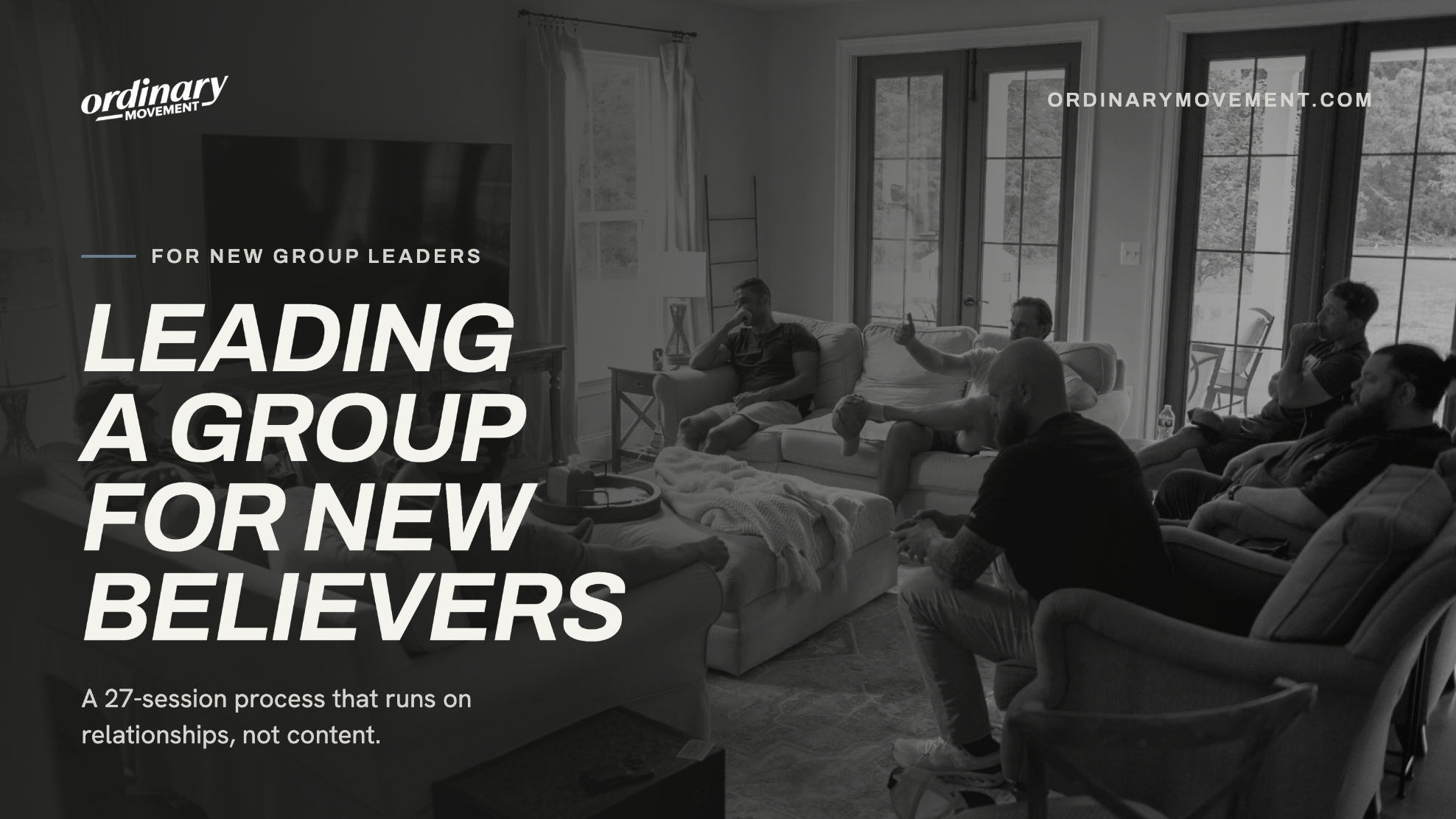
If you're looking for a discipleship curriculum for new believers, start with this: the best tool for a new Christian is not a better set of lessons. It's a few people who will follow Jesus with them, week after week, until they can do the same for someone else.
That's what we built at Ordinary Movement. It's a 27-session small group process, an Intro Session plus Sessions 1 through 26, that runs about six months if your group meets weekly or about twelve months if it meets every other week. Each participant uses the Participant Workbook, and each leader uses the Leader Guide. The workbook matters. It's also meant to be lived out with other people, not finished alone.
We wrote this for two kinds of readers: new believers wondering what comes next, and church leaders who need a plan ordinary people can actually lead. The first part is for new believers. The rest walks through how the process works, how to lead a group and how pastors can help groups get started.
On this page:
If You're a New Believer
What a Disciple Is
Session 17 of our workbook defines a disciple as "someone who follows Jesus by obeying His teachings and lifestyle." Discipleship is the intentional work of modeling and teaching the ways of Christ, so the people you disciple take ownership of their own faith and go on to disciple others.
Our mission fits in one sentence. We make disciples that make disciples.
For you, that means nobody is going to hand you a book and send you home. You'll join a small group led by an ordinary person who is a few steps ahead of you. You'll read the Bible, pray, tell your story and ask honest questions. Over time the Holy Spirit grows you into someone who can walk with another person along the same path.
Your First Steps After Coming to Faith
None of these require a class, and you don't have to get all of them done this week. Start here.
Start with assurance. You are saved by grace through faith in Jesus, not by your own effort (Ephesians 2:8-9). Your standing with God rests on what Jesus did, not on how you feel on a given day.
Tell someone. Say it out loud to a friend or family member. Your story is fresh right now, and people listen to fresh stories.
Get baptized. Jesus made baptism part of making disciples (Matthew 28:19-20). It's a public way of saying you belong to Him, so talk with your local church about how they practice it.
Join a local church. The church is people, not a building. You need them, and they need you.
Start a daily habit. Read one chapter of the Bible a day and pray about what God shows you. The Gospel of John is a good place to begin.
Find your two or three. Ask a mature believer to meet with you, or join a discipleship group.
Doing these things will build your confidence faster than reading about them.
How to Read the Bible as a New Christian
Keep it simple. Our workbook asks for a daily rhythm of reading the Bible and praying, starting with one chapter a day. After you read, ask one question: "What is God saying to me, and what am I going to do about it?" Write the answer down so you can come back to it.
Some people find the Word Hand helpful. It comes from The Navigators (©1964), not from us, and it names five ways to take in Scripture: hearing, reading, studying, memorizing and meditating. Use it if it helps. You don't need it to start.
When your group reads a passage together, three questions go a long way:
What does this say about God?
What does it say about people?
What will I obey this week, and who will I tell?
Prayer, Worship and Service
Prayer is a conversation with God, not a performance. If you want a simple pattern, try a plain-language version of the classic ACTS model: praise Him for who He is, confess what's wrong, thank Him for what He's done and ask for what you need. Then sit quietly for a minute and listen.
Worship is more than singing, though singing is a good place to start. Show up to your church's gathering and sing even if you don't know the song yet. Afterward, name one thing about God that stood out to you.
Service is one of the plainest ways faith shows up in ordinary life. A few first assignments: help with one practical need at your church this month, serve one person in your group outside of meeting time, and pray every day, by name, for one person who doesn't know Jesus.
Telling Your Story
You don't need training to share your faith. Start with three questions. What was life like before? How did you meet Jesus? What's different now?
Keep it under three minutes. Ask questions and listen more than you talk. Then invite. The invitation might be to church, to a meal or into a group.
When You Still Have Doubts
Questions and doubts don't disqualify you from a group. Bring them into the open. Faith grows when honest questions get honest conversation, and it stalls when they stay hidden.
How the 27-Session Process Works
Why Discipleship Needs More Than Curriculum
Most churches say discipleship is central to their mission. Few can show it reproducing.
In a 2020 study conducted by Grey Matter Research for Discipleship.org and Exponential, researchers surveyed 1,000 Protestant senior pastors by phone. By the study's measures, fewer than 5% of U.S. churches had a reproducing disciple-making culture, and the researchers found no clear examples of disciple-making movements among the churches surveyed. Those ratings came from pastors describing their own churches. The authors noted that pastors tend to be optimistic about their own churches, so the real picture may be harder than the numbers show.
Barna's 2015 State of Discipleship study, commissioned by The Navigators, came at the same gap from another angle. Only 1% of the church leaders surveyed said today's churches are doing very well at discipling new and young believers. When asked what they most wanted to improve, the most common answer, at 27%, was to develop "a more clearly articulated plan or approach to discipleship." Pastors in the same study ranked a comprehensive discipleship curriculum last among the elements of effective discipleship.
That last finding matches what we see. Curriculum isn't the problem, and it isn't the whole fix either. The problem is a loop many small groups fall into. A group forms, studies a book, finishes and asks, "What's next?" The same people consume more content. Nobody new leads, so nothing multiplies.
A process breaks that loop in three ways. It has a set start and a set end, and the sessions move people from taking part, to practicing, to leading. It trains ordinary believers to lead, so the church doesn't depend on a few staff members for all of its disciple-making. It ends with a send, not a sequel, which means multiplication is the goal from the first meeting.
Our Three Core Values
Everything in our groups flows from three core values, and the order matters.
Intimacy with Jesus comes first. Your identity is found in Him, and everything else grows out of time spent with Him.
Intentional Relationships means making time for other people, doing what you say and staying teachable. It's community that costs something.
Multiplication is the fruit, not the formula. Calling grows out of intimacy, and disciple-making grows out of calling.
Two more convictions shape how we lead. The first is that discipleship is modeled, not only taught. Jesus' invitation was personal: "Follow me." Leaders in our groups lead the same way, going first in honesty, in obedience and in inviting others.
The second is that we keep high challenge and high grace together. High challenge means we expect you to show up, do the reading and act on what God says. High grace means no one is shamed for where they are. We ask for willingness over ability. We want followers, not consumers.
How the Groups Work
Our groups are small on purpose. A leader gathers a handful of people, usually no more than ten. Two people who show up every time is not a failed group. Two committed people can do everything this process is built to do.
Groups meet weekly for about six months or every other week for about twelve months. In our experience the twelve-month rhythm goes deeper, because people have two weeks between meetings to live out what they're learning. Groups launch together and finish together. Nobody joins after launch, because the trust a group builds in its first sessions can't be caught up on later.
You can choose the kind of group that fits your people:
Ordinary Men for men's discipleship groups.
Ordinary Women for women's groups, led by Emily Webb.
Co-ed discipleship groups for couples and mixed communities.
Before a group launches, every person opts in. Leaders invite people personally, explain the commitment and say it plainly: "It's better to say no than to say yes and not be all in." A smaller group of committed people beats a big group of maybes.
The First Two Meetings
The first meeting is the Intro Session. Participants read it beforehand and come ready to talk about it. It sets the culture: what OM is and isn't, the mission, the three core values, high challenge and high grace, and what everyone can expect.
The second meeting is Session 1: Your Story. Everyone shares their testimony, and the workbook asks each person to come ready to share for 5 to 10 minutes. Session 1 often runs two to three hours because every person gets real time to tell their story. The leader goes first, and that honesty sets the tone for the room.
The 27 Sessions, in Order
The workbook is arranged in four modules. The list below follows that order and show the core value each session builds most. Sessions marked ★ build directly toward multiplication.
Module 1: Foundations
Intro Session: Introduction. Culture, mission, core values and expectations. Core value: All three.
Session 1: Your Story. Testimonies, with the leader going first. Core value: Intentional Relationships.
Session 2: Excuses Are No Excuse. God calls ordinary people who feel unqualified. Core value: Intimacy with Jesus.
Session 3: Milk vs Meat. Moving from spiritual infancy to maturity. Core value: Intimacy with Jesus.
Session 4 ★: What a Failure! How God uses failure. Some groups start sharing leadership here. Core value: Intimacy with Jesus.
Session 5: Review. Leveraging your gifts and reviewing Sessions 1 to 4. Core value: Intimacy with Jesus.
Module 2: The Core Values and the Cross
Session 6: Intimacy. Meeting with Jesus in the secret place. Core value: Intimacy with Jesus.
Session 7: Intentional Relationships. Community that costs something. Core value: Intentional Relationships.
Session 8: Multiplication. Why disciples make disciples. Core value: Multiplication.
Session 9: The Blood of Christ. What Jesus' death accomplished for you. Core value: Intimacy with Jesus.
Session 10: The Cross. Dying to the old self and living in Christ. Core value: Intimacy with Jesus.
Session 11: Spirit, Soul, and Flesh. Who is running your life. Core value: Intimacy with Jesus.
Session 12: Review. Reviewing Sessions 6 to 11. Core value: All three.
Module 3: The Holy Spirit
Session 13: Holy Spirit Part 1. The first of three sessions on the Holy Spirit. Core value: Intimacy with Jesus.
Session 14: Holy Spirit Part 2. The second of three sessions on the Holy Spirit. Core value: Intimacy with Jesus.
Session 15: Holy Spirit Part 3. The third of three sessions on the Holy Spirit. Core value: Intimacy with Jesus.
Session 16: Review. Reviewing Sessions 13 to 15. Core value: Intimacy with Jesus.
Module 4: Discipleship and the Send
In Session 17, participants sign up to lead the seven discipleship principle sessions. From Session 18 through Session 24, participants lead the group themselves.
Session 17 ★: Discipleship Intro. Defines disciple and discipleship. Participants sign up to lead Sessions 18 to 24. Core value: Multiplication.
Session 18 ★: Discipleship Principle #1: Accept Him. Participant led. Core value: Multiplication.
Session 19 ★: Discipleship Principle #2: Know Him. Participant led. Core value: Multiplication.
Session 20 ★: Discipleship Principle #3: Obey Him. Participant led. Core value: Multiplication.
Session 21 ★: Discipleship Principle #4: Make Sacrifices. Participant led. Includes the question, "What will you need to do differently in order to lead an OM group?" Core value: Multiplication.
Session 22 ★: Discipleship Principle #5: Share Him. Participant led. Core value: Multiplication.
Session 23 ★: Discipleship Principle #6: Love Others. Participant led. Core value: Intentional Relationships.
Session 24 ★: Discipleship Principle #7: Make Disciples. Participant led. Core value: Multiplication.
Session 25 ★: Urgency: A Call to Action. Why the time to act is now. Core value: Multiplication.
Session 26 ★: The Send. A send-off into disciple-making, not the close of a study. Core value: Multiplication.
If You're Leading a Group
How Ordinary Believers Learn to Lead
You don't need a seminary degree to lead. You need willingness, preparation and enough time to invite people well. Plan 30 to 45 days between signing up and launching. In our experience, groups that skip that window struggle more often.
A typical launch looks like this:
Pray about who to invite, then invite them in person.
Have participants register and get their Participant Workbook.
Lead the Intro Session, then Session 1.
Our team offers coaching through launch and beyond. For the full plan, use our group launch guide.
Some leaders step back during training. The training asks for real commitment on purpose. If someone realizes they aren't ready to lead, it's far better to learn that before a group launches than halfway through it.
How Participants Become Leaders
In practice, participants move toward leadership throughout the group.
During the group. Some groups start sharing leadership as early as Session 4. In Session 17, participants sign up to lead Sessions 18 through 24, which gives them low-stakes practice in a safe environment, with people who already know them.
At Session 26. Every participant faces the question, "Who has God placed in my life that I could disciple?"
After the group. The group can continue as an OC Group, a lighter, peer-led community built around two questions: "How is your heart?" and "What is God saying to you, and what are you going to do about it?" Participants who feel called launch their own groups, some right away and others the next season.
When a group finishes, the leader doesn't disappear. The leader becomes a mentor to the new leaders, checking in, praying for them, showing up to a session of their group now and then and helping them through the rough spots.
We now have groups in their second, third and fourth generations. [EDITOR: confirm with CTO lineage data, add one short example with the leader's permission, and add defensible totals (groups launched, states) from Master Analytics before publishing. Delete this note.]
We don't run a separate 12-month leader certification track. The group itself is the training.
When Leading Gets Hard
Burnout. One common path to burnout is trying to carry people alone. Share the leading early, lean on your coach and keep your own time with Jesus first. You're not a counselor. You're a brother or sister a few steps ahead.
Conflict. Deal with it directly and early, following Matthew 18:15. Go to the person first. Revisit the culture you set in the Intro Session, where grace and challenge stay together.
Attendance drops. At some point it will happen. Two committed people is still a group, so have honest conversations and keep going.
For Pastors and Churches
We ask pastors to champion the process, not lead every group. In practice that means talking about the groups from the platform, identifying two or three strong potential leaders and checking in with them monthly, and celebrating every new group publicly. Let ordinary people do the leading.
We recommend launching about a quarter of your potential leaders first. Their stories will recruit the next wave far better than an announcement will.
Be honest with your people about the timeline, too. Every leader needs 30 to 45 days before launch. OM also isn't a class you announce with an open sign-up. Groups grow through personal invitation, one leader at a time.
Church leaders can find planning tools and next steps in our discipleship resources for churches.
Common Questions
What is the best discipleship curriculum for new believers? The one your people will actually live out together. There are solid options: The Navigators' Design for Discipleship series, The 2:7 Series from The Navigators and NavPress, and Lifeway's Disciples Path. The deciding question isn't what's in the book. It's whether ordinary people can lead it, and whether it ends with them discipling someone else. That's why we built a process instead of a study.
What are the 7 D's of discipleship? There isn't one universal list. One widely circulated version comes from Julianne Stanz of Loyola Press, a Catholic publisher, in a 2019 series called "The Seven Ds of Discipleship": Desire, Discernment, Decision-Making for Christ, Discipline, Dwelling in the Word, Dependence on the Holy Spirit and Doing. Lifeway's David Francis wrote a different list, the "8 D's of personal discipleship": Devote, Declare, Develop, Display, Defend, Disciple, Deploy and Depend. These are their frameworks, not ours. The overlap with our process is real, though. Dependence on the Holy Spirit and actually doing what Jesus says sit at the center of what we do.
What is a good discipleship plan for new believers? A good plan settles assurance and belonging first: baptism, a local church and a daily habit of Bible reading and prayer. Then it puts the new believer in a small, committed group for 6 to 12 months, where they're known, challenged and eventually asked to lead.
What topics should discipleship cover? Start with your story, excuses and calling, spiritual maturity, failure, intimacy with Jesus, community, the cross, the Holy Spirit, obedience, sacrifice, sharing your faith, loving others and making disciples. Those are the threads that run through our 27 sessions.
How do I know I'm saved? Salvation is by grace through faith in Jesus Christ alone (Ephesians 2:8-9). Your assurance rests on what He did, not on your performance. If you're unsure, talk it through with your group leader or your pastor.
What does a group expect of me? Show up. Do the reading. Be honest. Keep what's shared confidential. Act on what God tells you.
Start Your First Group
If you've been waiting for someone to show you how, this is your next step.
To lead a group, sign up and start leader training, then plan your launch with our launch guide. Give yourself 30 to 45 days.
Looking for a men's or women's group? Start with Ordinary Men or Ordinary Women.
Have questions or want a coach? Read our common questions or email info@ordinarymovement.com.
If you're a pastor or church leader, share this page with your team and see our discipleship resources for churches.
Sources
Discipleship.org and Exponential, National Study on Disciple Making in USA Churches (Grey Matter Research, 2020): https://discipleship-org.s3.amazonaws.com/text/ebooks/Final+2020_National_Study_Report.pdf
Barna Group, "New Research on the State of Discipleship" (2015): https://www.barna.com/research/new-research-on-the-state-of-discipleship/
The Navigators, "The Word Hand": https://www.navigators.org/resource/the-word-hand/
Julianne Stanz, "The Seven Ds of Discipleship," Loyola Press Catechist's Journey (2019): https://catechistsjourney.loyolapress.com/2019/05/the-seven-ds-of-discipleship-1-desire/
David Francis, "Apply 8 D's of personal discipleship," Lifeway: https://www.lifeway.com/en/articles/apply-the-8-ds-of-personal-discipleship